[카테고리:] Asian Culture & Travel

  • The Resonant Craft of Japanese Furin: Wind Bells as Summer’s Fleeting Voice

    Photo by Hiroshi Tsubono on Unsplash

    A single glass sphere, no wider than a plum, hangs from a nylon thread outside a Tokyo apartment window. When the afternoon breeze finally arrives after a stifling July day, it doesn’t announce itself—it chimes, a thin glassy note that lasts less than a second before dissolving into the hum of traffic. That sound, more than any calendar date, is how many households in Japan actually register the arrival of summer.

    Origin: Adapted from Buddhist temple wind chimes (fūtaku) introduced from continental Asia

    Region: Most closely associated with Edo (Tokyo) and Morioka in Iwate Prefecture

    Era: Temple use traditionally dates back over a millennium; the glass form popularized during the Edo period

    Best known for: The Edo furin, hand-blown without a mold, producing an irregular, high-pitched ring

    Core value: A sensory marker of impermanence—sound as a way of noticing a season passing

    Why did wind bells become tied to summer in Japan?

    Long before furin hung from apartment eaves, similar bronze bells swung from the corners of Buddhist temple roofs. These fūtaku were believed to ward off misfortune, their ringing marking the boundary between sacred and ordinary space.

    Over centuries, the object drifted from religious practice into daily life, and its meaning shifted with it. By the time glass versions became common among Edo-period townspeople, the bell’s role had less to do with warding off evil spirits and more to do with marking the discomfort of the season—summer heat—with something cooling to the ear.

    Photo by Nam Hoang on Unsplash

    Sound became a kind of seasonal shorthand. Long before electric fans, a furin’s chime signaled that a breath of moving air had finally arrived.

    How is a furin actually made?

    The Edo furin, the style most people picture, is traditionally free-blown without a mold, a technique called uchibanashi. A craftsman gathers molten glass on a blowpipe and shapes the sphere by breath and gravity alone, which means no two bells are ever identical.

    The rim is left deliberately rough and unpolished, cut rather than smoothed. That irregular edge is not a flaw—it’s what gives each furin its particular pitch, since a perfectly smooth rim would ring in a duller, more uniform tone.

    A different regional tradition uses cast iron instead of glass. The Nanbu furin of Morioka, made using techniques tied to that region’s ironwork history, produces a lower, longer-sustained tone, closer to a bell struck in a quiet room than glass catching wind.

    What does the paper strip really do?

    Inside or beneath most furin hangs a narrow strip of paper called a tanzaku, often printed with a summer motif or a short verse. It looks decorative, but its job is mechanical.

    The strip catches even the faintest air movement, moving the clapper against the glass rim to produce sound. Without it, a furin could hang motionless through a breeze too weak to move glass alone.

    There’s something quietly practical in that design. The most fragile-looking part of the object is the one actually doing the work of translating invisible air into audible sound.

    Photo by Clay Banks on Unsplash

    Why do the sound and the season feel inseparable?

    Furin are almost never used outside summer, and that timing isn’t accidental. Hung in June, taken down by early autumn, they exist in a deliberately short window, tied to the specific discomfort of humid heat rather than to wind in general.

    This impermanence is part of what gives the sound its emotional weight. A chime heard in the stillness of a hot afternoon carries a different feeling than the same sound heard in a cooler month—it reads as relief, however brief.

    The furin doesn’t try to outlast the season. It’s built to belong entirely to it, then to go quiet again.

    How can you bring this practice into your own home?

    You don’t need an imported Edo furin to test the idea—any small glass or metal chime with an irregular edge will behave similarly. Hang it somewhere it will actually catch moving air, like a window that gets afternoon cross-breeze, rather than a sheltered corner.

    Pay attention the first time it rings unprompted. Notice what you were doing, what the air felt like, whether the sound registered before you consciously heard it.

    That small delay between wind and awareness is closer to the original point of the object than any decorative use. Try it this week, on the first genuinely hot afternoon, and just listen for what changes.

    A sound built to last one season teaches you to notice the season while it's still here.

  • The Woven Symmetry of Korean Jogakbo: Patchwork Wrapping Cloths as Everyday Art

    Photo by Sandra Harris on Unsplash

    The Cloth That Started as Leftovers

    A single square of jogakbo can hold more than forty scraps of ramie and silk, each piece barely bigger than a stamp, joined edge to edge until the seams themselves become the design. There is no printed pattern underneath, no template traced in chalk beforehand. A woman simply picked up what was left after cutting a hanbok — a triangle here, a sliver there — and began stitching.

    The word itself explains the object: jogak means fragment or scrap, and bo comes from bojagi, the general term for Korean wrapping cloth. Jogakbo, then, is quite literally “scrap-wrapper.” It was never meant to hang on a wall. It was meant to hold rice cakes, wrap a bride’s silk, or cover a bowl of soup on its way to a neighbor’s table.

    A Craft Born in the Sewing Room, Not the Court

    Jogakbo traditionally developed during the Joseon dynasty, in the women’s quarters of ordinary households rather than royal workshops. Cotton, silk, and ramie were costly enough that no offcut was thrown away; even a piece the width of a finger got folded into a basket for later use. Over months, sometimes years, those fragments accumulated until there was enough to piece together a cloth large enough to wrap something.

    Buddhist nuns are also linked to the tradition, stitching patchwork cloths as an extension of humility and non-waste, echoing the way monastic robes elsewhere were pieced from donated fabric. In both settings, the patchwork was not decoration for its own sake. It was what remained after nothing more could be salvaged, turned into something still useful.

    Photo by Clark Gu on Unsplash

    Why the Asymmetry Feels So Deliberate

    Look closely at a well-made jogakbo and the placement of color stops feeling random. Reds sit next to indigo, a pale yellow wedge breaks up a run of dark squares, and the eye keeps moving because no two adjacent patches share the same weight. Some makers worked loosely within the obangsaek palette — the five directional colors of white, black, blue, red, and yellow — without following it strictly, letting instinct and available scrap decide the next stitch.

    The seams carry the structure. Because ramie and hemp are sheer, sunlight passing through a hung jogakbo throws a grid of shadow lines onto the floor, turning the cloth into something closer to a stained-glass window than a textile. That effect was never planned by a single hand — it emerged from joining pieces together, seam by seam, over time.

    Wrapping as a Small Act of Blessing

    In Korean custom, wrapping something in cloth rather than paper carried a wish attached to it. A bojagi used for a wedding gift or a baby’s first birthday was thought to fold good fortune into the object it covered, a practice sometimes called bok ssam, or “wrapping in luck.” Jogakbo, made from many hands’ leftover fabric, extended that wish further: the cloth itself was a record of a household’s economy and care, reused until it had one more useful life left.

    Photo by zero take on Unsplash

    There is a quieter idea underneath this too. A patchwork made of mismatched fragments, sewn without any piece being wasted, reflects a value placed on thrift and restraint rather than abundance. Nothing about a jogakbo announces status. Its worth sits in the labor and years folded into it.

    Still Useful, Now Also Framed

    Museums and design institutions have begun collecting jogakbo as textile art, hanging pieces that once wrapped rice cakes as if they were paintings. Contemporary Korean textile artists reference jogakbo’s geometry in installations, and designers borrow its patchwork logic for garments and accessories. That shift changes how the object is seen, but not really what it is: a cloth built from constraint, whose pattern exists because someone refused to waste what was left over.

    You do not need a museum wall to notice this. Any drawer of old fabric scraps — a worn shirt, a curtain remnant, a child’s outgrown dress — holds the same raw material a Joseon-era seamstress worked with.

    Start today: set aside every fabric remnant from your next sewing or mending project for a month, then lay them out on a table before deciding what to do with them. That five-minute act of arranging scraps by color and size is precisely how a jogakbo begins.

    A jogakbo turns nothing wasted into something worth keeping, one scrap at a time.

  • The Ancient Wisdom of Chinese Medicinal Cuisine: Yao Shan and the Art of Healing Through Food

    A grandmother in Guangzhou once told me she could taste when a soup was “too hot” for the body—not in temperature, but in nature. She wasn’t talking about spice. She was diagnosing the dish the way a doctor might read a pulse, and to her, this wasn’t mysticism. It was Tuesday dinner.

    When Food and Medicine Shared One Kitchen

    In classical Chinese thought, there was never a hard border between the pharmacy and the pantry. The phrase yao shan, literally “medicinal cuisine,” reflects a principle traditionally traced back over two thousand years: that food and medicine share the same origin, often summarized as yao shi tong yuan.

    Ancient physicians didn’t just prescribe herbs. They prescribed meals. A court physician during the Zhou dynasty period was traditionally recorded as a distinct medical specialty—someone whose job was to design the emperor’s seasonal diet as preventive treatment, not as punishment for illness already present.

    This wasn’t fringe theory. It sat at the center of medical training for centuries, documented alongside acupuncture and herbal formulas in classical texts.

    The Logic Behind the Broth

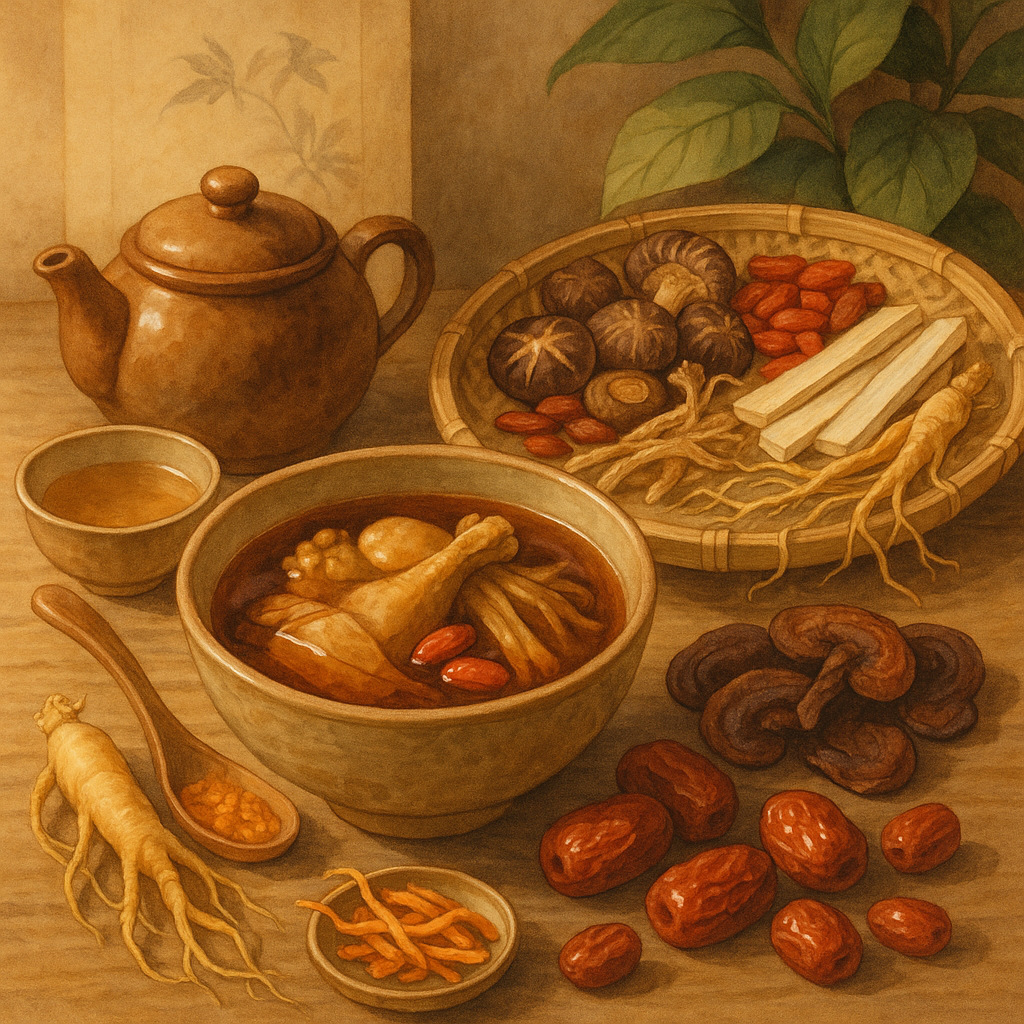
    Every ingredient in yao shan carries a “nature”—warming, cooling, or neutral—along with a flavor profile linked to specific organs. Ginger and lamb are warming, useful for someone who feels perpetually cold or fatigued in winter. Mung beans and bitter melon are cooling, meant to calm what practitioners call internal heat.

    This is why a bowl of soup in a Chinese household is rarely random. Someone recovering from a cold might get a scallion and ginger broth. Someone with dry skin or a persistent cough might be handed a pear stewed with rock sugar and a few slivers of snow fungus.

    The goal isn’t flavor first. It’s balance first, flavor second—though the two were never meant to be enemies.

    Photo by 金 运 on Unsplash

    Reading a Bowl Like a Diagnosis

    Walk into a Cantonese soup shop and you’ll notice the menu reads like a mild medical chart. Four ingredients might treat dampness. Another combination targets what’s called “liver heat,” often blamed for irritability or red eyes.

    This diagnostic habit comes from a body of knowledge, developed over centuries, that treats symptoms as signals of imbalance rather than isolated problems. A headache isn’t just a headache—it’s information about what’s happening elsewhere in the system.

    Home cooks absorb this logic without ever opening a textbook. Ask an older relative why she’s adding red dates to your tea, and she may not cite theory at all. She’ll simply say, “You look pale.”

    Ingredients That Do Double Duty

    Some of the most recognizable Chinese pantry staples started as medicinal materials before they became everyday flavorings. Goji berries, now scattered onto salads in Western cities, were traditionally used to support the eyes and kidneys. Dried longan, sweet and slightly resinous, was associated with calming the mind and nourishing blood.

    Astragalus root, often simmered whole in soup and removed before eating, has long been used to support stamina and immunity, particularly after illness or childbirth. Black sesame, ground into a thick paste, was traditionally recommended for hair health and for what practitioners describe as “deficiency” in older age.

    None of these ingredients taste like medicine in the bitter, chalky sense. Most taste like something your grandmother would serve without explanation, which is exactly the point.

    Photo by zhang kaiyv on Unsplash

    A Practice, Not a Prescription

    What makes yao shan durable across generations isn’t rigid rule-following. It’s adaptability. The same cough might call for a pear dessert in one household and a chrysanthemum tea in another, depending on the specific imbalance a person is believed to have.

    This flexibility separates yao shan from a strict medical protocol. It functions more like an inherited intuition, passed down through repeated meals rather than written instruction. Children absorb it the way they absorb table manners—by watching, not studying.

    Even now, in cities filled with pharmacies and hospitals, many families still reach for a specific soup before reaching for a pill. Not as a replacement for modern medicine, but as a companion to it.

    Try It Tonight

    You don’t need rare herbs or a decade of study to start. Pick one small discomfort—a scratchy throat, cold hands, restless sleep—and look up a single traditional Chinese soup or tea associated with it.

    Make just that one recipe tonight, using real ingredients rather than supplements. Pay attention to how you feel afterward, not as proof of anything, but as the beginning of the same quiet observation that built this entire tradition in the first place.

    Long before medicine had a name, someone was already healing with a spoon.

  • The Weathered Grace of Chinese Scholar Rocks: Gongshi and the Art of Natural Sculpture

    Photo by The Cleveland Museum of Art on Unsplash

    A Stone That Took Three Centuries to Look Right

    A collector in Suzhou once kept a limestone rock on his desk for forty years, turning it a quarter-inch every few months so that erosion patterns caught the light differently each season. He never called it finished. That’s the peculiar logic of gongshi: the rock was already complete when water and time made it, but human eyes need decades to catch up.

    Most people glancing at a scholar’s rock see a lump of stone with holes in it. What they’re missing is a centuries-old visual language, one where a single perforation can suggest a mountain pass, and a jagged silhouette can read as a solitary pine bent by wind.

    Where the Practice Actually Began

    Scholar rocks emerged as a serious pursuit during the Tang dynasty, when officials and poets began collecting unusual stones pulled from lakebeds and riverbanks, prizing them for shapes that suggested mountains in miniature. By the Song dynasty, the practice had matured into something closer to connoisseurship, with emperor Huizong reportedly assembling entire gardens organized around rare stones transported at enormous cost from Lake Tai.

    The rocks weren’t decoration in the way a vase or painting was decoration. They functioned as portable landscapes, letting a scholar confined to a courtyard in the capital summon the feeling of a mountain retreat he might visit only once a decade, if ever.

    This is worth sitting with: an entire aesthetic tradition built around not having to leave your desk.

    The Four Qualities That Actually Matter

    Traditional connoisseurs judged gongshi against four criteria: thinness, perforation, wrinkling, and porousness. A rock that was merely large or strange-looking didn’t qualify. What mattered was whether it achieved shou, a lean, almost skeletal thinness, combined with tou, meaning it had to be pierced through with openings you could see light and sometimes water through.

    Photo by geng zhang on Unsplash

    Add to that zhou, a wrinkled, weathered surface texture, and lou, a honeycomb quality of interconnected hollows, and you get a stone that looks less like rock and more like something carved by an artist who understood restraint. Except no one carved it. That tension between “obviously shaped” and “entirely natural” is the entire point.

    Lake Tai stones, quarried from the bottom of Taihu near Suzhou, became the gold standard precisely because centuries of underwater currents had already done this work before any human touched them.

    Why This Isn’t Really About Rocks

    Scholar rocks sit inside a much larger Chinese intellectual tradition that treats the natural world as something to be read rather than simply observed. A rock’s twisted form could evoke qi, the vital energy believed to animate landscapes, mountains, and even calligraphy strokes.

    Painters like those in the literati tradition would spend hours studying a single stone the way another artist might study a model, because the rock’s contours suggested the same dynamic tension they wanted their brushwork to carry. Su Shi, the Song dynasty poet and official, reportedly kept rocks on his writing desk specifically because their irregular forms interrupted habitual thinking and pushed his poetry somewhere less predictable.

    In that sense, the rock wasn’t a subject to depict. It was closer to a conversation partner, one that never spoke but somehow still talked you out of your assumptions.

    Photo by zhang kaiyv on Unsplash

    How to Actually Look at One

    If you find yourself in front of a gongshi in a museum or a garden, resist the urge to walk past it in four seconds like it’s furniture. Circle it. The shape changes entirely depending on the angle, and traditional display stands were often designed to let owners rotate the stone seasonally for exactly this reason.

    Notice where light passes through the openings and where it doesn’t. Notice whether the surface looks wet even when it’s bone dry, a quality collectors specifically prized and described using language usually reserved for skin or fabric.

    Ask yourself what it reminds you of, not to force a shape onto it, but because that half-recognition, a peak here, a cave there, a bent figure walking, is exactly the response Song and Ming dynasty collectors were chasing when they first pulled these stones from the mud.

    Bringing a Little of This Home

    You don’t need an imperial garden or a Lake Tai specimen to borrow this way of seeing. Any interestingly weathered stone, driftwood, or piece of coral can be placed on a low stand and lived with for a while rather than immediately explained.

    The practice was never really about owning something valuable. It was about training patience into your eyes, letting a shape reveal something new on the fortieth viewing that it withheld on the first.

    Next time you’re near a riverbank, a beach, or even a construction site with loose stone, spend five minutes actually looking before you walk away. Pick up whatever catches your eye, set it somewhere you’ll pass daily, and see what it looks like in a month.

    A scholar's rock was never finished by human hands, only recognized by a patient eye.

  • The Fragrant Ritual of Japanese Kōdō: Listening to Incense as an Art Form

    Photo by Boudewijn Huysmans on Unsplash

    The Room Went Silent Before the Smoke Even Rose

    Twelve people sat in a circle, knees folded beneath them, hands cupped in a specific shape against their chests. No one spoke. A small ceramic cup passed from person to person, each holding it close to their face for exactly three breaths before passing it on in silence.

    This wasn’t meditation, though it looked like it. It was kōdō — literally “the way of incense” — and the participants weren’t smelling anything. They were listening.

    Why “Listening” and Not “Smelling”

    In kōdō, practitioners use the verb “kiku,” the same word used for listening to music or hearing a story. You don’t sniff the incense; you let its scent arrive on its own terms, the way you’d let a melody unfold rather than rushing to identify each note.

    This distinction isn’t poetic flourish — it shapes the entire posture of the practice. A rushed inhale is considered clumsy, almost rude, like interrupting someone mid-sentence. The ideal is a slow, unhurried draw of breath that treats the fragrance as something with its own pace to be respected.

    A Practice Born from Aristocratic Boredom and Buddhist Ritual

    Incense arrived in Japan alongside Buddhism, traditionally understood to have reached the imperial court sometime in the sixth century, used mainly for religious ceremony and purification. For a few centuries it stayed largely functional — something burned in temples, not something contemplated for pleasure.

    The shift happened during the Heian period, when court nobles began blending their own signature incense recipes and using scent as a form of personal expression, almost like a private perfume line. By the Muromachi period, this appreciation had crystallized into something more structured, developing alongside tea ceremony and flower arranging into one of Japan’s recognized “ways” — a discipline with its own etiquette, vocabulary, and aesthetic philosophy.

    It’s worth noting that kōdō emerged in the same cultural moment as chadō and kadō, all three sharing a root idea: that everyday sensory experience, refined enough, becomes a vehicle for discipline and presence.

    Photo by Thomas Marban on Unsplash

    The Wood That Makes the Practice Possible

    At the center of kōdō sits jinkō, agarwood formed when a specific tree becomes infected by mold and produces a dense, fragrant resin as a defense response. Not every piece of agarwood is usable — practitioners distinguish between grades based on where the tree grew, how long the resin developed, and the specific balance of sweet, bitter, sour, spicy, and salty notes it produces when heated.

    Yes, salty is one of the traditional categories, alongside the other four flavors borrowed from classical taste vocabulary. This is part of what makes kōdō genuinely difficult: participants are trained to identify these qualities the way a sommelier identifies tannins, except the “tasting” happens entirely through the nose.

    The wood itself is never burned directly. Instead, a small chip sits atop a mica plate, which rests over glowing charcoal buried in ash — enough heat to release fragrance without producing smoke or char. The scent that reaches you is closer to warmth releasing an idea than fire consuming a material.

    Kumikō: The Incense Game That Is Also a Memory Test

    One of the most distinctive elements of kōdō is kumikō, a structured game where participants try to identify or match different incense samples by scent alone, often referencing classical poetry or literary themes tied to each fragrance. A famous set called Genji-kō, for instance, draws its scent combinations from chapters of The Tale of Genji.

    Getting it “right” matters less than the quality of attention brought to the guessing. Some sessions score participants, but the real measure of skill is whether someone can hold three or four scents in memory long enough to compare them without losing the thread — a surprisingly demanding form of concentration.

    What This Practice Asks of a Modern Nose

    Most of us have never trained our sense of smell the way we’ve trained our eyes or ears. Kōdō asks something unusual: patience with a sense we normally treat as background noise, useful mainly for detecting coffee or smoke alarms.

    Photo by Clay Banks on Unsplash

    Practitioners describe a strange side effect after sustained practice — everyday smells become more legible. Rain on pavement, old paper, a specific tea, all start to separate into distinguishable layers instead of blurring into a single vague impression.

    That shift, more than any specific ritual gesture, may be the actual point of kōdō: retraining attention itself, using scent simply as the material at hand.

    Where the Practice Survives Today

    Kōdō is far less visible than tea ceremony, partly because it requires rare, expensive materials and partly because it doesn’t photograph well — there’s no elaborate visual choreography to capture. Schools like Oie-ryū and Shino-ryū still maintain formal lineages, mostly concentrated in Kyoto, teaching students over years rather than weekends.

    Public sessions do exist, though, often held at temples or cultural centers, sometimes translated for non-Japanese speakers with a brief explanation of hand positions and etiquette before the incense is passed. These introductory sessions won’t make anyone an expert, but they offer something rarer: forty minutes where the only task is to notice.

    Try This Tonight, No Ceremony Required

    You don’t need agarwood or a mica plate to borrow the core idea. Tonight, light a stick of good incense or even brew a cup of tea, and instead of doing anything else, sit with it for three full breaths before reacting.

    Notice how the scent changes between the first breath and the third. That small delay — resisting the urge to immediately label or dismiss what you’re smelling — is the entire discipline of kōdō, distilled into something you can practice in your own kitchen tonight.

    To listen to incense is to admit that attention, not the nose, is the true instrument.

  • The Woven Warmth of Korean Nubi Quilting: Stitching Comfort into Tradition

    Photo by K Adams on Unsplash

    The Sound Before the Softness

    Before you ever touch a nubi quilt, you hear it. Run your palm across the surface and there’s a faint, rhythmic ridge pattern beneath your fingers—rows upon rows of tiny parallel stitches, so dense they feel almost like corduroy.

    This isn’t decoration. Each line of stitching is doing real work, trapping pockets of air between layers of fabric and cotton batting. That’s the whole secret of nubi: warmth engineered one needle-pull at a time.

    Where the Technique Comes From

    Nubi quilting traditionally traces back centuries in Korea, originally developed as a practical solution to brutal winters on the peninsula. Farming and working-class families needed bedding and clothing that could withstand harsh cold without the expense of thick fur or heavy layers.

    The technique likely spread from royal courts and Buddhist temples, where monks needed durable, warm garments for meditation in unheated halls, down into everyday households. Over generations, what started as a survival necessity became a refined craft, with regional variations in stitch width and pattern density.

    Some of the finest surviving examples show stitches so fine and evenly spaced that they resemble machine work—except every single one was done by hand, often by women working through winter evenings by candlelight.

    The Math Hidden in the Stitches

    Here’s something most people don’t realize: the width between nubi stitch lines isn’t random. Traditionally, makers followed measurements based on finger-widths or simple ratios, spacing rows anywhere from a few millimeters to about a centimeter apart depending on the intended use.

    Tighter stitching meant a stiffer, more durable fabric suited for outerwear or floor cushions that would see heavy daily use. Looser stitching produced a softer drape, better for blankets meant to be wrapped around the body at night.

    Photo by K Adams on Unsplash

    This wasn’t guesswork passed down through trial and error alone—it was a kind of textile engineering, refined by people who understood exactly how much air a body needs trapped against it to stay warm.

    Cotton, Not Silk, Was the Point

    Unlike some East Asian textile traditions that prized silk brocade for warmth items, nubi quilting historically centered on cotton. Cotton batting sandwiched between two layers of plain-weave cotton fabric, then stitched through all three layers at once.

    This made nubi items accessible. A family didn’t need imported silk or elaborate dye work to stay warm—they needed skill, patience, and a needle.

    That egalitarian quality is part of why nubi survived so widely across social classes. It shows up in humble sleeping mats and simple vests just as often as in more elaborate ceremonial pieces.

    Why It Still Matters in a World of Synthetic Insulation

    You can buy a down jacket rated to negative twenty degrees at any outdoor store. So why does nubi persist?

    Partly it’s texture—the specific weight and give of hand-quilted cotton feels different against skin than synthetic fill, less slippery, more grounded. Partly it’s breathability; cotton batting handles moisture in a way that synthetic insulation sometimes struggles with, which matters if you’re wrapped in a blanket all night.

    Photo by zero take on Unsplash

    But there’s also something less measurable happening. A nubi quilt carries visible evidence of hours of human attention. Every stitch line is a small record of someone’s patience, and that’s not something a factory-sealed insulated jacket can replicate.

    Finding Nubi Today

    Contemporary Korean designers have started reinterpreting nubi for modern life—quilted jackets with cleaner silhouettes, home goods that keep the stitch pattern but simplify the color palette. You’ll find it in boutique shops in Seoul’s Insadong district or increasingly through independent makers selling online.

    The craft hasn’t fossilized into museum-piece status. It’s still being made, worn, and slept under.

    Try This Today

    You don’t need a full quilt to understand nubi’s logic. Take any scrap fabric and a piece of thin batting, sandwich them, and hand-stitch three or four parallel lines a centimeter apart.

    Feel how the fabric stiffens slightly and gains loft where you’ve stitched. That small experiment tells you more about why this technique kept generations warm than any photograph ever could.

    Warmth, it turns out, can be stitched—one patient line at a time.

  • The Sculpted Silence of Korean Dol Hareubang: Guardians in Stone

    Photo by yebin kim on Unsplash

    A Face Carved From Fire

    Run your fingers across a dol hareubang and you’ll notice something odd: the stone feels almost spongy, pitted with thousands of tiny air pockets. This is vesicular basalt, formed when Jeju’s volcanic lava cooled quickly and trapped gas bubbles inside. The islanders didn’t choose this rock for convenience. They worked with what the volcano gave them, and the result is a texture unlike granite or marble carvings found on the mainland.

    That porousness changes everything about how these statues age. Rain doesn’t just wash over dol hareubang; it seeps into them, darkening the surface unevenly over decades. Older specimens near Jeju’s coast look almost black in places, gray in others, as if the weather itself had been sculpting alongside the original carver.

    Guardians at the Three Gates

    Traditionally, dol hareubang stood at the entrances to Jeju’s three main administrative towns during the Joseon period: Jeju-mok, Daejeong-hyeon, and Jeongui-hyeon. Each town reportedly placed pairs of these figures at its gates, a practice believed to have developed from earlier stone-guardian traditions on the island going back centuries. Their placement wasn’t decorative. It marked where civil order began and where the wilder, spirit-filled edges of the island ended.

    Historical records suggest that dozens once stood across these three towns, though exact original counts remain uncertain and many were lost, moved, or damaged over generations. Today around forty-five are recognized as authentic originals, scattered between museums, government offices, and their original sites. That number keeps local historians careful; unlike mass-produced replicas sold in shops now, each surviving original carries its own specific provenance.

    Reading the Hands

    Look closely at any dol hareubang and you’ll notice the hands rest on the belly, but not identically. On some, the right hand sits higher than the left. On others, it’s reversed.

    Photo by Gabriela Starzec on Unsplash

    Local tradition holds this hand placement once distinguished rank, possibly separating figures associated with civil authority from those tied to military function, though scholars debate how consistently this rule was applied across the three original towns. What’s certain is that no two dol hareubang are truly identical. The bulging eyes, the wide flat nose, the faint smile pressed into thick lips, these repeat as a pattern but never as a copy.

    Silence as Protection

    The mushroom-shaped hat sitting atop each head isn’t just visual style. Some researchers connect the shape to older forms of stone spirit-guardians used across Jeju before written Korean administrative history took hold there, statues meant to ward off misfortune and mark thresholds between village and outside world.

    What makes dol hareubang distinct from noisier guardian figures elsewhere is their stillness. There’s no aggressive posture, no raised weapon. The protection comes from presence alone, a kind of watchfulness carved permanently into an expression that never shifts.

    Jeju’s isolation from the mainland, surrounded by unpredictable sea currents and volatile weather, shaped a spiritual culture where boundaries mattered intensely. A guardian that simply stood and stared may have felt more reassuring than one caught mid-action, frozen forever in readiness rather than urgency.

    Photo by zero take on Unsplash

    From Sacred Marker to Souvenir Shelf

    Walk through Jeju City today and you’ll see dol hareubang everywhere: keychains, phone cases, miniature garden ornaments sold outside every tourist shop near the airport. This commercial version has become one of Korea’s most recognized regional symbols, arguably more famous now than the original stone guardians themselves.

    Something gets lost in that transition, but something also survives. Even in plastic replica form, the wide eyes and folded hands remain recognizable enough that people who’ve never visited Jeju can still identify the shape instantly. The image outlived its original administrative function and found a second life as cultural shorthand for the island itself.

    Locals sometimes express mixed feelings about this. The commercialized version rarely mentions the original gate placements or the meaning behind hand positioning. It sells the face without the history attached to it.

    Standing Where They Still Stand

    If you’re near Jeju anytime soon, seek out Samseonghyeol or the Jeju National Museum grounds, where several original dol hareubang remain in something close to their historical context rather than gift-shop shelving. Spend five unhurried minutes with just one statue instead of photographing a row of them.

    Notice which hand sits higher. Notice the pitting in the stone where centuries of Jeju rain have worn tiny craters smoother. That specific attention, more than any souvenir, is what actually carries the memory of what these figures once meant.

    A guardian doesn't need to move to protect a threshold; sometimes stillness itself is the vigilance.

  • The Intricate Beauty of Chinese Cloisonné: Enamel Art Across Centuries

    Ten Thousand Cells Before a Single Drop of Color

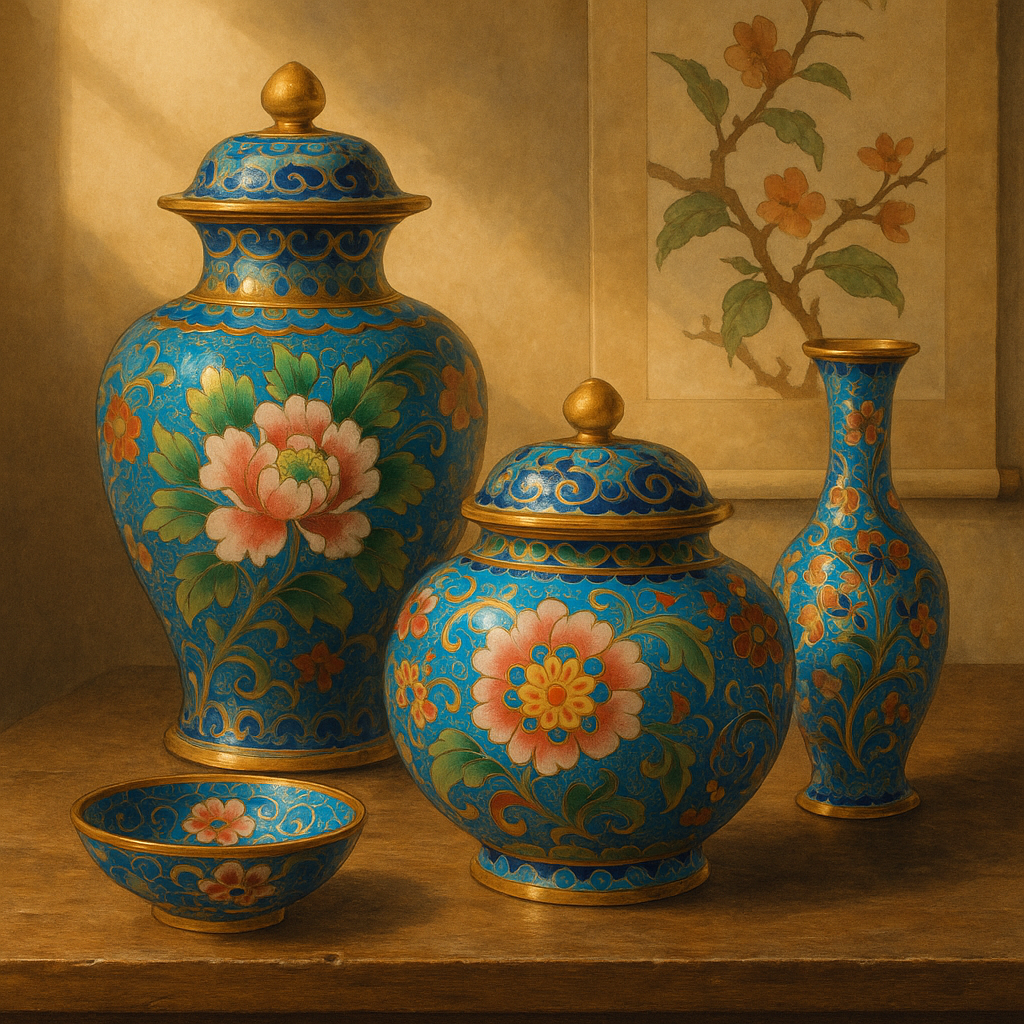
    A cloisonné vase the size of a dinner plate can hold more than ten thousand tiny copper cells, each one bent from wire by hand before any enamel ever touches it. The artisan works with tweezers and a small hook, pressing thin metal ribbons into curves no wider than a grain of rice. Only after every cell sits soldered into place does the color work even begin.

    This is the part most people never notice when admiring a finished piece behind museum glass. The wirework alone can take weeks, and a single crooked line means unpicking an entire section and starting over.

    Where the Name “Jingtailan” Comes From

    Chinese cloisonné is traditionally known as jingtailan, a name tied to the Jingtai reign of the Ming dynasty in the fifteenth century, when the technique reportedly reached a level of refinement prized by the imperial court. The craft itself likely arrived earlier, carried along trade routes from the Byzantine world through Central Asia, but it was under Ming patronage that it developed a distinctly Chinese palette and pattern language.

    Deep cobalt blue became so associated with this period that the craft’s name translates roughly to “Jingtai blue.” Workshops in Beijing produced vessels for temples, palace interiors, and diplomatic gifts, and that link to imperial taste lingered for centuries afterward, long past the Jingtai era itself.

    Building Color Cell by Cell

    Once the wire framework is soldered onto a copper body, enamel paste goes into each cell with a small spatula, one color at a time. The paste comes from mineral pigments mixed with glass powder, and the piece then goes into a kiln, where the enamel shrinks as it fires. Because of that shrinkage, the filling and firing steps repeat several times before every cell sits flush with its wire border.

    Photo by 嘲 风 on Unsplash

    After the final firing, the surface is ground down with abrasive stones until wires and enamel are level, then exposed metal edges are gilded. What looks rough and pitted straight out of the kiln comes out glassy and smooth, closer to stained glass pressed flat onto metal than anything painted.

    Colors That Carried Meaning

    Turquoise and cobalt dominate older pieces partly because those pigments held up best at firing temperature, not purely for symbolic reasons. Even so, certain colors picked up meaning over generations: yellow tied to imperial authority, red to celebration, lotus motifs to Buddhist ideas of purity.

    Dragon and phoenix patterns marked pieces destined for court use, while floral scrollwork covered the incense burners and vases sold into merchant households. Looking at the pattern alone, a buyer could usually guess who the object was made for.

    A Craft That Nearly Disappeared, Then Didn’t

    By the early twentieth century, cloisonné production had shrunk to a handful of workshops as demand shifted and skilled wire-benders grew scarce. Beijing enamel factories established later in the century trained new generations of artisans, keeping the wire-laying and enamel-filling techniques from vanishing entirely.

    Photo by zhang kaiyv on Unsplash

    Working studios in Beijing today still follow a process that looks almost identical to descriptions from centuries ago, aside from electric kilns replacing wood-fired ones. Some contemporary artists have started pushing the technique toward abstract forms, moving away from the traditional dragon and lotus vocabulary altogether.

    What to Look For If You Ever Hold One

    Pick up a genuine piece and the weight tells you something immediately: a solid copper body, not a thin stamped shell that rings hollow. Run a finger lightly across the surface and you should feel the wire ridges just barely, since well-finished work polishes them nearly flush with the enamel.

    Check the underside too. Careful, older work often shows a cleanly enameled or gilded base rather than raw, unfinished metal left exposed.

    If any of this has you curious, skip the gift shop reproductions for now. Search your local or nearest major museum’s online collection for “cloisonné” or “jingtailan,” zoom into the high-resolution photos, and trace one wire cell from edge to edge with your eyes. It’s the fastest way to see, up close, exactly how many decisions went into a single square inch.

    Beauty here is not applied to metal — it is built into it, wire by wire, fire by fire.

  • The Silent Poetry of Japanese Karesansui: Raking Meaning into Stone and Sand

    Photo by Kari Shea on Unsplash

    A Monk, a Rake, and Forty-Five Minutes of Silence

    At Ryōan-ji in Kyoto, a monk begins raking the gravel before the temple gates open. He works alone, drawing the same concentric arcs around fifteen stones that have not moved in centuries. There is no music, no explanation posted for the tourists who will arrive in an hour and squint at the rocks, wondering what they are supposed to feel.

    This is karesansui—literally “dry mountain water”—a garden built without a drop of water. Gravel stands in for the sea. Stone stands in for mountains, islands, or nothing at all. The rake marks are waves, and somehow, they are also thought.

    Where the Idea Came From

    Karesansui traditionally traces back to the Muromachi period, when Zen Buddhist temples in Kyoto began stripping garden design down to its barest elements. Earlier Japanese gardens, influenced by Chinese landscape traditions, had ponds, bridges, and strolling paths meant to be walked through and admired from multiple angles.

    Zen priests wanted something different: a garden meant to be viewed from a single fixed seat, usually the temple veranda, so that looking became a form of sitting meditation. Water was removed not for lack of resources but as a philosophical statement—the mind supplies what the eye does not see. A garden without water forces the viewer to complete it internally.

    The Grammar of Gravel and Stone

    Every element in a karesansui garden carries weight, quite literally and otherwise. Stones are rarely placed in even numbers; odd groupings of three, five, or seven feel less static to the eye, avoiding the sense of a balanced, closed composition. At Ryōan-ji, the fifteen stones are arranged so that no matter where a viewer sits, at least one stone stays hidden from view—a quiet reminder that human perception is always partial.

    Photo by panpan ma on Unsplash

    The raked lines in the gravel are not decorative flourishes. Straight lines suggest calm water; tight circles around a stone suggest ripples where an island disturbs the current. Gardeners rake these patterns fresh, sometimes daily, knowing that wind, rain, and falling leaves will undo the work within hours.

    Impermanence You Can Rake Over

    This is the detail most visitors miss: the raking is not preservation, it is repetition. A karesansui garden is never finished the way a painting is finished. It is redone, stroke by stroke, in an act that resembles handwriting more than sculpture.

    Zen teaching holds that clinging to a fixed outcome creates suffering. A raked garden practices the opposite—effort poured into a form that will be erased by tomorrow’s wind, then poured in again without complaint. The gardener is not fighting entropy; he is having a conversation with it.

    Reading the Empty Space

    Western garden design tends to fill space; karesansui deliberately empties it. The bare gravel between stones is called ma, a term used across Japanese aesthetics to describe meaningful emptiness—the pause in music, the blank margin on a scroll painting.

    Photo by Clay Banks on Unsplash

    Sit at Ryōan-ji long enough and the empty gravel stops feeling empty. It starts to feel like the space where your own thoughts are supposed to go. The garden gives you almost nothing, and in doing so, hands you back to yourself.

    Bringing a Sliver of This Home

    You do not need a temple courtyard to borrow this practice. A small tray of sand, a rake the size of a comb, and one stone on your desk can hold the same principle: draw lines, watch them hold for a day, then smooth them away and draw again.

    Try it tonight before bed instead of scrolling on your phone. Trace five slow lines around a single object, notice what your mind does in the thirty seconds it takes, and leave the pattern there until morning undoes it for you.

    A garden that asks nothing of the eye leaves everything for the mind to finish.

  • The Layered Elegance of Japanese Furoshiki-Inspired Bento: Packing Food as an Art of Care

    Photo by Henry Lim on Unsplash

    The Sound Before the Meal

    At 6:40 in the morning, before rice cookers click off and trains start running, there’s a specific sound in some Japanese kitchens: the soft snap of cotton cloth being pulled taut, then folded. Not plastic wrap crinkling. Cloth.

    A square of fabric, patterned with cranes or waves or simple indigo dye, gets laid flat on the counter. A lacquered box sits in its center. Then, in four quick motions, the cloth becomes a container.

    This is furoshiki-wrapped bento — and it looks nothing like the bento culture most people picture from convenience store shelves or Instagram grids.

    From Bathhouse Cloth to Lunchbox Wrap

    Furoshiki traditionally trace back to cloth used for carrying belongings — including clothes and toiletries — to communal bathhouses, a practice that spread widely during the Edo period. The cloth kept one’s items separate from others’ in the changing area, then doubled as a mat to stand on while dressing.

    Over time, the same wrapping logic moved into daily errands: carrying gifts, books, and eventually food. Bento itself has an older lineage, tracing to simple portable meals workers and travelers carried in earlier centuries.

    The marriage of the two — cloth and lunchbox — wasn’t a design trend. It solved a practical problem: how do you carry a warm, slightly heavy box without a bag, and keep it upright on a train seat or bicycle basket?

    The answer was already sitting in most households, folded in a drawer.

    Photo by Henry Lim on Unsplash

    Four Corners, One Intention

    The most common bento wrap uses a technique sometimes called otsukai-tsutsumi — literally, an “errand wrap.” Two opposite corners of the square cloth cross over the top of the box, then knot. The remaining two corners follow, tucked and tied to form a handle.

    There’s no buckle, no zipper, no adhesive. The tension of the knot itself holds everything in place, which means the person tying it has to actually pay attention to the box’s shape and weight.

    A rounder box needs a slightly looser first cross. A tall box needs the corners pulled higher before the second knot. You learn this by feel, not by instruction — the way you learn how tightly to tie a shoelace that won’t slip on stairs.

    What the Knot Says Without Words

    In many households, the person who ties the furoshiki isn’t the person who eats from it. A parent wraps a child’s lunch; a spouse wraps a partner’s. The knot, in that context, becomes a small, quiet message — someone woke up early enough to do this properly.

    This connects to a broader cultural idea sometimes called omotenashi, a kind of anticipatory hospitality where care is shown through attention to detail rather than verbal expression. The wrapped bento doesn’t announce affection. It simply exists, tied a particular way, at a particular hour.

    Untying it, too, has its own small ritual — the cloth gets folded flat again, sometimes tucked under the lid to be reused for carrying the empty box home.

    Photo by Sorasak on Unsplash

    Untying the Habit Today

    Furoshiki nearly disappeared during the decades when plastic bags and disposable containers became the default across Japan. Convenience won, at least for a while.

    But over the last fifteen or so years, furoshiki has seen a quiet return — partly driven by concerns about single-use plastic, partly by a renewed interest in objects that last decades rather than weeks. A well-made cotton or silk furoshiki can outlive several lunchboxes.

    What’s notable is that people aren’t reviving it out of nostalgia alone. It’s genuinely more practical for certain shapes of bento boxes, and it folds flat into a bag when not in use — something no plastic tote does gracefully.

    Some younger users are experimenting with the technique on non-traditional containers: mason jars, rectangular tiffins, even coffee cups for transport. The cloth adapts; the box doesn’t have to match any particular era.

    Try This Today

    You don’t need a furoshiki to test the idea. A cotton bandana, a square scarf, or even a clean dish towel works for a first attempt.

    Place your lunch container in the center, cross two opposite corners over the top and knot them once, then take the remaining two corners and tie them the same way, slightly to the side to form a small handle.

    Carry it to work or school exactly once this week. Notice whether the extra ten seconds of folding changes how you feel handing it to someone — or how it feels to receive it.

    A knot tied with attention says more about care than any words wrapped around it ever could.