[카테고리:] Asian Culture & Travel

  • The Slow Craft of Japanese Shibori: Dyeing Cloth with Nature’s Patterns

    Photo by Jimmy Liu on Unsplash

    The Cloth That Refuses to Lie Flat

    Pick up a piece of authentic shibori and you’ll notice it first with your fingers, not your eyes. The surface puckers and ripples like skin that’s been in water too long. Even after pressing, the cloth holds a faint memory of the knots and folds that shaped it. That texture is the whole point—it’s not decoration applied to fabric, it’s a record of pressure and resistance.

    Most people encounter shibori as a flat photograph: a swirl of indigo and white, framed and hung on a wall. But the technique was never meant to be still. It’s a negotiation between cloth, thread, and dye, and the results carry small variations that no machine could replicate twice.

    Not Tie-Dye—A Different Logic Entirely

    Westerners often assume shibori is Japan’s version of tie-dye, and the comparison does it a disservice. Tie-dye tends toward randomness; shibori is closer to sculpture. Artisans bind, stitch, fold, twist, or clamp cloth into a three-dimensional form before it ever touches dye.

    Kanoko shibori uses tiny bound points to create scattered dot patterns, each one tied by hand with thread pulled tight enough to leave calluses. Arashi shibori wraps cloth diagonally around a wooden pole, then compresses it like an accordion to produce diagonal streaks resembling rain. Itajime shibori sandwiches folded fabric between carved wooden boards, so the dye only reaches the exposed edges. Each method demands a different physical vocabulary, and a skilled dyer can often identify the technique just by running a palm across the finished cloth.

    A Craft Born From Necessity

    Shibori traditionally traces back well over a thousand years in Japan, with early examples associated with Nara-period textiles used in temple offerings and court garments. Indigo, the dye most closely tied to shibori’s identity, was prized not just for its color but for its practical qualities—it repelled insects and was believed to have antibacterial properties, useful for farmers and laborers who wore indigo-dyed cotton daily.

    Photo by Jimmy Liu on Unsplash

    The technique found its most famous home in Arimatsu and Narumi, two post towns along the old Tokaido road connecting Kyoto and Edo. Travelers passing through would stop to buy shibori-dyed cloth as souvenirs, and local families developed and guarded specific binding techniques as trade secrets passed down within households. What began as a rural craft tied to travel commerce slowly became a regional identity.

    The Hands Remember What the Eyes Cannot Plan

    A single piece of high-quality shibori can take weeks to complete, and much of that time isn’t spent dyeing at all—it’s spent in preparation. Binding a large bolt of cloth in the kanoko style might require tens of thousands of individual knots, each one tied at a consistent tension so the dye resists evenly.

    The indigo vat itself demands its own attention. Traditional natural indigo dye baths are alive in a sense—fermented from indigo leaves, lime, and wheat bran, and maintained through careful monitoring of pH and temperature over days or weeks before they’re ready to use. Dip cloth into a mismanaged vat and the color turns muddy instead of the deep blue-violet that defines fine shibori work. Experienced dyers judge readiness by smell and the surface sheen of the liquid, a kind of knowledge that resists being written down in exact measurements.

    Why Arimatsu Still Matters

    Today, the number of artisans who can execute the most demanding shibori techniques by hand has shrunk considerably. Many binding techniques require years of practice to achieve consistent tension, and younger generations have largely moved toward less physically punishing work. Some workshops in Arimatsu have adapted by offering shorter courses and smaller-scale projects, hoping to keep at least partial knowledge of the craft in circulation.

    Photo by Clay Banks on Unsplash

    There’s also been a quiet resurgence of interest from outside Japan, particularly among textile artists drawn to the unpredictability that machine printing can’t offer. This isn’t nostalgia for its own sake—it’s a recognition that certain kinds of beauty only emerge from processes that can’t be rushed or perfectly controlled.

    Bringing the Pattern Into Your Own Life

    You don’t need an indigo vat or a decade of practice to understand what makes shibori compelling. A simple itajime experiment with rubber bands, wooden clothespins, and a small piece of white cotton can be done in an afternoon using pre-mixed indigo dye kits sold online.

    Fold the fabric into a fan or triangle, clamp it between two flat objects, and submerge it briefly. The result won’t match a master dyer’s decades of muscle memory, but it will teach you something no article can: how much of the final pattern depends on decisions made before the dye ever touches the cloth.

    If a hands-on project feels like too much this week, start smaller. Look up a shibori textile piece online and spend two full minutes studying just the edges where the pattern fades into white—that transition zone is where the entire technique reveals itself.

    Some patterns can only be made by hands willing to let the cloth decide part of the outcome.
  • The Woven Heritage of Korean Hanji Paper: Craftsmanship in Every Fiber

    The Paper That Outlives Its Makers

    Run your fingers across a sheet of hanji and you’ll notice something odd: it doesn’t feel like paper at all. It feels closer to cloth, slightly rough, with a faint sheen that catches light unevenly.

    Some Buddhist sutras written on hanji during the Goryeo period have survived for centuries, their fibers still intact while wood-pulp paper from a hundred years ago crumbles at the edges. Conservators often cite this longevity as one of hanji’s defining traits, though exact aging estimates vary depending on storage conditions and materials used.

    That contrast raises an obvious question. What makes a sheet of paper strong enough to hold up entire dynasties of documentation?

    From Mulberry Bark to Sheet: The Dak Tree’s Journey

    The answer starts with a tree, not a factory. Hanji is made from the inner bark of the paper mulberry, locally called dak namu, which grows abundantly on Korean hillsides.

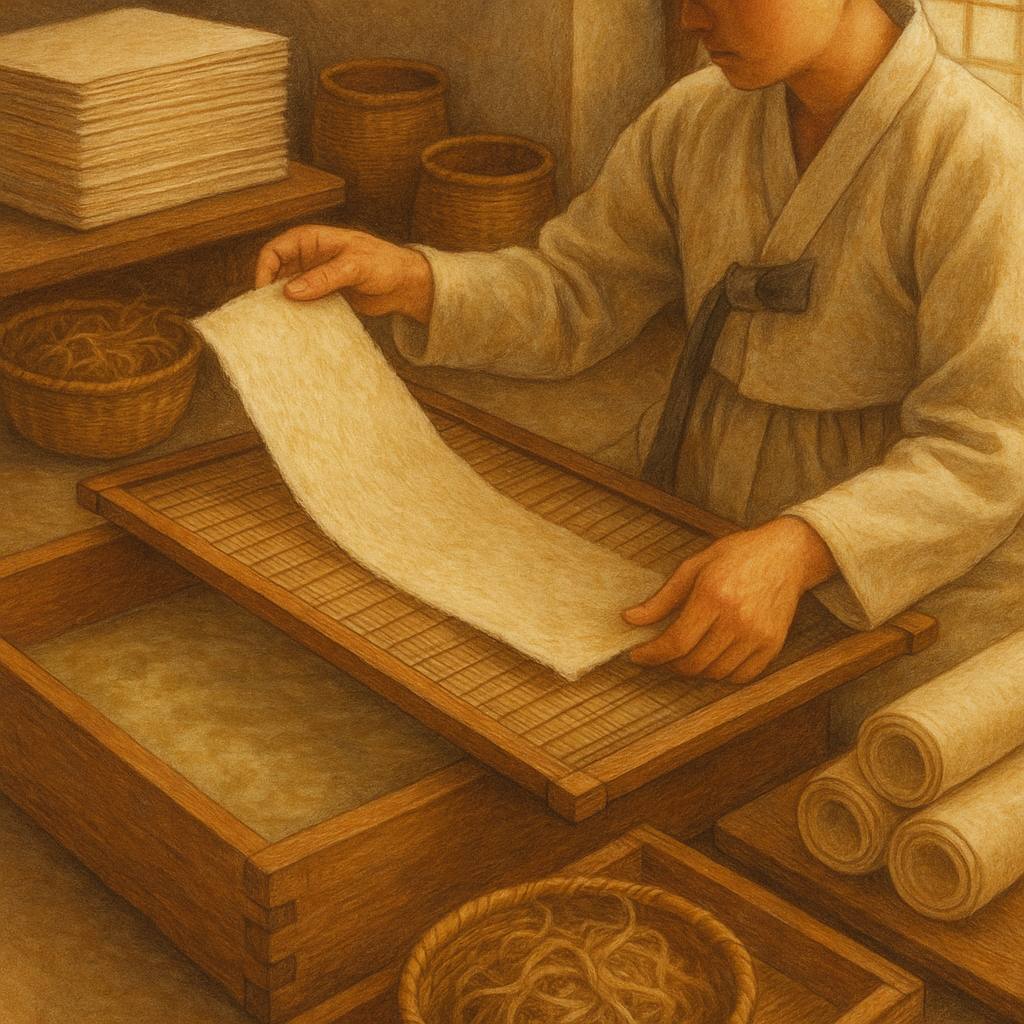
    Artisans strip the bark, boil it with wood ash lye, then beat the fibers by hand until they separate into long, thread-like strands. This step matters more than people assume — the length of the fiber is what gives hanji its unusual tensile strength, unlike shorter wood-pulp fibers used in most commercial paper today.

    The pulp is then mixed with a mucilage extracted from hibiscus root, which helps the fibers spread evenly in water. Using a bamboo screen, the papermaker sweeps the pulp back and forth in a technique called oe-ol-tteugi, layering fibers in crisscrossing directions rather than a single pass.

    That crosshatching is the real secret. It’s why hanji resists tearing along any one direction, unlike paper made with fibers aligned only one way.

    Photo by Chang Patrick on Unsplash

    Ink, Sutras, and the Weight of Dynasties

    Historically, hanji carried more than words — it carried diplomatic weight. During the Joseon dynasty, Korean paper was sent as tribute to the Chinese imperial court, where it was reportedly prized above local varieties for its smoothness and durability.

    Buddhist temples relied on hanji to copy sutras that needed to survive for generations, not just years. Government offices used it for official records, understanding that ink sat differently on hanji than on other papers — absorbing just enough to stay crisp without bleeding through the sheet.

    This reputation wasn’t accidental. Papermaking villages developed specialized knowledge passed through families, with certain regions like Jeonju becoming known for particular grades of hanji suited to calligraphy versus everyday use.

    Beyond the Page: Windows, Armor, Everyday Life

    Here’s what surprises most visitors to a hanok, a traditional Korean house: the windows aren’t glass. They’re covered in changhoji, a thin hanji stretched over wooden lattice frames.

    Light passing through changhoji softens into a warm, diffused glow rather than a harsh beam — something residents describe as changing the entire mood of a room throughout the day. Layered thickly, hanji was also used for flooring in a technique called jangpanji, coated with bean oil until it became waterproof and surprisingly durable underfoot.

    Less known is hanji’s role in protective gear. Records describe paper armor, jibgap, made from multiple compressed layers of hanji, light enough to wear yet dense enough to blunt an arrow’s impact. Clothing, fans, umbrellas, and even burial shrouds were made from treated hanji, each application demanding a slightly different thickness or coating.

    Photo by Sean Lee on Unsplash

    Craftsmen Today: A Fragile Continuity

    Fewer than a handful of workshops in Korea still produce hanji entirely by hand using traditional methods. Wonju and Jeonju remain centers where this knowledge persists, often passed down through master papermakers who trained for years before touching a finished product on their own.

    The work is physically demanding — hours spent standing in cold water, beating fiber, repeating the same sweeping motion with a bamboo screen hundreds of times a day. Younger generations show interest but the economics are difficult, since machine-made paper is far cheaper and faster to produce.

    Some artisans have adapted by creating hanji art pieces, lamps, and home décor for international markets, finding new relevance for an old material. Others focus on restoration work, since museums worldwide still need hanji to repair centuries-old Korean documents properly.

    Try It Yourself

    You don’t need to visit Korea to feel the difference hanji makes. Several online shops ship hanji sheets, notebooks, and lamp shades internationally, often at reasonable prices for small quantities.

    Order a single sheet, hold it up to a window, and watch how the light moves through the fibers unevenly, almost like watching cloud shadows cross a field. That small moment might tell you more about six centuries of craftsmanship than any museum placard could.

    In every fiber of hanji lies a patience machines have never learned to imitate.

  • The Living Pattern: How Japanese Kintsugi Turns Breakage into Beauty

    Photo by Riho Kitagawa on Unsplash

    A Crack You Can See From Across the Room

    Hold a kintsugi bowl up to the light and the first thing you notice isn’t the break — it’s the line of gold tracing across the ceramic surface like a river on a map. The seam catches light differently than the glaze around it, slightly raised, slightly rough under your thumb.

    Most people expect a repaired object to hide its wound. This one advertises it. The gold doesn’t blend in; it interrupts the pattern of the original glaze on purpose, turning a fracture line into something closer to a brushstroke.

    The Shogun Who Started a Trend

    The story most often told begins with Ashikaga Yoshimasa, a 15th-century shogun who, according to tradition, sent a favorite Chinese tea bowl overseas for repair after it cracked. It came back held together with ugly metal staples — functional, but visually crude.

    Dissatisfied, Yoshimasa is said to have asked Japanese craftsmen to find a better way, one that honored the bowl rather than just patching it. Whether or not every detail of this account is precise, it captures something real: kintsugi grew out of tea culture, where the vessel itself was treated as worthy of the same attention as the tea inside it.

    By the Edo period, the practice had spread well beyond the shogun’s court. Collectors reportedly began seeking out already-broken pieces specifically so they could be repaired this way — the damage became part of what made an object desirable.

    Photo by Perry Merrity II on Unsplash

    Rice Glue, Lacquer, and Gold Dust

    The actual process has nothing to do with epoxy or quick fixes. Broken pieces are first joined with urushi, a lacquer made from the sap of the urushi tree, mixed with rice flour to create an adhesive paste.

    Each layer needs days, sometimes weeks, to cure in a humid box called a muro, since lacquer hardens through moisture rather than air-drying. Only after the structural repair is stable does the craftsperson apply a final coat of lacquer dusted with fine gold, silver, or platinum powder along the seam.

    A single bowl can take a month or more from first crack to finished repair. There’s no shortcut version of this that still counts as kintsugi — the slowness is part of the technique, not an accident of it.

    Why the Repair Costs More Than the Bowl

    Here’s the part that surprises people outside Japan: a kintsugi repair can genuinely increase an object’s value beyond what it was worth intact. This isn’t nostalgia or sentimentality — it reflects an idea, connected to wabi-sabi, that impermanence and wear are part of an object’s real history rather than flaws to erase.

    Photo by Clay Banks on Unsplash

    There’s a related concept, mottainai, a sense of regret over wasting something still useful. Throwing away a cracked bowl feels wasteful in a way that goes beyond money; repairing it visibly, rather than hiding the repair, turns that waste into a kind of record.

    The bowl now carries two stories instead of one — how it was made, and how it survived being broken.

    Finding Kintsugi in Your Own Home

    You don’t need a centuries-old teacup to start noticing this. Look around your kitchen for a mug with a chip, a plate with a hairline crack you’ve been meaning to throw out. Before you toss it, sit with the question kintsugi asks: what if the damage were the most interesting part of the object’s story, not the part to hide?

    Authentic urushi kintsugi requires real training and food-safe lacquer, so if you want to try it properly, look for a workshop or a kit using food-safe epoxy resin with mica powder — a common modern adaptation for beginners. It won’t be traditional urushi, but it teaches the same instinct: repair as something visible, not something to apologize for.

    A crack, once mended in gold, stops being a flaw and becomes a line worth following.

  • The Enduring Charm of Chinese Courtyard Homes: Siheyuan and the Art of Family Living

    Photo by vnwayne fan on Unsplash

    A Wall That Reveals Nothing

    Walk down a hutong in Beijing’s older districts and you’ll see mostly gray brick walls, unmarked wooden doors, maybe a pair of stone lions worn smooth by decades of hands. Nothing hints at what’s inside. This is by design.

    Chinese courtyard homes, known as siheyuan, were built to give away nothing to the street. The real architecture happens once you step through that narrow entrance and the space suddenly opens into sky, packed dirt or brick paving, and rooms arranged on four sides facing inward. The contrast is almost physical, like holding your breath and then exhaling.

    That inward orientation isn’t accidental. It reflects a much older idea about what a home is supposed to protect.

    Where the Layout Comes From

    The siheyuan form traces back, in its basic logic, over two thousand years, with layouts documented in northern Chinese cities as early as the Han dynasty and refined heavily during the Yuan and Ming periods when Beijing was rebuilt as an imperial capital. Traditionally, city planners laid out residential blocks along a strict north-south, east-west grid, and the courtyard house fit neatly into that geometry.

    Feng shui principles shaped nearly every decision, from the placement of the main gate at the southeast corner to the orientation of the primary hall facing south to catch winter sun and block cold northern wind. None of this was decorative thinking. It was practical wisdom passed down through generations of builders who had no thermometers but plenty of harsh Beijing winters to learn from.

    By the Qing dynasty, the siheyuan had become the standard housing form for everyone from modest merchants to high officials, scaled up or down depending on the family’s wealth and rank.

    Four Sides, One Family Order

    What makes a siheyuan more than just an enclosed courtyard is how precisely each building corresponds to a person’s place in the family. The northern hall, the one that gets the most sun and sits furthest from the gate, traditionally belonged to the grandparents or the household head. It was the most respected space, physically and socially.

    Photo by vnwayne fan on Unsplash

    The side wings, running east and west, housed married sons and their families, while the southern building near the entrance was reserved for servants, storage, or a study. Daughters, once married, typically moved into their husband’s household entirely, which tells you something about how these homes were built around continuity of the male family line rather than around any single nuclear unit.

    Meals, arguments, festivals, funerals, matchmaking negotiations, all of it happened with the courtyard as a kind of shared stage. Nobody in a siheyuan family lived in isolation. Every cough, every raised voice, traveled across that open square.

    The Courtyard as a Working Room

    It’s worth pausing on the courtyard itself, because it wasn’t just decorative open space. Families dried peppers and grain there in autumn, kept small gardens of pomegranate or jujube trees, sometimes a fish tank or a bird cage hanging under the eaves. Children did homework at a stone table under a locust tree while grandmothers shelled peas nearby.

    In summer, the courtyard cooled the surrounding rooms through cross ventilation and shade from potted plants. In winter, sunlight bounced off the pale ground and warmed the south-facing rooms even when snow sat on the roof tiles. This is climate control achieved entirely through geometry, centuries before anyone used that phrase.

    There’s a particular kind of quiet that settles into a siheyuan around dusk, when cooking smoke drifts up past gray tiles and someone’s radio plays faintly from one of the side rooms. It’s a soundscape unique to this kind of layered, communal living.

    What Happened to Them

    Much of old Beijing’s siheyuan stock disappeared through the twentieth century, first through wartime damage, then through waves of urban redevelopment that replaced entire hutong neighborhoods with apartment towers. Many surviving courtyard homes were subdivided during periods of housing shortage, with multiple families sharing what was once a single household’s compound, kitchens and toilets added haphazardly in the courtyard itself.

    Photo by zhang kaiyv on Unsplash

    Today there’s a real split in how these buildings are treated. Some remain crowded, low-income housing where five families share a courtyard meant for one. Others, particularly in central Beijing neighborhoods like Nanluoguxiang or parts of Xicheng, have been renovated into boutique guesthouses, restaurants, or private residences for buyers drawn to the historical cachet.

    Preservation groups in Beijing now push to protect remaining siheyuan clusters as heritage zones, arguing that losing them means losing a specific, legible record of how Chinese family life was physically organized for centuries.

    Why the Idea Still Resonates

    Even Chinese families living in high-rise apartments today sometimes describe wanting a sense of “siheyuan feeling,” meaning a home where generations aren’t scattered into separate units but share proximity without total exposure. That balance, private rooms opening onto a shared center, feels increasingly rare in dense modern cities.

    Contemporary architects in China have started reinterpreting the courtyard concept in new residential projects, using internal light wells or shared garden spaces to recreate that same inward-facing intimacy within concrete and glass buildings. The vocabulary changes, but the underlying question stays the same: how do you design a home that holds a family together rather than just housing them separately under one roof?

    That question is exactly what the siheyuan answered, imperfectly and rigidly by today’s standards perhaps, but with an architectural clarity that’s hard to find in most modern housing.

    Try This Today

    You don’t need a courtyard to borrow the underlying idea. Pick one space in your own home, a kitchen table, a small balcony, a corner of the living room, and treat it deliberately as the shared center everyone passes through and gathers at, rather than a leftover space between private rooms.

    For one week, make a small ritual there: morning tea, evening phone-free dinner, even just five minutes of sitting together without a screen. Notice whether that single, small gesture toward shared space changes how your household feels.

    A home reveals its values not in its walls, but in how it arranges people around a shared center.

  • The Enduring Craft of Japanese Boro Textiles: Mending as a Philosophy of Life

    Photo by Art Institute of Chicago on Unsplash

    A Jacket That Weighs More Than It Should

    Pick up an authentic boro noragi and the weight surprises you first. What looks like a single indigo jacket is actually a dozen or more, stacked and stitched into one, each layer added by a different pair of hands across decades.

    Some patches are cotton scraps from a worn-out diaper cloth. Others come from a sibling’s outgrown work coat, cut down and pressed into service. There is no matching pattern, no symmetry to admire from a distance — only the record of necessity, sewn stitch by stitch.

    This is not decoration. It is survival, made visible.

    Where Boro Came From: Cotton Scarcity in Rural Japan

    Boro emerged primarily among farming and fishing communities in northern Japan, particularly the Tohoku region, where winters are long and cotton did not grow well in the cold climate. Traditionally, cotton had to be imported from warmer regions to the south, making it expensive and scarce for rural households.

    Families could not afford to discard fabric, so worn garments were mended again and again, patch layered over patch, until the original cloth was barely visible. A single piece of clothing or bedding might be repaired across two or even three generations before it was finally too fragile to hold together.

    The word itself, boro, is generally understood to mean something tattered or ragged — a plain, unromantic label for what was, at the time, simply the reality of getting by. Nobody was making art. They were keeping warm.

    The Stitch Beneath the Surface: Sashiko as Structural Necessity

    People often assume sashiko stitching was invented as decoration, but its original purpose was reinforcement. The running stitch, worked in white or undyed thread against deep indigo cloth, bound layers of fabric together so they could withstand the physical strain of farm labor or fishing work.

    Photo by Brayden Prato on Unsplash

    Indigo dye itself served a practical function beyond color. It was believed to repel insects and strengthen fibers, which mattered when a garment needed to survive years of hard use in the fields.

    Over time, the stitching patterns took on a rhythm of their own — rows of parallel lines, grids, sometimes looser and more improvised depending on the mender’s skill. But the beauty was always a byproduct, never the point.

    Mending as an Attitude, Not a Technique

    What makes boro worth studying today is not the aesthetic, though that has captivated designers from Paris to Tokyo. It is the underlying attitude toward objects: that a thing’s value increases, rather than decreases, with the marks of its repair.

    This sits close to the concept of mottainai, a sense of regret over waste, though boro is more specific — it is about the labor of continuation rather than a general philosophy of thrift. Each patch is proof that someone decided this cloth was still worth an hour of their evening.

    Contrast this with how most of us relate to a torn shirt or a stained tablecloth now. The instinct is to discard and replace, not because the item is beyond saving, but because saving it no longer feels worth the effort.

    From Rags to Runways, and What Gets Lost in Translation

    Since the late twentieth century, boro textiles have been collected, exhibited, and increasingly sold at high prices in vintage and design markets outside Japan. Fashion houses have referenced its patchwork logic in ready-to-wear collections, and sashiko-inspired stitching now appears on jackets that cost more than a month’s rent.

    Photo by Clay Banks on Unsplash

    There is something worth noting here, gently: the people who made boro were not trying to make a statement. They were often the rural poor, and the textiles survived largely by accident, stored away in attics rather than treasured as art.

    None of this diminishes the craft’s relevance now. It simply means the philosophy behind boro — patience, resourcefulness, a refusal to see damage as an ending — carries more weight than the fabric’s current market price suggests.

    Try This With Something You Already Own

    You do not need indigo-dyed cotton or a sashiko needle to borrow the logic of boro. Find one item in your home with a small tear or thinning patch — a favorite pair of jeans, a linen napkin, a canvas bag.

    Instead of researching the “correct” technique, thread a needle with contrasting thread and simply stitch the damage closed, visibly, without hiding it. Let the repair show.

    Notice how the object feels different in your hands afterward — not lesser for the mend, but more clearly yours.

    To mend a thing openly is to admit it was worth keeping in the first place.

  • The Quiet Art of Japanese Ikebana: Flower Arranging as a Meditative Practice

    Photo by 五玄土 ORIENTO on Unsplash

    The Twenty-Minute Decision

    In a small studio near Kyoto’s Kamo River, an ikebana teacher once spent nearly twenty minutes deciding which branch to cut away. The final placement of the remaining stem took less than a minute. When a student asked why the removing took so much longer than the arranging, the teacher simply said, “Because what stays must earn its place.”

    That answer captures something Western flower arranging rarely asks of us. We tend to think of a bouquet as an act of addition — more blooms, more color, more fullness. Ikebana works the opposite way, and that reversal is where its meditative quality begins.

    Roots in Offering, Not Decoration

    Ikebana traditionally traces back to the practice of kuge, floral offerings placed before Buddhist altars, brought into daily temple life sometime around the sixth century as Buddhism spread through Japan. Monks arranged flowers not to please the eye but to honor the Buddha, which meant the arrangement carried a kind of devotional discipline from its very origin.

    Over the centuries, this offering practice moved from altars into the hands of specialists. The Ikenobo lineage, connected to the Rokkakudo temple in Kyoto, is traditionally credited with shaping the earliest formal styles, including the upright rikka form associated with priest-arrangers of the fifteenth century. Rikka arrangements were built to represent landscapes — mountains, valleys, waterfalls — condensed into a single container.

    Later schools softened this formality. The simpler nageire and eventually moribana styles, developed in the following centuries, allowed more asymmetry and open space. What stayed constant, though, was the idea that an arrangement should be composed with intention, not abundance.

    What You Leave Out

    Walk into most Western floral shops and you’ll see arrangements built around fullness — a dome of color with no visible gaps. Ikebana treats empty space, called ma, as an active material, as important as the stems themselves.

    A single branch angled sharply to one side, with nothing on the other, isn’t unfinished. It’s a deliberate statement about balance through asymmetry rather than symmetry. The eye is meant to travel through the gaps as much as across the flowers.

    Photo by Nguyen Phuc Hau on Unsplash

    This is harder than it sounds. Most beginners instinctively want to fill every open space with another stem, and learning to resist that urge is, in practice, the first real lesson ikebana teaches about restraint.

    The Body Before the Bloom

    Long before a single stem is cut, there’s a physical ritual to settle into. Practitioners often kneel or stand with a straight spine, breathe slowly, and observe the materials in silence for several minutes before touching them.

    This isn’t ceremony for its own sake. The slower breathing changes the pace of the hands, and a rushed cut almost always shows in the final line of a branch. Teachers frequently repeat a simple instruction: look at the material longer than you think you need to.

    The scissors themselves, often heavy iron kenzan-paired shears, make a distinct clean sound with each cut — a small, sharp punctuation that many practitioners describe as oddly calming after enough repetition. Over time, the cutting itself becomes a kind of counting practice, similar to tracking breath in seated meditation.

    Reading the Container as Part of the Work

    A container in ikebana isn’t a neutral vessel waiting to be filled — it’s treated as the horizon line of the whole piece. A shallow, wide dish paired with the kenzan pin-holder (a heavy metal base studded with needles) invites a low, spreading arrangement that mimics a riverbank or open field.

    A tall, narrow vase asks for verticality, something reaching rather than resting. Choosing the container before selecting flowers, rather than after, forces the arranger to think about proportion from the very first decision, not as an afterthought once the stems are already in hand.

    Photo by Clay Banks on Unsplash

    Starting Without a Teacher

    You don’t need a kenzan or a formal vase to feel what this practice offers. Three stems of noticeably different lengths — say a bare branch, a single flower, and one leafy stem — placed in any jar will teach you more than a dozen tutorials.

    Cut them at different heights on purpose. Resist adding a fourth stem to “balance” it, even when the arrangement feels unfinished by ordinary bouquet standards. Sit with it for a minute before deciding whether it’s done.

    What most people notice, the first time they try this, is how uncomfortable the empty space feels — and how that discomfort fades the longer they look at it. That shift, more than any technique, is the actual practice ikebana is built around.

    Your Next Small Cut

    Today, before you do anything elaborate, go outside or to your kitchen and find three stems — a twig, a single bloom, anything green will do. Cut them at three different lengths, place them in whatever container is nearby, and leave the arrangement visibly asymmetrical.

    Don’t photograph it right away. Just sit near it for five minutes and notice what your eye keeps returning to — the flower, or the space around it.

    In ikebana, what you choose to remove says as much as what you choose to keep.

  • The Seasonal Wisdom of Chinese Solar Terms: Living in Rhythm with Nature

    An Ancient Clock Without Hands

    Ask a farmer in rural Shaanxi when to plant sorghum, and he might not check an app. He’ll tell you it’s three days past Guyu, the “grain rain” term, when the soil finally holds enough moisture to sprout seeds without rotting them.

    This isn’t superstition. It’s the residue of a system that predates thermometers, satellites, and even the printed calendar—one that Chinese farmers refined by watching the sky for centuries.

    Twenty-Four Signposts Through a Single Year

    The system, known as the 24 solar terms (二十四节气), divides the solar year into twenty-four roughly fifteen-day segments, each tied to the sun’s position and named for what actually happens on the ground: Awakening of Insects, Grain in Ear, White Dew, Frost’s Descent.

    Traditionally, the framework took shape through generations of agricultural observation along the Yellow River basin, and was recorded in something close to its full form in the Huainanzi, a text compiled around the 2nd century BCE during the Han dynasty. It wasn’t invented by one scholar in a study; it was assembled from what worked in the fields.

    Each term carries a small, testable prediction. Jingzhe, “Awakening of Insects,” marks the point when the first spring thunder is expected to rouse hibernating creatures from the soil. You can actually listen for it.

    The Kitchen Calendar

    Long before nutritionists talked about seasonal eating, Chinese households were already doing it by the solar terms. At Qingming in early April, families in southern China make qingtuan—glutinous rice balls dyed green with mugwort or barley grass juice, eaten cool, slightly grassy, faintly sweet.

    Dongzhi, the Winter Solstice term, splits the country in two at the dinner table. In the north, families gather to make dumplings, following an old warning that skipping them on this day will leave your ears frozen through winter. In the south, people eat tangyuan instead—soft rice balls in warm syrup, round like the returning light after the year’s longest night.

    These aren’t nostalgic gestures performed once a year for show. In many households, they’re simply what’s for dinner when that date rolls around.

    Thunder, Superstition, and the Logic of Small Rituals

    Some solar term customs sound stranger out of context. In Guangdong, Jingzhe is when some people still practice “da siu yan,” striking a paper effigy with a shoe to beat away bad luck and troublesome people for the year ahead.

    It sounds theatrical, but the timing makes sense once you know the season. Insects and pests are waking up alongside the thunder—so, symbolically, is misfortune, and the ritual gives people a concrete moment to push it back out the door.

    This is the real function of the solar terms: they turn an abstract, sliding year into a series of specific, nameable moments you can act on.

    Photo by zhang kaiyv on Unsplash

    Why an Old Farming System Still Matters

    In 2016, UNESCO inscribed the 24 solar terms onto its Representative List of the Intangible Cultural Heritage of Humanity, recognizing them not as a relic but as a living system still shaping calendars, cuisine, and even traditional medicine practice across China today.

    Air conditioning and greenhouse produce have loosened our dependence on the seasons, which is exactly why the terms feel worth revisiting now. They offer something a digital calendar can’t: a built-in prompt to actually notice whether the air has changed, whether the light is different, whether something outside your window shifted overnight.

    Try It This Week

    Look up which solar term the current date falls under—there are only twenty-four, and most have a simple name in English that tells you exactly what to watch for. Then spend one afternoon this week doing what the term suggests: listen for the first thunder, notice the length of daylight, or cook one dish tied to the season instead of whatever’s easiest.

    You don’t need the whole system to start. You just need one term, and a few minutes of paying attention.

    Long before clocks, people told time by what the sky and soil were already telling them.

  • The Timeless Elegance of Hanbok: How Korean Traditional Dress Shapes Modern Fashion

    Photo by Anna Oliinyk on Unsplash

    A Silk Ribbon Tied at a Seoul Wedding

    Watch a Korean bride today and you might see her switch outfits mid-ceremony — a Western white gown for the vows, then a jeogori and chima in jade green and crimson for the paebaek, the family bowing ritual that follows. The fabric catches light differently than anything else in the room. It moves like water when she bows.

    That moment captures something important: hanbok in modern Korea is not a museum artifact. It is a garment people still choose to put their bodies into, on the days that matter most.

    What the Silhouette Is Actually Doing

    A hanbok for women centers on two pieces: the jeogori, a short bodice jacket that stops above the waist, and the chima, a high-waisted, voluminous skirt gathered into soft folds. Men wear jeogori paired with baji, roomy trousers tied at the ankle for ease of movement, often under a longer coat called durumagi.

    The proportions matter more than the ornamentation. The high waistline sits just under the bust, which lengthens the look of the torso and lets the skirt fall in a wide, bell-like curve rather than clinging to the body. There is no corseting, no tailored waist seam pulling fabric tight — the shape is built from geometry, not compression.

    This is a fundamentally different logic from Western dressmaking, where fit follows the body’s contours. Hanbok drapes around the body instead, leaving room to sit on a heated ondol floor, kneel, or bow deeply without a single seam straining.

    Color That Was Never Decorative Alone

    Traditionally, color in hanbok followed obangsaek, the five-direction color system rooted in yin-yang and the five elements — blue, red, yellow, white, and black. These were not chosen for taste; they marked age, marital status, and social rank. A young child’s saekdong jeogori, sewn from horizontal stripes of every color in that palette, was believed to ward off misfortune and bad energy, which is why the garment still appears at first-birthday (doljanchi) celebrations today.

    Photo by Gabriela Starzec on Unsplash

    Married women historically wore richer, deeper tones, while unmarried women’s hanbok leaned toward brighter reds and yellows. Commoners, over centuries of sumptuary custom, were largely restricted to undyed or muted cotton and ramie, while brighter silks in saturated dyes were reserved for the yangban aristocracy. Color, in other words, was a language before it was an aesthetic.

    The Fabric Question: Ramie, Cotton, Silk

    Summer hanbok and winter hanbok are not the same garment in different colors — they are built from entirely different materials. Mosi, a ramie fabric woven from plant fiber, is stiff and semi-translucent, chosen precisely because it holds its shape away from sweat-damp skin during Korea’s humid summers. You can hear it before you see it; the fabric has a dry, papery rustle when it moves.

    Winter versions use quilted or padded cotton, sometimes lined with silk, giving the chima real weight and a duller, softer sound underfoot. Silk hanbok, saved for weddings and holidays, has a different kind of shine altogether — not glossy like satin, but a muted, warm sheen that shifts subtly as the wearer moves through changing light.

    Where Hanbok Nearly Disappeared

    Hanbok’s form settled into something close to its current shape over the Joseon dynasty, a period spanning roughly five centuries during which Confucian ideas about modesty, hierarchy, and family shaped nearly every visible detail of the garment. But the twentieth century was not kind to it. During the Japanese colonial period, traditional Korean dress was actively discouraged as part of broader efforts to suppress Korean cultural identity, and Western-style clothing spread quickly through Korea’s rapid industrialization in the decades that followed.

    By the late twentieth century, hanbok had been pushed almost entirely into ceremonial territory — Lunar New Year, weddings, funerals. It became something you photographed rather than lived in, folded carefully in a closet for the one or two days a year it was needed.

    Photo by zero take on Unsplash

    The Hanbok That Broke Out of the Closet

    Something shifted over the past decade, largely driven by younger Koreans renting “saenghwal hanbok” — daily-wear hanbok — to walk the stone alleys of Bukchon Hanok Village in Seoul. Rental shops there now do brisk business fitting tourists and locals alike into simplified, easier-to-move-in versions, often in dusty pastels rather than the bold traditional palette, worn with sneakers instead of the traditional beoseon socks and rubber-soled shoes.

    Designers noticed. Korean fashion houses have folded hanbok elements into ready-to-wear lines: the jeogori’s cropped, wrapped bodice reappearing as a blouse silhouette, the chima’s high waist and A-line volume showing up in contemporary skirts cut from wool or denim instead of silk or ramie. None of this replaces ceremonial hanbok — it runs alongside it, a separate but related conversation about what Korean dress can look like on an ordinary Tuesday.

    K-pop styling and Korean period dramas have pushed this further outward, putting hanbok-inspired silhouettes in front of audiences who have never set foot in Korea. The jacket-and-skirt logic, the high waistline, the wide sleeve — these details now surface in runway collections far from Seoul, sometimes credited, sometimes not, which is its own ongoing conversation within Korean fashion circles.

    Try This Instead of Just Reading About It

    If you’re in Seoul, skip the souvenir-shop rentals near major palaces and head to a hanbok atelier in Ikseon-dong, where several small studios let you choose fabric weight and color rather than grabbing a pre-packaged set — you’ll notice the difference in how the chima moves. If you’re not traveling anytime soon, look up Lee Young Hee or Danha Studio, two Korean designers whose modern hanbok lines are documented in detail online, and compare their cut of the jeogori collar to historical examples from the National Palace Museum of Korea’s digital archive. Either way, look closely at the collar line first — it’s the single detail that tells you the most about how carefully a hanbok was made.

    To wear hanbok well is to let history move quietly with the body, not behind it.

  • The Korean Bathhouse Experience: Discovering Wellness Through Jjimjilbang Culture

    Photo by Minku Kang on Unsplash

    The Sound of a Hundred Slippers on Wet Tile

    You hear a jjimjilbang before you see it. Plastic sandals slap against damp floors, water runs in steady sheets from shower heads lined up in open rows, and somewhere behind a wall a grandmother is scolding her grandson for splashing too much. There’s no hush here, no spa-brochure serenity. It’s loud, communal, and strangely comforting.

    Walk further in and the air changes. Steam thickens, the tile gives way to warm wooden floors, and the noise softens into the low hum of people sleeping on mats, cracking sunflower seeds, or watching a wall-mounted TV in pajama-like shorts and t-shirts issued at the front desk. This is not a single room but a small ecosystem, and understanding how it works changes how you experience it.

    Where the Custom Comes From

    Public bathing has deep roots in Korean life, tied historically to natural hot springs and communal bathhouses that served practical needs long before wellness became a marketing word. Traditionally, Koreans didn’t have private bathtubs at home, so neighborhood bathhouses called mokyoktang became the place to properly wash, soak, and socialize.

    Over centuries, this practical habit absorbed something more communal and less transactional. Bathing wasn’t just hygiene; it was a shared, unhurried pause in the week, often done with family or close friends. The modern jjimjilbang, which layers heated rooms and shared lounging spaces on top of the older bathhouse model, grew out of that same instinct: get clean, then stay a while.

    The Bathing Floor Isn’t Optional

    Before anything else, you wash. This part surprises a lot of first-timers because it’s not modest or quick — everyone bathes nude in gender-separated halls, sitting on low plastic stools in front of mirrors and handheld shower heads.

    Nobody stares, and nobody rushes. Older women scrub each other’s backs with rough Italian-towel mitts until the skin turns pink, a practice called seshin that’s less about vanity and more about a kind of ritual thoroughness. Skipping this step, or trying to enter the hot tubs without washing first, will get you a sharp look from the ajumma running the floor.

    Photo by Sung Jin Cho on Unsplash

    Soaking, Then Sweating

    Once you’re clean, the tubs are next: usually a cold pool, a lukewarm pool, and at least one scalding hot pool tiled in blue or white. Koreans move between temperatures deliberately, hot to cold and back again, treating it almost like a circulation exercise rather than a lazy soak.

    After the tubs, you change into the cotton uniform provided at check-in and head to the communal floor, where the jjimjilbang really becomes itself. This is where men and women mix again, families sprawl out on the floor together, and the heated rooms wait.

    The Heated Rooms Each Have a Personality

    A proper jjimjilbang has several themed saunas, and they’re not interchangeable. The hwangto room, lined with ochre clay, radiates a dry, earthy heat and smells faintly of baked soil. The salt room has coarse white crystals underfoot and a sharper, mineral smell in the air.

    Then there’s the ice room, kept just above freezing, where people duck in for a few minutes specifically to shock their body after the heat — a jarring but oddly satisfying contrast. Most jjimjilbangs also have a pyramid-shaped or dome-shaped extreme heat room, sometimes hot enough that a five-minute stay feels like the limit, with a thermometer by the door daring you to check.

    Eating on the Floor, Sleeping on a Mat

    Food is not an afterthought here. The snack counter almost always sells sikhye, a sweet rice punch served ice-cold in a foil-topped cup, alongside hard-boiled eggs that people crack against their foreheads before peeling — a small ritual that gets a laugh from foreign visitors every time.

    Photo by zero take on Unsplash

    Beyond snacks, many jjimjilbangs run a small restaurant serving noodles or rice dishes, meant to be eaten cross-legged on the heated floor. And when the day stretches into night, that same floor becomes a bed. Rolled mats and blockish wooden pillows line the corners of the main hall, and it’s completely normal to see someone asleep there at 2 p.m. on a Tuesday.

    Why Koreans Actually Go

    It would be easy to frame the jjimjilbang purely as a wellness destination, but that undersells what it actually does socially. Families bring toddlers here on weekends instead of a park. Office workers stop by after a late shift because it’s cheaper than a hotel and open all night. Teenagers hang out in the common room because the WiFi is decent and nobody’s rushing them out.

    That layered use — hygiene, heat therapy, cheap lodging, family outing, all under one roof — is what makes the jjimjilbang distinctly Korean rather than a generic Asian spa. It solves several problems at once, and it does so with almost no pretense about being a luxury experience.

    What to Actually Bring and Expect

    Bring nothing more than a phone, a bit of cash or a card, and low expectations about privacy. Most jjimjilbangs supply the shorts-and-shirt uniform, a small towel, and sometimes a locker key on a rubber wristband that also charges purchases to your room number.

    Entry fees are modest, often covering unlimited access for the day or even overnight. If you’re self-conscious about the nude bathing floor, know that the mixed-gender common area with saunas and food is fully clothed, so you can experience most of the culture without ever entering the single-gender baths.

    Try This Tonight, Not Someday

    If you’re in Seoul, Dragon Hill Spa near Yongsan Station and Siloam Sauna near Seoul Station are both open 24 hours and used to foreign visitors, which makes them forgiving places for a first attempt. Go in the evening, wash properly before soaking, spend ten minutes in the hwangto room, then reward yourself with a cold sikhye at the snack counter — that specific sequence is the most authentic short version of the experience you can get in under two hours.

    To be truly clean, you must first be willing to be seen.