Slow Living, Asian Wisdom

블로그

  • The Living Pattern: How Japanese Kintsugi Turns Breakage into Beauty

    Photo by Riho Kitagawa on Unsplash

    A Crack You Can See From Across the Room

    Hold a kintsugi bowl up to the light and the first thing you notice isn’t the break — it’s the line of gold tracing across the ceramic surface like a river on a map. The seam catches light differently than the glaze around it, slightly raised, slightly rough under your thumb.

    Most people expect a repaired object to hide its wound. This one advertises it. The gold doesn’t blend in; it interrupts the pattern of the original glaze on purpose, turning a fracture line into something closer to a brushstroke.

    The Shogun Who Started a Trend

    The story most often told begins with Ashikaga Yoshimasa, a 15th-century shogun who, according to tradition, sent a favorite Chinese tea bowl overseas for repair after it cracked. It came back held together with ugly metal staples — functional, but visually crude.

    Dissatisfied, Yoshimasa is said to have asked Japanese craftsmen to find a better way, one that honored the bowl rather than just patching it. Whether or not every detail of this account is precise, it captures something real: kintsugi grew out of tea culture, where the vessel itself was treated as worthy of the same attention as the tea inside it.

    By the Edo period, the practice had spread well beyond the shogun’s court. Collectors reportedly began seeking out already-broken pieces specifically so they could be repaired this way — the damage became part of what made an object desirable.

    Photo by Perry Merrity II on Unsplash

    Rice Glue, Lacquer, and Gold Dust

    The actual process has nothing to do with epoxy or quick fixes. Broken pieces are first joined with urushi, a lacquer made from the sap of the urushi tree, mixed with rice flour to create an adhesive paste.

    Each layer needs days, sometimes weeks, to cure in a humid box called a muro, since lacquer hardens through moisture rather than air-drying. Only after the structural repair is stable does the craftsperson apply a final coat of lacquer dusted with fine gold, silver, or platinum powder along the seam.

    A single bowl can take a month or more from first crack to finished repair. There’s no shortcut version of this that still counts as kintsugi — the slowness is part of the technique, not an accident of it.

    Why the Repair Costs More Than the Bowl

    Here’s the part that surprises people outside Japan: a kintsugi repair can genuinely increase an object’s value beyond what it was worth intact. This isn’t nostalgia or sentimentality — it reflects an idea, connected to wabi-sabi, that impermanence and wear are part of an object’s real history rather than flaws to erase.

    Photo by Clay Banks on Unsplash

    There’s a related concept, mottainai, a sense of regret over wasting something still useful. Throwing away a cracked bowl feels wasteful in a way that goes beyond money; repairing it visibly, rather than hiding the repair, turns that waste into a kind of record.

    The bowl now carries two stories instead of one — how it was made, and how it survived being broken.

    Finding Kintsugi in Your Own Home

    You don’t need a centuries-old teacup to start noticing this. Look around your kitchen for a mug with a chip, a plate with a hairline crack you’ve been meaning to throw out. Before you toss it, sit with the question kintsugi asks: what if the damage were the most interesting part of the object’s story, not the part to hide?

    Authentic urushi kintsugi requires real training and food-safe lacquer, so if you want to try it properly, look for a workshop or a kit using food-safe epoxy resin with mica powder — a common modern adaptation for beginners. It won’t be traditional urushi, but it teaches the same instinct: repair as something visible, not something to apologize for.

    A crack, once mended in gold, stops being a flaw and becomes a line worth following.

  • The Enduring Charm of Chinese Courtyard Homes: Siheyuan and the Art of Family Living

    Photo by vnwayne fan on Unsplash

    A Wall That Reveals Nothing

    Walk down a hutong in Beijing’s older districts and you’ll see mostly gray brick walls, unmarked wooden doors, maybe a pair of stone lions worn smooth by decades of hands. Nothing hints at what’s inside. This is by design.

    Chinese courtyard homes, known as siheyuan, were built to give away nothing to the street. The real architecture happens once you step through that narrow entrance and the space suddenly opens into sky, packed dirt or brick paving, and rooms arranged on four sides facing inward. The contrast is almost physical, like holding your breath and then exhaling.

    That inward orientation isn’t accidental. It reflects a much older idea about what a home is supposed to protect.

    Where the Layout Comes From

    The siheyuan form traces back, in its basic logic, over two thousand years, with layouts documented in northern Chinese cities as early as the Han dynasty and refined heavily during the Yuan and Ming periods when Beijing was rebuilt as an imperial capital. Traditionally, city planners laid out residential blocks along a strict north-south, east-west grid, and the courtyard house fit neatly into that geometry.

    Feng shui principles shaped nearly every decision, from the placement of the main gate at the southeast corner to the orientation of the primary hall facing south to catch winter sun and block cold northern wind. None of this was decorative thinking. It was practical wisdom passed down through generations of builders who had no thermometers but plenty of harsh Beijing winters to learn from.

    By the Qing dynasty, the siheyuan had become the standard housing form for everyone from modest merchants to high officials, scaled up or down depending on the family’s wealth and rank.

    Four Sides, One Family Order

    What makes a siheyuan more than just an enclosed courtyard is how precisely each building corresponds to a person’s place in the family. The northern hall, the one that gets the most sun and sits furthest from the gate, traditionally belonged to the grandparents or the household head. It was the most respected space, physically and socially.

    Photo by vnwayne fan on Unsplash

    The side wings, running east and west, housed married sons and their families, while the southern building near the entrance was reserved for servants, storage, or a study. Daughters, once married, typically moved into their husband’s household entirely, which tells you something about how these homes were built around continuity of the male family line rather than around any single nuclear unit.

    Meals, arguments, festivals, funerals, matchmaking negotiations, all of it happened with the courtyard as a kind of shared stage. Nobody in a siheyuan family lived in isolation. Every cough, every raised voice, traveled across that open square.

    The Courtyard as a Working Room

    It’s worth pausing on the courtyard itself, because it wasn’t just decorative open space. Families dried peppers and grain there in autumn, kept small gardens of pomegranate or jujube trees, sometimes a fish tank or a bird cage hanging under the eaves. Children did homework at a stone table under a locust tree while grandmothers shelled peas nearby.

    In summer, the courtyard cooled the surrounding rooms through cross ventilation and shade from potted plants. In winter, sunlight bounced off the pale ground and warmed the south-facing rooms even when snow sat on the roof tiles. This is climate control achieved entirely through geometry, centuries before anyone used that phrase.

    There’s a particular kind of quiet that settles into a siheyuan around dusk, when cooking smoke drifts up past gray tiles and someone’s radio plays faintly from one of the side rooms. It’s a soundscape unique to this kind of layered, communal living.

    What Happened to Them

    Much of old Beijing’s siheyuan stock disappeared through the twentieth century, first through wartime damage, then through waves of urban redevelopment that replaced entire hutong neighborhoods with apartment towers. Many surviving courtyard homes were subdivided during periods of housing shortage, with multiple families sharing what was once a single household’s compound, kitchens and toilets added haphazardly in the courtyard itself.

    Photo by zhang kaiyv on Unsplash

    Today there’s a real split in how these buildings are treated. Some remain crowded, low-income housing where five families share a courtyard meant for one. Others, particularly in central Beijing neighborhoods like Nanluoguxiang or parts of Xicheng, have been renovated into boutique guesthouses, restaurants, or private residences for buyers drawn to the historical cachet.

    Preservation groups in Beijing now push to protect remaining siheyuan clusters as heritage zones, arguing that losing them means losing a specific, legible record of how Chinese family life was physically organized for centuries.

    Why the Idea Still Resonates

    Even Chinese families living in high-rise apartments today sometimes describe wanting a sense of “siheyuan feeling,” meaning a home where generations aren’t scattered into separate units but share proximity without total exposure. That balance, private rooms opening onto a shared center, feels increasingly rare in dense modern cities.

    Contemporary architects in China have started reinterpreting the courtyard concept in new residential projects, using internal light wells or shared garden spaces to recreate that same inward-facing intimacy within concrete and glass buildings. The vocabulary changes, but the underlying question stays the same: how do you design a home that holds a family together rather than just housing them separately under one roof?

    That question is exactly what the siheyuan answered, imperfectly and rigidly by today’s standards perhaps, but with an architectural clarity that’s hard to find in most modern housing.

    Try This Today

    You don’t need a courtyard to borrow the underlying idea. Pick one space in your own home, a kitchen table, a small balcony, a corner of the living room, and treat it deliberately as the shared center everyone passes through and gathers at, rather than a leftover space between private rooms.

    For one week, make a small ritual there: morning tea, evening phone-free dinner, even just five minutes of sitting together without a screen. Notice whether that single, small gesture toward shared space changes how your household feels.

    A home reveals its values not in its walls, but in how it arranges people around a shared center.

  • The 3-Tier Round End Table That Solves the Small-Space Struggle

    Photo by Orkun Azap on Unsplash

    You know that spot next to the couch or beside your bed that’s just… empty? Too small for a bookshelf, too awkward for a full-size nightstand, but you still need somewhere to set down a mug, your phone, or that stack of books you swear you’ll finish this month.

    That’s the exact gap this Round Small End Table is built to fill. It’s designed specifically for tight corners and small spaces, which makes it a natural fit for apartments, reading nooks, or that narrow strip between your armchair and the wall.

    Three Tiers Instead of One Flat Surface

    Most small end tables give you a single tabletop and call it a day. This one uses a 3-tier oval design, which means you actually get layered storage instead of just one crowded surface.

    That matters more than it sounds. The top tier can hold your lamp or drink, the middle tier can catch your remote or glasses, and the bottom tier becomes a landing spot for books or a plant. You’re not stacking everything precariously in one place.

    Rustic Wood and Metal, Built to Blend In

    The rustic brown wood paired with metal legs gives it that Asian-inspired, understated look that works whether it’s sitting next to a couch or doubling as a nightstand. It’s not trying too hard to be a statement piece, which is honestly the point of a good side table.

    The metal frame also does practical work here. It’s what allows the tiered design to stay open and airy instead of feeling like a boxy cabinet, so it doesn’t visually crowd a small room the way bulkier furniture can.

    Easy to Assemble Actually Means Something

    The listing specifically calls out that it’s easy to assemble, and for a piece like this, that’s not a throwaway detail. A three-tier table has more parts to align than a basic single-top table, so straightforward assembly instructions save you from an afternoon of frustration.

    If you’ve ever wrestled with furniture that looked simple in photos but turned into a puzzle once the box was open, you’ll appreciate when a brand actually delivers on that promise.

    One Honest Caveat

    Because this table is designed for small spaces, it’s not going to give you the surface area of a full-size console or a wide coffee table. If you’re picturing a spot to spread out a laptop, snacks, and a candle all at once, the tiers help, but each individual shelf is still on the smaller side. It’s built for compact convenience, not sprawling storage.

    Where It Fits Best

    Think tight bedroom corners where a bulky nightstand won’t fit, small apartment living rooms, or that narrow gap beside a recliner. The oval shape also helps it tuck into spaces where a square table’s corners would feel like they’re in the way.

    It’s a table that seems designed around the reality that not every room has room to spare, which is exactly the problem it’s solving.

    This post contains an affiliate link. If you purchase through it, we may earn a small commission at no extra cost to you.

    If you’ve been putting off filling that awkward empty corner, this one’s worth a look: Round Small End Table – 3 Tier Oval Accent Table.

    Sometimes the right piece of furniture isn’t the biggest one in the room, it’s the one that finally makes an awkward space make sense.

    🛒 Check the Current Price on Amazon

  • The Little Table That Solves Big Small-Space Problems

    Photo by Alex Padurariu on Unsplash

    You know that awkward corner in your bedroom or the sliver of space next to your couch that’s too small for furniture but too big to ignore? We’ve all stared at that gap wondering what could possibly fit there without making the room feel cramped.

    That’s exactly the puzzle this 3-tier oval accent table seems built to solve. It’s compact enough for tight spots but still gives you three separate surfaces to work with, which is a rare combination in small-space furniture.

    Three Tiers, Three Jobs

    The obvious win here is the tiered design itself. Instead of one flat surface where your lamp, phone, book, and coffee mug all compete for room, you get three distinct levels to spread things out.

    This matters more than it sounds. A single-tier nightstand often turns into a cluttered mess within a week, while a tiered layout naturally encourages you to designate a spot for each item, like books on the bottom, lamp up top, glasses in the middle.

    Rustic Wood Meets Metal Frame

    The rustic brown wood paired with a metal frame gives it a look that fits comfortably into farmhouse, industrial, or Asian-inspired minimalist spaces without screaming for attention. It’s the kind of piece that blends in rather than competes with your existing decor.

    The metal frame construction also matters for a practical reason: it typically holds up better than an all-wood build when you’re using the table as a nightstand and reaching for it in the dark, or when it’s doing double duty as a couch-side table that gets bumped into regularly.

    Genuinely Easy to Assemble

    Furniture assembly is often the part nobody wants to talk about until it’s a frustrating hour with an Allen wrench. This table is specifically built to be easy to assemble, which is worth calling out since not every “accent table” delivers on that promise.

    For anyone who’s ever sworn off flat-pack furniture after a bad experience, this is a small but meaningful detail.

    One Honest Caveat

    Because this is a small end table designed specifically for tight spaces, it’s not going to work as a primary coffee table or a surface for larger lamps and decor pieces. If you’re picturing something that can hold a stack of oversized books plus a large plant plus a lamp all at once, this may feel limited. Measure your space and your intended use before buying, since “small” is the whole point of this design, not a bonus.

    Where It Fits Best

    This table seems best suited for exactly the spaces its name suggests: a bedroom nightstand, a narrow gap beside a couch, or any small living room corner that needs function without bulk. If your space is genuinely tight, the round oval shape also helps it avoid sharp corners that can make small rooms feel more cramped.

    This post contains an affiliate link. If you purchase through it, we may earn a small commission at no extra cost to you.

    If this sounds like the piece your small space has been missing, you can check it out here: Round Small End Table – 3 Tier Oval Accent Table.

    Sometimes the smallest pieces in a room end up doing the most quiet, consistent work.

    🛒 Check the Current Price on Amazon

  • The Enduring Craft of Japanese Boro Textiles: Mending as a Philosophy of Life

    Photo by Art Institute of Chicago on Unsplash

    A Jacket That Weighs More Than It Should

    Pick up an authentic boro noragi and the weight surprises you first. What looks like a single indigo jacket is actually a dozen or more, stacked and stitched into one, each layer added by a different pair of hands across decades.

    Some patches are cotton scraps from a worn-out diaper cloth. Others come from a sibling’s outgrown work coat, cut down and pressed into service. There is no matching pattern, no symmetry to admire from a distance — only the record of necessity, sewn stitch by stitch.

    This is not decoration. It is survival, made visible.

    Where Boro Came From: Cotton Scarcity in Rural Japan

    Boro emerged primarily among farming and fishing communities in northern Japan, particularly the Tohoku region, where winters are long and cotton did not grow well in the cold climate. Traditionally, cotton had to be imported from warmer regions to the south, making it expensive and scarce for rural households.

    Families could not afford to discard fabric, so worn garments were mended again and again, patch layered over patch, until the original cloth was barely visible. A single piece of clothing or bedding might be repaired across two or even three generations before it was finally too fragile to hold together.

    The word itself, boro, is generally understood to mean something tattered or ragged — a plain, unromantic label for what was, at the time, simply the reality of getting by. Nobody was making art. They were keeping warm.

    The Stitch Beneath the Surface: Sashiko as Structural Necessity

    People often assume sashiko stitching was invented as decoration, but its original purpose was reinforcement. The running stitch, worked in white or undyed thread against deep indigo cloth, bound layers of fabric together so they could withstand the physical strain of farm labor or fishing work.

    Photo by Brayden Prato on Unsplash

    Indigo dye itself served a practical function beyond color. It was believed to repel insects and strengthen fibers, which mattered when a garment needed to survive years of hard use in the fields.

    Over time, the stitching patterns took on a rhythm of their own — rows of parallel lines, grids, sometimes looser and more improvised depending on the mender’s skill. But the beauty was always a byproduct, never the point.

    Mending as an Attitude, Not a Technique

    What makes boro worth studying today is not the aesthetic, though that has captivated designers from Paris to Tokyo. It is the underlying attitude toward objects: that a thing’s value increases, rather than decreases, with the marks of its repair.

    This sits close to the concept of mottainai, a sense of regret over waste, though boro is more specific — it is about the labor of continuation rather than a general philosophy of thrift. Each patch is proof that someone decided this cloth was still worth an hour of their evening.

    Contrast this with how most of us relate to a torn shirt or a stained tablecloth now. The instinct is to discard and replace, not because the item is beyond saving, but because saving it no longer feels worth the effort.

    From Rags to Runways, and What Gets Lost in Translation

    Since the late twentieth century, boro textiles have been collected, exhibited, and increasingly sold at high prices in vintage and design markets outside Japan. Fashion houses have referenced its patchwork logic in ready-to-wear collections, and sashiko-inspired stitching now appears on jackets that cost more than a month’s rent.

    Photo by Clay Banks on Unsplash

    There is something worth noting here, gently: the people who made boro were not trying to make a statement. They were often the rural poor, and the textiles survived largely by accident, stored away in attics rather than treasured as art.

    None of this diminishes the craft’s relevance now. It simply means the philosophy behind boro — patience, resourcefulness, a refusal to see damage as an ending — carries more weight than the fabric’s current market price suggests.

    Try This With Something You Already Own

    You do not need indigo-dyed cotton or a sashiko needle to borrow the logic of boro. Find one item in your home with a small tear or thinning patch — a favorite pair of jeans, a linen napkin, a canvas bag.

    Instead of researching the “correct” technique, thread a needle with contrasting thread and simply stitch the damage closed, visibly, without hiding it. Let the repair show.

    Notice how the object feels different in your hands afterward — not lesser for the mend, but more clearly yours.

    To mend a thing openly is to admit it was worth keeping in the first place.

  • The Quiet Art of Japanese Ikebana: Flower Arranging as a Meditative Practice

    Photo by 五玄土 ORIENTO on Unsplash

    The Twenty-Minute Decision

    In a small studio near Kyoto’s Kamo River, an ikebana teacher once spent nearly twenty minutes deciding which branch to cut away. The final placement of the remaining stem took less than a minute. When a student asked why the removing took so much longer than the arranging, the teacher simply said, “Because what stays must earn its place.”

    That answer captures something Western flower arranging rarely asks of us. We tend to think of a bouquet as an act of addition — more blooms, more color, more fullness. Ikebana works the opposite way, and that reversal is where its meditative quality begins.

    Roots in Offering, Not Decoration

    Ikebana traditionally traces back to the practice of kuge, floral offerings placed before Buddhist altars, brought into daily temple life sometime around the sixth century as Buddhism spread through Japan. Monks arranged flowers not to please the eye but to honor the Buddha, which meant the arrangement carried a kind of devotional discipline from its very origin.

    Over the centuries, this offering practice moved from altars into the hands of specialists. The Ikenobo lineage, connected to the Rokkakudo temple in Kyoto, is traditionally credited with shaping the earliest formal styles, including the upright rikka form associated with priest-arrangers of the fifteenth century. Rikka arrangements were built to represent landscapes — mountains, valleys, waterfalls — condensed into a single container.

    Later schools softened this formality. The simpler nageire and eventually moribana styles, developed in the following centuries, allowed more asymmetry and open space. What stayed constant, though, was the idea that an arrangement should be composed with intention, not abundance.

    What You Leave Out

    Walk into most Western floral shops and you’ll see arrangements built around fullness — a dome of color with no visible gaps. Ikebana treats empty space, called ma, as an active material, as important as the stems themselves.

    A single branch angled sharply to one side, with nothing on the other, isn’t unfinished. It’s a deliberate statement about balance through asymmetry rather than symmetry. The eye is meant to travel through the gaps as much as across the flowers.

    Photo by Nguyen Phuc Hau on Unsplash

    This is harder than it sounds. Most beginners instinctively want to fill every open space with another stem, and learning to resist that urge is, in practice, the first real lesson ikebana teaches about restraint.

    The Body Before the Bloom

    Long before a single stem is cut, there’s a physical ritual to settle into. Practitioners often kneel or stand with a straight spine, breathe slowly, and observe the materials in silence for several minutes before touching them.

    This isn’t ceremony for its own sake. The slower breathing changes the pace of the hands, and a rushed cut almost always shows in the final line of a branch. Teachers frequently repeat a simple instruction: look at the material longer than you think you need to.

    The scissors themselves, often heavy iron kenzan-paired shears, make a distinct clean sound with each cut — a small, sharp punctuation that many practitioners describe as oddly calming after enough repetition. Over time, the cutting itself becomes a kind of counting practice, similar to tracking breath in seated meditation.

    Reading the Container as Part of the Work

    A container in ikebana isn’t a neutral vessel waiting to be filled — it’s treated as the horizon line of the whole piece. A shallow, wide dish paired with the kenzan pin-holder (a heavy metal base studded with needles) invites a low, spreading arrangement that mimics a riverbank or open field.

    A tall, narrow vase asks for verticality, something reaching rather than resting. Choosing the container before selecting flowers, rather than after, forces the arranger to think about proportion from the very first decision, not as an afterthought once the stems are already in hand.

    Photo by Clay Banks on Unsplash

    Starting Without a Teacher

    You don’t need a kenzan or a formal vase to feel what this practice offers. Three stems of noticeably different lengths — say a bare branch, a single flower, and one leafy stem — placed in any jar will teach you more than a dozen tutorials.

    Cut them at different heights on purpose. Resist adding a fourth stem to “balance” it, even when the arrangement feels unfinished by ordinary bouquet standards. Sit with it for a minute before deciding whether it’s done.

    What most people notice, the first time they try this, is how uncomfortable the empty space feels — and how that discomfort fades the longer they look at it. That shift, more than any technique, is the actual practice ikebana is built around.

    Your Next Small Cut

    Today, before you do anything elaborate, go outside or to your kitchen and find three stems — a twig, a single bloom, anything green will do. Cut them at three different lengths, place them in whatever container is nearby, and leave the arrangement visibly asymmetrical.

    Don’t photograph it right away. Just sit near it for five minutes and notice what your eye keeps returning to — the flower, or the space around it.

    In ikebana, what you choose to remove says as much as what you choose to keep.

  • The Seasonal Wisdom of Chinese Solar Terms: Living in Rhythm with Nature

    An Ancient Clock Without Hands

    Ask a farmer in rural Shaanxi when to plant sorghum, and he might not check an app. He’ll tell you it’s three days past Guyu, the “grain rain” term, when the soil finally holds enough moisture to sprout seeds without rotting them.

    This isn’t superstition. It’s the residue of a system that predates thermometers, satellites, and even the printed calendar—one that Chinese farmers refined by watching the sky for centuries.

    Twenty-Four Signposts Through a Single Year

    The system, known as the 24 solar terms (二十四节气), divides the solar year into twenty-four roughly fifteen-day segments, each tied to the sun’s position and named for what actually happens on the ground: Awakening of Insects, Grain in Ear, White Dew, Frost’s Descent.

    Traditionally, the framework took shape through generations of agricultural observation along the Yellow River basin, and was recorded in something close to its full form in the Huainanzi, a text compiled around the 2nd century BCE during the Han dynasty. It wasn’t invented by one scholar in a study; it was assembled from what worked in the fields.

    Each term carries a small, testable prediction. Jingzhe, “Awakening of Insects,” marks the point when the first spring thunder is expected to rouse hibernating creatures from the soil. You can actually listen for it.

    The Kitchen Calendar

    Long before nutritionists talked about seasonal eating, Chinese households were already doing it by the solar terms. At Qingming in early April, families in southern China make qingtuan—glutinous rice balls dyed green with mugwort or barley grass juice, eaten cool, slightly grassy, faintly sweet.

    Dongzhi, the Winter Solstice term, splits the country in two at the dinner table. In the north, families gather to make dumplings, following an old warning that skipping them on this day will leave your ears frozen through winter. In the south, people eat tangyuan instead—soft rice balls in warm syrup, round like the returning light after the year’s longest night.

    These aren’t nostalgic gestures performed once a year for show. In many households, they’re simply what’s for dinner when that date rolls around.

    Thunder, Superstition, and the Logic of Small Rituals

    Some solar term customs sound stranger out of context. In Guangdong, Jingzhe is when some people still practice “da siu yan,” striking a paper effigy with a shoe to beat away bad luck and troublesome people for the year ahead.

    It sounds theatrical, but the timing makes sense once you know the season. Insects and pests are waking up alongside the thunder—so, symbolically, is misfortune, and the ritual gives people a concrete moment to push it back out the door.

    This is the real function of the solar terms: they turn an abstract, sliding year into a series of specific, nameable moments you can act on.

    Photo by zhang kaiyv on Unsplash

    Why an Old Farming System Still Matters

    In 2016, UNESCO inscribed the 24 solar terms onto its Representative List of the Intangible Cultural Heritage of Humanity, recognizing them not as a relic but as a living system still shaping calendars, cuisine, and even traditional medicine practice across China today.

    Air conditioning and greenhouse produce have loosened our dependence on the seasons, which is exactly why the terms feel worth revisiting now. They offer something a digital calendar can’t: a built-in prompt to actually notice whether the air has changed, whether the light is different, whether something outside your window shifted overnight.

    Try It This Week

    Look up which solar term the current date falls under—there are only twenty-four, and most have a simple name in English that tells you exactly what to watch for. Then spend one afternoon this week doing what the term suggests: listen for the first thunder, notice the length of daylight, or cook one dish tied to the season instead of whatever’s easiest.

    You don’t need the whole system to start. You just need one term, and a few minutes of paying attention.

    Long before clocks, people told time by what the sky and soil were already telling them.

  • The Layered Art of Japanese Furoshiki: Wrapping as a Way of Life

    Photo by Sandra Harris on Unsplash

    The Cloth That Remembers Its Folds

    In a small grocery in Kyoto, an elderly clerk once wrapped a single watermelon in a square of indigo cotton, tucked the corners into a knot, and handed it over with a built-in handle. No tape, no box, no plastic net. The whole transaction took maybe fifteen seconds.

    That square of cloth is called furoshiki, and it does something most modern packaging can’t: it disappears back into your bag when you’re done, ready to become something else tomorrow. A grocery wrap today, a gift cover next week, a picnic mat after that.

    From the Bathhouse Floor to the Merchant’s Cart

    The name itself tells a story. “Furo” means bath, “shiki” means to spread out, and the cloth traditionally got its name from the mats bathers used to stand on while undressing at communal bathhouses, keeping their belongings separate from everyone else’s.

    Cloth wrapping in Japan goes back further still, with fabric used to bundle and protect valuables traditionally dating to the Nara period, when temple treasures were kept folded in cloth for storage. But it was during the Edo period, as bathhouse culture spread through the growing city of Edo, that the practical habit of wrapping one’s clothes and toiletries in a square cloth turned into something closer to a design tradition.

    Merchants noticed. A wrapped parcel was easier to carry through crowded streets than a rigid box, and a printed cloth signaled who you were, what shop you patronized, even what season it was.

    A Different Knot for Every Shape

    What makes furoshiki genuinely clever is that the cloth adapts to the object instead of the other way around. A book gets a simple diagonal fold called otsukai-zutsumi, tight and flat. A bottle of sake gets bin-zutsumi, where two corners twist upward into a carrying loop that also cushions the glass.

    Photo by Sandra Harris on Unsplash

    Watermelons, awkward and round, have their own method entirely: the cloth cradles the fruit like a sling, knotted at the top so the weight distributes evenly across your palm instead of straining your fingers. There are traditionally dozens of named wraps, each solving a specific problem of shape, weight, or fragility.

    Learning even three or four of these folds changes how you look at a square of fabric. It stops being decorative and starts being a tool.

    Plastic Bags, and Why the Cloth Came Back

    Furoshiki nearly vanished after the war, pushed aside by cheap paper bags and then plastic. For a few decades, wrapping cloth felt like something only grandmothers still bothered with.

    That changed as Japan’s Ministry of the Environment began actively promoting furoshiki in the 2000s as a low-effort alternative to single-use bags, distributing instructional pamphlets and holding public demonstrations. The timing lined up with a broader unease about packaging waste, and suddenly a centuries-old habit looked less nostalgic and more practical.

    Textile designers responded by printing furoshiki with contemporary patterns, bold geometric prints alongside the traditional cranes and waves, so the cloth could sit on a office desk without looking like a museum piece.

    Photo by Clay Banks on Unsplash

    Wrapping as an Act of Attention

    There’s a concept in Japanese called mottainai, a sense of regret over waste, and furoshiki carries that idea in its very construction. You don’t throw away a wrapping cloth after one use; you fold it flat and use it again next week, in a completely different shape.

    Gift-giving makes this especially visible. Wrapping a present in furoshiki takes longer than taping paper around a box, and that extra time is part of the message. You’re telling the recipient the object mattered enough to handle carefully, and the cloth itself becomes a second gift once the first one is unwrapped.

    Compare that to gift wrap destined for the trash within minutes, and the philosophy behind furoshiki starts to feel less quaint and more like a quiet argument about what things are worth.

    Try This Today

    Find any square scarf or bandana in your closet, roughly 20 inches across. Place a book or a bottle in the center, fold two opposite corners over the top, then tie the remaining two corners into a simple knot on top.

    Carry it that way for one errand this week instead of reaching for a bag. Notice how the cloth folds flat in your pocket afterward, ready for whatever you need to carry next.

    A single cloth, folded differently each time, can hold almost anything you're willing to carry with care.

  • The Graceful Art of Korean Tea Ceremony: Discovering Darye

    The Sound Before the Tea

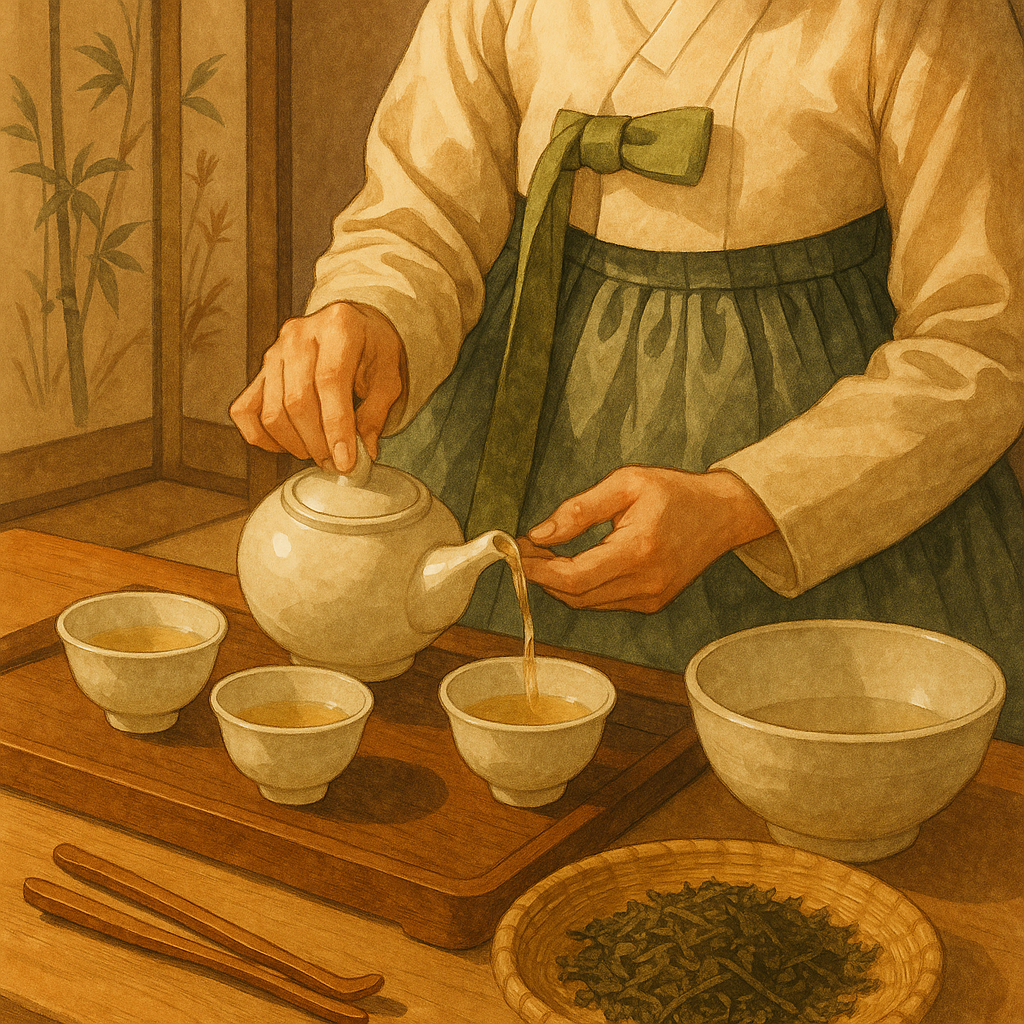
    A kettle sits over low coals in a wood-floored room, and for a full minute nobody speaks. The host watches the water, not the guests, waiting for the exact moment the bubbles turn from a hiss to a soft rolling murmur. Only then does she reach for the cups. This waiting, more than the drinking itself, is the first thing you notice about darye, Korea’s traditional way of tea.

    Not Japan’s Chanoyu, Not China’s Gongfu Cha

    It’s tempting to lump all Asian tea rituals together, but darye follows its own logic. Where Japanese chanoyu is built on precise, almost theatrical choreography, and Chinese gongfu cha centers on repeated short infusions poured over a tightly packed clay pot, Korean darye leans toward restraint and naturalness, a value Koreans call jayeon.

    There is no single fixed script that every host must follow. Movements are unhurried and quiet rather than performed, and the emphasis falls less on technical mastery than on the mood created between host and guest, a concept rooted in jeong, the warmth of genuine care for another person.

    Roots in Temples and Scholars’ Studies

    Tea drinking in Korea traces back to contact with continental Buddhist culture, when monks began cultivating tea for use in temple offerings and quiet contemplation. Over centuries, tea moved from monastery gardens into the daily life of Confucian scholars, the seonbi, who found in tea preparation a discipline for cultivating a calm, upright mind.

    Photo by Sergey N on Unsplash

    By the nineteenth century, Korean tea culture had faded in many households, kept alive mainly in temples. The Buddhist monk Chosun Uisun helped revive it, writing “Dongdasong,” a poem-essay praising Korean tea and arguing that the spirit of tea and the spirit of Zen practice were one and the same. His writing is still cited today whenever Koreans talk about what makes their tea culture distinct.

    The Leaves Themselves

    Korean green tea is graded by when the leaves are picked, not by variety alone. Ujeon, harvested before the spring rains, produces a pale yellow-green liquor with a faint sweetness and almost no bitterness. Sejak and jungjak, picked slightly later, give a fuller body and a grassier, more vegetal cup.

    Two regions dominate Korean tea farming: Boseong, with its terraced hillsides in South Jeolla province, and Hadong, along the Seomjin River, where wild tea bushes have grown on steep slopes for generations. Water temperature matters here more than in most tea traditions; Korean green tea is typically brewed cooler than boiling, around 60 to 70 degrees Celsius, to avoid scorching the leaf and to protect its natural sweetness.

    Photo by zero take on Unsplash

    A Room Built for Quiet

    The setting matters as much as the tea. A traditional darye room uses a low wooden table called a dawon, floor cushions, and sliding doors covered in hanji, the translucent mulberry paper that softens sunlight into a warm, even glow.

    Cups and pots are often celadon, the pale jade-green glazed pottery Korea has produced since the Goryeo period, its surface sometimes etched with cranes or willow branches under the glaze. The room stays sparse on purpose. Nothing competes with the sound of water or the color of the tea in the cup.

    The Unspoken Rules of the Table

    Guests are served before the host, and cups are offered and received with both hands, a small gesture of respect rather than casual habit. A slight bow of the head, not a deep bow, acknowledges the pour.

    Nobody rushes to drink immediately. The pause before the first sip lets the guest notice the tea’s color and aroma, and it signals attentiveness to the host’s effort. These small courtesies come from

    In the quiet space between pouring and receiving, tea becomes a language of respect.
  • Finding Beauty in Imperfection: Wabi-Sabi Minimalism for Your Home

    Photo by Glauco Zuccaccia on Unsplash

    The Chip in the Mug You Never Threw Away

    There’s a mug in my cupboard with a hairline crack running from the rim down toward the handle. It doesn’t leak, not yet, but every time I pour tea into it, the crack catches the light and reminds me it’s been dropped, used, forgiven. I could replace it. I haven’t.

    That small, stubborn attachment to an imperfect object is close to what Japanese aesthetics call wabi-sabi. It’s not a design trend you can shop for in a single afternoon. It’s a way of looking at things that have weathered, faded, or cracked, and finding them more honest for it.

    Where the Words Come From

    Wabi originally described the quiet melancholy of solitude, a rustic simplicity found in modest, unadorned surroundings. Sabi referred to the beauty that emerges as objects age, the patina on bronze, the moss creeping over a stone lantern, the silvering of unfinished wood left out in the rain.

    Over centuries, these two ideas merged and were shaped deeply by Zen Buddhism, particularly through the tea ceremony tradition associated with the tea master Sen no Rikyu. Rikyu favored rough, hand-shaped tea bowls over polished Chinese porcelain, and small, unadorned tea rooms over grand halls. His preference wasn’t poverty for its own sake; it was a deliberate turn away from display and toward presence.

    This history matters because wabi-sabi isn’t decoration layered onto a room. It grew out of a spiritual practice concerned with impermanence, the Buddhist idea that nothing lasts and that trying to freeze things in a flawless state is a kind of suffering. A cracked bowl, in that light, isn’t a failure. It’s evidence of time passing honestly.

    Not the Same as “Minimalist” Instagram Rooms

    It’s worth separating wabi-sabi from the crisp, all-white minimalism that’s become a design cliché online. That look often prizes newness disguised as simplicity, glossy surfaces, matching furniture, nothing out of place.

    Photo by Vatsal Tyagi on Unsplash

    Wabi-sabi minimalism tolerates asymmetry, uneven edges, and visible signs of handwork or age. A shelf doesn’t need to be spotless plywood painted white; it can be a single slab of unvarnished cedar with a knot in the grain left exposed. The point isn’t emptiness for its own sake, but removing what’s unnecessary so the few remaining things, worn as they are, can be seen clearly.

    What It Actually Looks Like in a Room

    Walk into a home shaped by this sensibility and you’ll notice texture before color. Walls might be finished in rough plaster instead of smooth paint. Floors are often unlacquered wood that darkens and dents over years of bare feet crossing them.

    Ceramics are rarely a matched set. A tea cup might have a slightly uneven lip because it was thrown by hand, its glaze pooling darker in one spot than another. Natural materials dominate: linen that wrinkles, paper screens that yellow slightly with sunlight, iron kettles that develop rust-colored patches with use.

    Light plays a quiet role too. Rooms are often kept dim compared to Western interiors, lit by a single low lamp or the filtered glow through a shoji screen rather than overhead fixtures. Shadows are allowed to stay, not chased out of every corner.

    The Discipline of Leaving Things Alone

    One of the harder parts of this philosophy, especially for anyone used to renovating or upgrading, is resisting the urge to fix everything. A wooden table that’s scarred with water rings from decades of teacups isn’t sanded down and refinished. The marks stay, because they’re part of the object’s history.

    Photo by jack berry on Unsplash

    This requires a kind of restraint that goes against most modern home advice, which usually pushes toward “before and after” transformations. Wabi-sabi asks you to sit with the “after” that just keeps aging, without rushing to intervene.

    Bringing This Into a Home That Isn’t in Kyoto

    You don’t need a traditional Japanese house to work with this idea, but you do need to change what you reach for when something in your home shows wear. Instead of replacing a scratched wooden cutting board, oil it and keep using it.

    Choose one or two handmade ceramic pieces, a bowl or a cup with a slightly irregular shape, and use them daily rather than saving them for guests. Let a linen curtain wrinkle instead of ironing it flat. If you have houseplants, resist deadheading every fading leaf immediately; a slightly drooping branch has its own quiet shape.

    Pare down what’s on display, not to achieve a sterile look, but so the objects you keep, worn as they are, actually get noticed instead of disappearing into visual clutter.

    Try This Tonight

    Pick one object in your home that you’ve been meaning to replace simply because it’s chipped, faded, or scuffed, a mug, a cutting board, a wooden stool. Instead of setting it aside, use it tonight exactly as it is, and notice what the wear actually looks like up close.

    If you want to go a step further this week, visit a local pottery studio or a shop that sells handmade ceramics rather than a big-box store, and choose one imperfect piece, uneven glaze, a slightly off-center shape, to bring into your daily routine. Living with it, rather than reading about it, is where wabi-sabi actually starts to make sense.

    Wear is not damage to hide, but a life quietly recorded on the surface of things we use.