[카테고리:] Home Decor

  • Why Japanese Kitchen Tools are Designed for Small Spaces

    A Kitchen the Size of a Closet

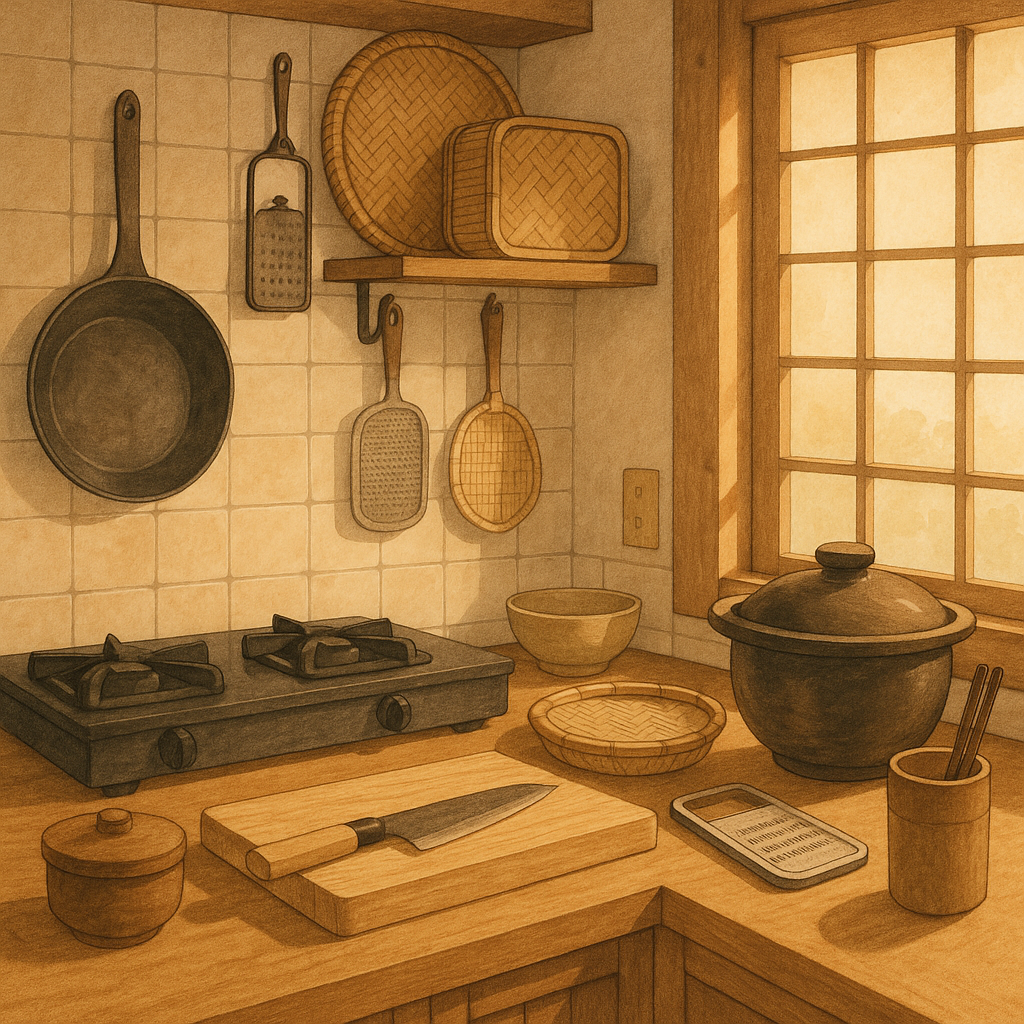
    Stand in a typical Tokyo apartment kitchen and you can touch both walls without stretching. The stove has one burner, sometimes two. The sink is barely wide enough to fit a dinner plate sideways.

    And yet, somehow, a full meal comes out of that space: grilled fish, simmered vegetables, miso soup, steamed rice. The secret isn’t magic. It’s in the tools themselves, which are built from the ground up to work inside four square meters, not despite them.

    Why Japanese Kitchens Got So Small

    Japan’s urban housing crunch didn’t happen overnight. Cities like Tokyo and Osaka grew dense over centuries, with land scarcity pushing homes to build upward and inward rather than outward. After the mass apartment developments of the postwar decades, known as danchi, kitchens were often tucked into a single corner of a one-room or 1K layout.

    Traditionally, even rural Japanese homes kept cooking areas modest. The daidokoro, or kitchen, was typically a work area near an entrance, organized around a single hearth or a compact wood-and-charcoal stove called a kamado. Efficiency wasn’t a design trend; it was a daily necessity passed down through generations of cooks who never had extra room to spare.

    One Tool, Several Jobs

    Walk through Kappabashi, Tokyo’s kitchenware district, and you’ll notice how few single-purpose gadgets are on the shelves. A suribachi, the ridged ceramic mortar used for grinding sesame seeds, doubles as a mixing bowl and a serving dish for dressed vegetables. Its wooden pestle, the surikogi, is often carved from sansho wood specifically because the grain holds up under repeated grinding.

    The otoshibuta, a drop-lid used in simmered dishes like nikujaga, is another example. It’s a plain wooden disc, slightly smaller than the pot it sits in, but it does the job of holding ingredients submerged, distributing heat evenly, and reducing liquid, all without a dedicated appliance. A single donabe clay pot can go from stovetop to table, then double as serving ware, cutting down on dishes that need washing in a sink barely bigger than a shoebox.
    Everything Nests, Stacks, or Hangs

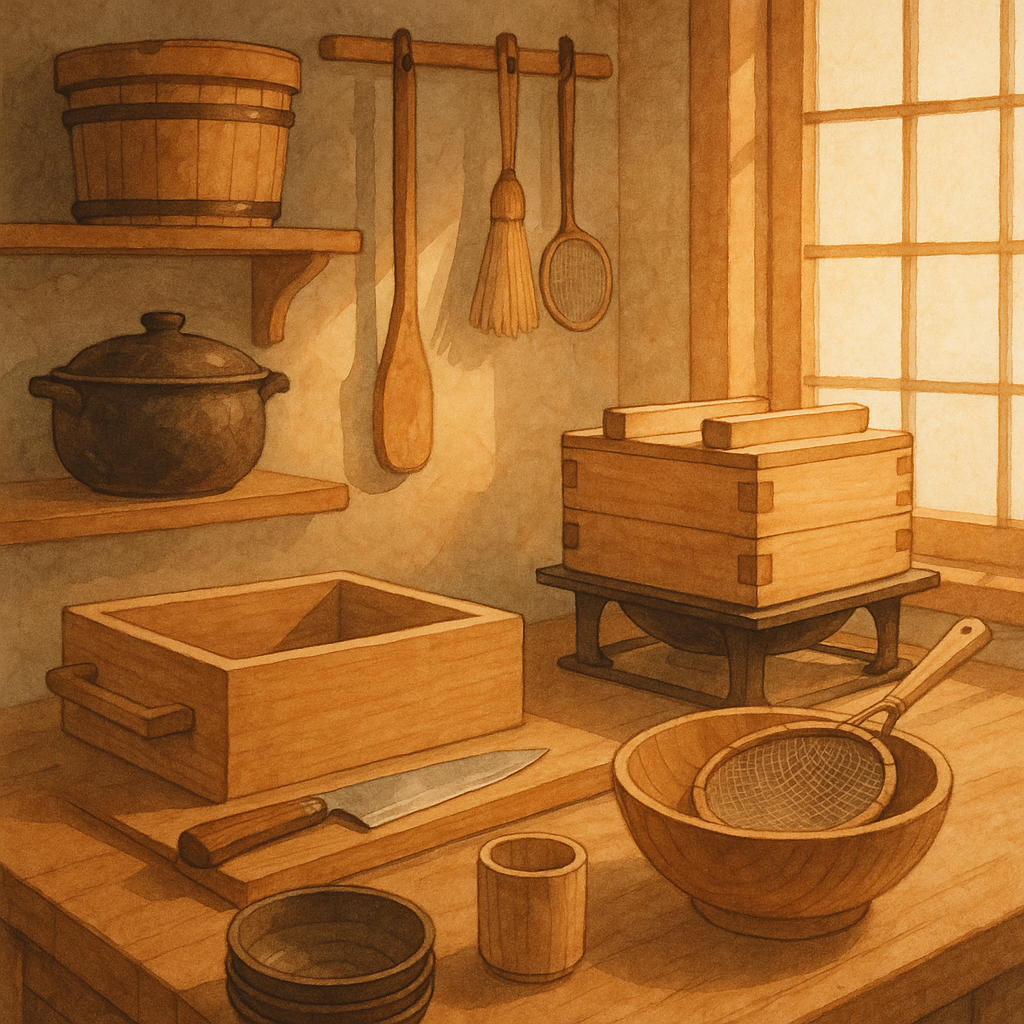
    Japanese steamer baskets, made of woven bamboo, are sized to sit directly on top of a wok or pot rather than requiring their own base. Several layers stack on top of each other, so you can steam dumplings, vegetables, and buns simultaneously using the steam from one pot of boiling water below.

    Storage follows the same stacking logic outside of cooking too. Nesting mixing bowls, called bousai, tuck into one another by size, and flat bamboo colanders called zaru hang from a single nail rather than taking up shelf space. Even the manaita, the wooden cutting board, is often designed to lean upright in a narrow gap between the counter and the wall, drying vertically instead of lying flat and eating into precious surface area.

    The Knife Drawer That Isn’t a Drawer

    Most Japanese kitchens skip the bulky knife block entirely. Instead, a single well-balanced knife, often a santoku or nakiri, does the bulk of the work: slicing, dicing, and mincing with one blade instead of five.

    That knife is frequently stored on a magnetic strip mounted to the wall above the counter, keeping the one precious surface clear for actual food prep. It’s a small choice, but in a kitchen where counter space might only be sixty centimeters wide, every centimeter reclaimed matters.

    Cooking with Fire, Carefully Contained

    The portable konro, a small tabletop grill traditionally fueled by charcoal, reflects another piece of this puzzle: heat sources in Japan have long been treated as temporary, moveable things rather than fixed installations. Instead of a large built-in oven, many households rely on a fish grill built directly into the stove, a narrow drawer-like compartment just wide enough for a single mackerel or two rounds of grilled onigiri.

    Photo by Clay Banks on Unsplash

    This isn’t a downgrade from a Western oven. It’s a different assumption about what a kitchen needs to do. Rather than roasting a large tray of food at once, the fish grill is built for cooking exactly enough for the people eating that night, no more, no less.

    What This Teaches About Small-Space Cooking

    The underlying philosophy here isn’t about giving something up. It’s about designing around actual daily use instead of theoretical maximum capacity. A suribachi that also serves food, a lid that doubles as a heat regulator, a knife strip that frees up counter space, these are all decisions made by people who cooked in tight kitchens for generations and refined their tools accordingly.

    That’s a useful lesson even for kitchens that aren’t physically small. Fewer tools, chosen for versatility, often mean less clutter and less decision fatigue when you’re actually cooking dinner after a long day.

    Try This in Your Own Kitchen

    Pick one drawer in your kitchen this week and count how many single-purpose gadgets sit inside it, things like an avocado slicer or an egg separator. Replace two of them with one multi-use tool: a suribachi and pestle if you already grind spices, or a wooden otoshibuta sized to fit your most-used pot.

    If you’re near a city with an Asian grocery or import store, look specifically for a bamboo steamer basket that fits the diameter of a pot you already own. Using it for even one meal this week, stacking vegetables over rice as it cooks, will show you exactly how much a single well-chosen tool can replace.

    A smaller kitchen thinks clearly when each tool earns its place through many uses, not one.

  • The Glowing Legacy: How Chinese Lantern Festivals Illuminate Modern Home Design

    Photo by H&CO on Unsplash

    The Water Remembers the Light First

    Along the Qinhuai River in Nanjing, the surface turns the color of embers once the sun drops behind the old city wall. Strings of red silk lanterns sway from eaves and stone bridges, and their reflections stretch and ripple across the black water like something spilled rather than lit. Vendors sell grilled hawthorn skewers nearby, the sugar coating cracking audibly with each bite, while paper lanterns overhead creak faintly in the river wind.

    It’s a scene that has little to do with spotlights or dimmer switches, yet it explains something many interior designers have been chasing for years: light that feels warm without trying too hard. That quality — soft, uneven, slightly imperfect — is exactly what modern homes have been borrowing from Chinese lantern festivals, often without naming the source.

    A Festival Built Around Fifteen Nights of Waiting

    The Lantern Festival, or Yuan Xiao Jie, traditionally falls on the fifteenth day of the first lunar month, closing out the Lunar New Year celebrations. Over centuries, the custom grew from a mix of agricultural ritual and Buddhist lamp-lighting practice, eventually settling into a shared civic event: families walked the streets at night, children carried small lanterns on sticks, and riddles were pasted onto lantern surfaces for passersby to solve.

    What’s worth noticing is that the lanterns were never meant to overpower the darkness. They were meant to punctuate it — small pools of light spaced along a street, each one distinct enough to be noticed individually. That spacing logic, more than the color or shape, is the part that has quietly made its way into contemporary lighting design.

    Bamboo Ribs, Rice Paper, and Why the Material Matters

    A traditional lantern is built on a skeleton of thin bamboo strips, bent and tied into a frame, then covered with mulberry paper or silk. The material choice isn’t decorative alone. Paper and silk diffuse candlelight rather than transmit it directly, which is why the light from a lantern never has a hard edge or a visible bulb.

    Photo by Arisa Chattasa on Unsplash

    This is the detail that translates most successfully into home design. Pendant lamps made with washi-style paper shades or woven bamboo cages produce the same effect: a glow with texture, rather than a flat white wash of light. Designers who understand this rarely try to make the light brighter — they try to make it softer at the boundary.

    Shapes That Carry Meaning Into a Room

    Lantern shapes are not arbitrary. Round lanterns, called yuan deng, symbolize reunion and completeness, which is part of why they dominate festival displays. Rabbit-shaped lanterns reference the moon and children’s play, while long cylindrical ones often line temple corridors and market streets in rows.

    In a living room or entryway, the round lantern form shows up as globe pendants clustered above a dining table, usually at slightly different heights rather than a single flat row. The unevenness is intentional — it echoes how real lanterns hang, never perfectly aligned, always catching a slightly different current of air.

    Where Red and Gold Actually Belong

    Cinnabar red and gold trim are the colors most associated with lantern festivals, largely because red is tied to luck and celebration in Chinese culture, while gold reflects candlelight in a way white paper alone cannot. But using both colors across an entire room tends to overwhelm a modern interior built on neutral walls and matte wood.

    Photo by zhang kaiyv on Unsplash

    A more workable approach borrows the colors selectively: a single red paper lantern in an entry hall, or gold-threaded trim on a linen lampshade near a reading chair. The rest of the palette — pale wood, unbleached cotton, soft gray — lets that one point of color do the work a whole street of lanterns once did.

    Layering Light the Way a Festival Street Does

    Walk through any lantern display and you’ll notice there’s rarely a single light source. Low lanterns line the ground, mid-height ones hang from stalls, and taller structures glow from rooftops — three layers working at once, none of them dominant.

    Home lighting benefits from the same layering. A paper pendant overhead, a woven rattan floor lamp in a corner, and a small votive-style candle lantern on a side table together create depth that a single ceiling fixture never can. The goal isn’t more light; it’s light arriving from more directions at once, so no single shadow falls too hard.

    What to Actually Look For

    Authentic lanterns — bamboo-framed, hand-pasted paper — are still sold in Chinatown markets in the weeks before Lunar New Year, and increasingly through small sellers online who specialize in traditional craft rather than mass-produced plastic versions with printed patterns. The bamboo ones cost more, but they hold their shape for years and the paper can be replaced when it yellows.

    If you’re rewiring one for indoor use, an LED filament bulb rated for enclosed fixtures keeps the paper from scorching, unlike a bare incandescent bulb pressed too close to the shade. It’s a small technical detail, but it’s the difference between a lantern that lasts a decade and one that browns at the seams within a season.

    Where to Start This Week

    A lantern's true worth lies not in mass-made shine, but in bamboo, paper, and patient light.