[작성자:] chaewon

  • The Woven Comfort of Japanese Tatami: Living Close to the Ground

    Photo by Se. Tsuchiya on Unsplash

    The Floor That Smells Like Summer

    Step barefoot onto a new tatami mat and the first thing you notice isn’t the texture but the smell—something between fresh-cut hay and green tea leaves. That scent comes from igusa, the soft rush grass woven into the mat’s surface, and it fades slowly over months as the mat ages into a deeper gold. Long-time users say they can tell how old a tatami room is just by breathing in.

    This is not a decorative detail. The smell signals something real about how the material works, absorbing moisture from the air in humid months and releasing it back when things dry out. Few flooring materials do this. Fewer still are replaced, resurfaced, and re-bound as part of an ordinary household rhythm rather than a renovation emergency.

    From Aristocratic Cushion to Household Floor

    Tatami traditionally began not as flooring at all, but as a portable cushion. In the Heian period, thick woven mats were laid over wooden floors for nobles to sit or sleep on, placed only where a person needed one—not covering an entire room.

    Over the following centuries, as shoin-style architecture developed among the samurai class, tatami gradually expanded to cover full floor surfaces, turning rooms into spaces defined by the mats themselves rather than furniture. By the Edo period, tatami had spread beyond the elite into merchant and commoner homes, though thickness and quality still marked social standing. What started as a seat for the privileged became, slowly, the surface an entire household lived on.

    A Room Measured in Mats, Not Meters

    Ask someone about the size of a traditional Japanese room and they won’t say square meters—they’ll say “six jo” or “four-and-a-half jo,” counting tatami mats instead. Each standard mat measures roughly 90 by 180 centimeters, and this single unit became the invisible ruler behind an entire architectural system.

    Photo by Se. Tsuchiya on Unsplash

    Room layouts followed unwritten rules too. Mats were never arranged so that four corners met at a single point—a pattern considered visually unsettling and, in some households, simply bad luck. Instead they interlocked in staggered patterns, which is why an experienced eye can glance at a floor plan and immediately sense whether it was laid out correctly.

    Woven Grass Over a Rice-Straw Core

    Underneath the smooth igusa surface, a traditional tatami mat traditionally hides a thick core of compressed rice straw, layered and stitched into a dense, springy block. The rush grass is woven tightly over this base, and the long edges are finished with a cloth border called heri, often patterned in a way that quietly indicated a household’s taste or status.

    Because the surface wears and fades with sunlight and foot traffic, households historically had it redone in stages: flipping the mat, then replacing just the woven surface, and only after years of use replacing the entire core. This process, called omote-gae, meant a single tatami mat could remain in a family’s home for decades, renewed layer by layer rather than thrown away.

    Living Low: Posture, Sleep, and Distance from the Ground

    A room floored entirely in tatami changes how a body moves through it. Shoes come off at the entrance without discussion, and sitting shifts from chairs to the floor itself, often in seiza, knees folded beneath the body, weight settled directly onto the woven surface.

    Photo by Clay Banks on Unsplash

    At night, a futon unrolls straight onto the tatami rather than onto a raised bed frame, and by morning it folds away into a closet, freeing the same square meter of floor to become a sitting room again. Furniture in these spaces tends to sit low—a chabudai table barely knee-height, cushions instead of chairs—because everything is designed around a body that spends real time close to the ground, not several feet above it.

    Where Tatami Fits Into a Modern Apartment

    Most contemporary Japanese homes are floored in wood or vinyl, but many still keep one washitsu—a single tatami room—tucked among otherwise Western-style rooms. It might serve as a guest space, a place to lay out a futon for visiting relatives, or simply a corner where someone kneels to arrange flowers or fold laundry.

    Caring for that one room follows old habits in miniature: keeping direct sunlight off the mats to slow fading, airing the room on dry days to prevent mold in humid seasons, and never dragging furniture legs across the surface. It’s a small maintenance ritual, but it’s also one of the few places in a modern apartment where a resident still negotiates directly with a living, breathing material underfoot.

    Try It in Your Own Space

    You don’t need a full washitsu to feel any of this. A single tatami cushion, or a small rush-mat rug placed under a low table, is enough to notice the difference—the give underfoot, the faint grassy smell in the first weeks, the way sitting on the floor changes how long you linger in a room. Buy one, place it somewhere you already sit, and spend a week noticing what changes about how you use that corner of your home.

    To live on tatami is to let the floor itself decide how close to the ground your life should be.

  • The Layered Warmth of Japanese Kotatsu: Gathering Around Winter’s Heart

    Photo by Susann Schuster on Unsplash

    The Table That Swallows You Whole

    Your knees hit fabric before your eyes adjust to the dim orange glow underneath. Someone’s grandmother has already claimed the spot closest to the heating unit, and nobody argues about it. The quilt drapes over your lap like a second skin, and within minutes you understand why Japanese families sometimes eat, nap, and watch television without ever standing up.

    This is the kotatsu experience—a low table with a heat source underneath, blanketed by a thick futon-like cover, topped with a wooden surface for tea cups and mikan peels. It sounds simple. It isn’t, not once you’re actually inside one.

    Charcoal Beginnings, Electric Present

    The kotatsu traces back to the Muromachi period, when households would dig a small pit into the floor and place a charcoal heater inside it, called an irori. A wooden frame went over the pit, and a blanket draped over the frame to trap the rising heat.

    People didn’t sit at this early kotatsu so much as dangle their legs into it, feet dropping into the warm pit below floor level. Traditionally, this design suited homes without central heating, where warming an entire room wasted precious fuel. Why heat empty air when you could heat the people directly?

    By the twentieth century, the pit design gave way to the “oki-gotatsu,” a freestanding table version that didn’t require cutting into the floor. Electric heating elements eventually replaced charcoal entirely, removing the carbon monoxide risk that had quietly ended more than a few lives over the centuries. What remained constant was the core idea: concentrate the heat where the body actually sits.

    The Physics of Staying Put

    A kotatsu heater typically sits mounted to the underside of the tabletop, radiating downward into the enclosed space created by the blanket. Because the quilt traps warm air rather than letting it escape into the room, the temperature under the table can feel ten or fifteen degrees warmer than the air just outside it.

    Photo by Masaaki Komori on Unsplash

    This creates a specific kind of laziness that has its own vocabulary in Japanese homes. Once you’re in, sliding out to grab something from the kitchen requires genuine willpower. The cold air waiting beyond the blanket’s edge feels almost hostile by comparison.

    Many families position the television, the snacks, and sometimes even a laptop within arm’s reach of the kotatsu precisely because leaving isn’t really part of the plan for the evening.

    Mikan, Naps, and the Sound of Nothing

    Winter in a kotatsu household has a texture to it. Someone peels a mikan and the citrus oil hits the air just as the heater hums quietly below. A cat—there is almost always a cat—claims the warmest corner without permission.

    Conversation slows down under a kotatsu in a way it doesn’t at a regular dining table. Nobody’s rushing to clear plates and move to the couch, because you’re already exactly where you want to be. Silence stretches comfortably between sentences instead of feeling like something to fill.

    It’s common to find someone asleep with their upper body slumped forward, head resting on folded arms, legs still warm beneath the blanket. This half-nap has become such a recognizable image that it shows up constantly in anime and manga as visual shorthand for domestic winter comfort.

    Photo by Clay Banks on Unsplash

    A Design Object Hiding in Plain Sight

    What’s easy to miss is how much the kotatsu shapes the actual layout of a room. Furniture arranges itself around this low table the way a fireplace once organized a Western living room—except here, everyone sits on the floor or on cushions, at the same eye level, facing inward.

    There’s no head of the table in a kotatsu arrangement. The circular, communal seating flattens hierarchy in a small but noticeable way, putting grandparents and children at the identical height, sharing the identical warmth.

    Contemporary versions have adapted to smaller apartments and modern tastes—slimmer profiles, adjustable heat settings, covers in patterns that would have been unrecognizable a century ago. The core mechanism, though, a heater under a blanketed table, hasn’t needed reinventing.

    Try This Tonight

    You don’t need an authentic kotatsu to borrow the idea behind one. Tonight, instead of turning up the thermostat for the whole apartment, try heating just your immediate space: a heating pad under a thick blanket over your lap, a warm drink close by, your phone or a book within reach so you have no reason to get up.

    Turn the lights down low, skip the overhead lighting entirely if you can. Notice how differently a room feels when the warmth is personal rather than ambient—when it wraps around you specifically instead of just filling the air around everyone.

    Warmth shared under one blanket lingers longer than heat that simply fills a room.

  • The Balanced Bite: How Chinese Culinary Philosophy Shapes the Art of the Meal

    Photo by Aditya Romansa on Unsplash

    A Table With No Beginning

    Picture a round table in Chengdu: a clay pot of mapo tofu, a plate of stir-fried greens slicked with garlic, a whole steamed fish, and a bowl of plain rice, all set down within minutes of each other. No one waits for a “first course.” Chopsticks reach across the table, not down a timeline.

    This isn’t casual disorder. It’s a different logic of eating entirely, one where a meal is judged not dish by dish but as a single, balanced composition.

    Where the Idea of Balance Comes From

    The roots of this thinking trace back to yin-yang cosmology and the theory of the Five Elements, ideas that traditionally took shape during the Warring States period and later fused with medical texts on food and the body. Cooling foods and warming foods, moistening textures and drying ones, were mapped much like symptoms and remedies.

    By the time of the Tang and Song dynasties, this framework had settled firmly into kitchen practice, not just medical theory. A cook wasn’t just seasoning for taste; they were adjusting a private ecosystem inside the diner.

    That’s why watermelon appears at the end of a summer meal heavy with fried food, or why ginger turns up in dishes built around crab, considered “cooling” in traditional food logic. The pairing isn’t decorative. It’s corrective.

    Five Flavors, Not One Star

    Chinese culinary theory traditionally names five core flavors: sour, bitter, sweet, pungent, and salty. A well-built dish, or better, a well-built meal, doesn’t chase one flavor to its extreme. It moves between them.

    Photo by zhang kaiyv on Unsplash

    Sweet and sour pork works because the sweetness never fully wins; vinegar keeps cutting back in. A meal of only rich, oily dishes feels unfinished without something sharp, sour, or plain to reset the palate, which is exactly why a clear broth or pickled vegetable so often appears alongside heavier plates.

    The goal isn’t intensity. It’s rotation, so the tongue never settles into monotony and the stomach never feels overwhelmed by any single quality.

    Texture Is Its Own Language

    Ask a home cook in Guangdong what makes a dish good, and taste might be only half the answer. The other half is kou gan, mouthfeel: the snap of a water chestnut, the slither of glass noodles, the give of slow-braised pork skin.

    A meal with only soft textures, congee, tofu, steamed egg, reads as flat even if every dish tastes fine on its own. So a crunchy stir-fried vegetable or a crisp-skinned piece of duck gets slotted in, not for contrast’s sake alone, but because texture is treated as seriously as flavor in the overall arithmetic of the meal.

    This is part of why Chinese cooking uses so many techniques side by side within one sitting, steaming, deep-frying, blanching, slow-braising, rather than committing an entire meal to a single method.

    Photo by Arisa Chattasa on Unsplash

    Rice as the Quiet Anchor

    Amid all this movement between flavors and textures, plain rice or a simple noodle dish often sits at the center, deliberately understated. It isn’t there to impress. It’s there to hold everything else in proportion, soaking up sauce, tempering spice, giving the palate a neutral space to return to.

    In many regions, a meal is still considered incomplete without this starch, no matter how many other dishes crowd the table. The elaborate dishes exist in orbit around it, not the other way around.

    What This Looks Like on a Real Weeknight

    None of this requires a banquet. A home cook making dinner for two might pair a quick stir-fry of bok choy with a simmered soup and rice, instinctively covering warm and cool, soft and crisp, without ever naming the theory behind it.

    That’s the real inheritance of this culinary philosophy: it’s less a rulebook than a set of reflexes, absorbed at family tables long before anyone reads a word about yin and yang.

    Try It At Your Own Table Tonight

    Next time you cook, resist plating one dominant dish. Set out something crisp beside something soft, something plain beside something bold, and let them share the table at the same time rather than arriving in sequence.

    Notice how differently a meal feels when it’s built as a small, balanced system instead of a single showpiece. That shift in attention is the whole philosophy, already at work on your own plate.

    A meal isn't a single dish done well, but many small tensions held in balance.

  • The Delicate Art of Korean Norigae: Ornamental Knots as Wearable Poetry

    Photo by Khanh Do on Unsplash

    A Grandmother’s Jewelry Box in Insadong

    Last autumn, an antique dealer in Seoul’s Insadong district unrolled a strip of faded silk on his counter, and inside sat three norigae the color of dried persimmon and jade. He wouldn’t sell them. “These traveled through three generations of women who never met each other,” he said, “but they all tied the same knot before leaving the house.”

    That single sentence stuck with me longer than any museum placard could have. A norigae is not simply decoration. It is a small, knotted sentence passed from hand to hand.

    What Exactly Hangs From a Hanbok

    A norigae is a traditional Korean ornament, typically fastened to the goreum (the ribbon tie) of a hanbok or to a skirt band. It usually consists of three parts: a decorative head made of jade, coral, amber, or metal; a body of tightly woven silk knots called maedeup; and a tassel, known as sul, that swings loose at the bottom.

    Unlike a brooch pinned once and forgotten, a norigae moves with the wearer. It sways when she walks, catches light when she bows, and settles when she sits still.

    Every part carries intention. The material of the head might signal rank or family wealth, the knot pattern might carry a wish for long life or many children, and the tassel color often matched the season or the occasion.

    Knots That Were Never Meant to Be Read Casually

    The knotting technique itself, maedeup, traditionally developed as a broader craft used for everything from Buddhist ritual objects to musical instruments. Applied to norigae, it became something more intimate.

    Each knot has a name and a fixed number of loops: the “flower knot,” the “butterfly knot,” the “strawberry knot.” Skilled artisans could tie dozens of variations, but the vocabulary itself stayed within a recognized tradition, passed down through apprenticeship rather than written instruction.

    What makes this craft demanding is not complexity for its own sake. A single misplaced loop changes the knot’s symmetry entirely, and there is no way to hide a mistake in silk cord pulled taut.

    Photo by Clark Gu on Unsplash

    Worn by Queens, Copied by Commoners

    Historically, norigae were most elaborate within the royal court, where the thickness of silk, the rarity of the gemstone, and the intricacy of the knot indicated a woman’s status. Court records and surviving textile fragments suggest that certain colors and materials, like coral or gold-threaded knots, were traditionally reserved for royal or noble households.

    Commoner women, however, still wore simpler versions made from cotton thread and inexpensive stones. The ornament wasn’t only about wealth display; it also carried protective symbolism, since certain shapes were believed to ward off misfortune or invite good luck for a marriage, a birth, or a long journey.

    This dual life, precious in the palace and humble in the countryside, is part of why norigae survived as a living tradition rather than a museum relic exclusive to the elite.

    Reading the Symbols Without a Translator

    A butterfly-shaped norigae traditionally suggested a wish for marital happiness. A gourd shape often symbolized abundance, since gourds produce many seeds. Bats, oddly enough to Western eyes, represented good fortune in Korean symbolic language, appearing on norigae meant as gifts for new mothers or brides.

    None of this was arbitrary. Women who could not always speak freely about their hopes for their families found a quiet outlet in what they chose to wear at their waist.

    In this sense, norigae functioned like folded letters that never needed to be opened to be understood by those who shared the same visual language.

    Why the Craft Nearly Disappeared

    Through the twentieth century, as hanbok gave way to Western-style clothing in daily life, norigae lost their everyday function. Fewer women needed an ornament that only made sense attached to a goreum tie that no longer existed in ordinary wardrobes.

    Photo by Elliot Gouy on Unsplash

    The craft persisted mainly through hanbok rental shops for weddings, museum conservation efforts, and a small number of maedeup masters who kept teaching students privately. Several of these artisans have since been recognized as holders of Intangible Cultural Heritage status, a designation meant to keep hand-knotting alive as a documented skill rather than a lost one.

    What saved norigae from disappearing entirely was, ironically, its uselessness in daily fashion. Precisely because it wasn’t needed, it became something people sought out deliberately, as a way to mark a wedding, a first birthday celebration (dol), or a formal ceremony.

    Trying One On Feels Different Than Looking at One

    Photographs flatten norigae into flat ornaments, but holding one changes the impression completely. The silk cord has a particular tension, tighter than typical decorative rope, and the tassel has real weight that makes it swing rather than dangle.

    When I finally tied one to a bag strap, just to see how it moved, I noticed how the knot caught slightly on fabric each time I turned, a small resistance that felt oddly satisfying. It behaves less like jewelry and more like a small, animated companion.

    That tactile quality is easy to miss until you’re the one wearing it, which may explain why so many people who encounter norigae only in photos assume it’s purely visual.

    Bringing a Small Piece of This Into Your Own Life

    You don’t need a hanbok to start noticing norigae. Search for maedeup workshops, many Korean cultural centers abroad now offer beginner knot-tying classes using the same basic techniques.

    Or simply visit a museum collection online, several Korean national museums have digitized close-up photographs of norigae from their textile archives, and look closely at how the knots repeat and vary.

    If you find yourself near an actual hanbok specialty shop, ask to hold a norigae rather than just look at it through glass. The weight in your palm will tell you something the display case never could.

    A norigae is a wish, knotted tight enough to survive being worn.

  • The Silent Language of Chinese Window Lattices: Geometry as Cultural Expression

    Photo by 一只猫的橘 on Unsplash

    A Hexagon That Refuses to Repeat

    Stand under a lattice window in an old Suzhou courtyard and look up. What seems like one pattern from the street splits, on closer inspection, into three or four overlapping geometries—hexagons nested inside diamonds, diamonds bleeding into a key-fret border.

    Nothing about this is accidental. Every angle was cut by hand, and the carpenter who made it likely never wrote down why he chose that particular turn.

    This is the puzzle at the heart of Chinese window lattices: they look decorative, but they were never meant to be merely pretty.

    Wood That Was Never Just Structural

    Traditionally, lattice windows—known as chuanghua or, in more elaborate garden architecture, as bingjiao chuang—served a practical function first. Paper or thin silk was glued behind the wooden grid to filter light while keeping out wind, since glass remained rare and costly in most of China until relatively late in its architectural history.

    The wood itself had to breathe with the humidity of the region, so builders favored fine joinery over nails, letting mortise-and-tenon joints flex slightly with the seasons. This is why so many surviving lattices, especially in the humid south, still hold together after centuries without a single metal fastener.

    But somewhere between necessity and craft, the grid stopped being just a window and became a sentence.

    Geometry as Vocabulary, Not Decoration

    Look closely and you’ll notice the shapes recur with intention. A hexagonal lattice often echoes the tortoise shell—a symbol of longevity in Chinese cosmology—while a swastika-like motif, the wan character, was drawn from Buddhist iconography and repeated to suggest the number ten thousand, meaning boundless fortune.

    The key-fret pattern, that continuous unbroken line turning back on itself, was believed to represent an uninterrupted flow of good luck. Cut the line, and superstition held that you’d cut the luck too.

    Photo by 一只猫的橘 on Unsplash

    None of these patterns were chosen at random by the carpenter. Pattern books circulated among craftsmen, and clients—especially wealthy merchant families—would specify which motifs they wanted worked into their windows, the way someone today might choose a font for a wedding invitation.

    Reading a Courtyard Like a Room-by-Room Diary

    In a traditional siheyuan courtyard house, not every window carried the same pattern, and that variation wasn’t just aesthetic variety. The lattice above a study might lean toward plum blossom motifs, associated with scholarly resilience through winter, while the window of a young daughter’s chamber might feature bats—chosen not for their nocturnal reputation but because the word for bat, fu, sounds identical to the word for fortune.

    Visitors literate in this visual language could walk through a home and understand, without asking, which room served what purpose and what the family valued. It functioned almost like signage, except the signs were riddles built from puns and symbols rather than words.

    This layered meaning is easy to miss now, since most of us walk past lattice windows the way we walk past patterned fences—background texture rather than text.

    Why the South and North Speak Different Dialects

    Travel from a Beijing courtyard to a Suzhou garden and the lattice grammar shifts noticeably. Northern lattices, shaped by colder winters and thicker paper coverings, tend toward bolder, simpler geometric repetition—straight lines, larger hexagons, less fragile detail that could survive frost and wind.

    Southern gardens, especially those built by Ming and Qing dynasty scholar-officials in the Jiangnan region, indulged in far more intricate, curvilinear lattice work, sometimes incorporating clouds, waves, or even miniature landscapes into the grid itself. The milder climate allowed for thinner, more delicate cuts of wood that would have splintered further north.

    So the same cultural vocabulary produced two very different accents, shaped as much by climate as by regional taste.

    Photo by Arisa Chattasa on Unsplash

    What Survives, and What We’re Losing

    Many original lattice windows didn’t survive the twentieth century—wars, demolition, and decades of urban renewal took a heavy toll on old courtyard houses across Chinese cities. What remains today is often in restored gardens like those in Suzhou or in a scattering of preserved village homes in Anhui and Fujian provinces.

    Contemporary architects occasionally borrow the geometric logic of these lattices for modern facades, though usually stripped of the symbolic meaning that once justified every angle. The pattern survives; the reading of it often doesn’t.

    That loss matters more than it might seem, because a lattice window without its meaning is just a nice-looking screen.

    Try This the Next Time You See One

    Next time you come across a Chinese lattice window—in a museum photo, a restaurant interior, or an actual garden—resist the urge to just admire the symmetry. Look for repetition: is there a hexagon, a fret line, a flower shape appearing more than once?

    Ask what that specific shape might have meant to the person who commissioned it, rather than assuming it’s just visual rhythm. Even a quick search on symbols like the bat, the plum blossom, or the key-fret pattern will start to translate the design into something closer to its original intent.

    You don’t need to read Chinese to start reading a window. You just need to stop looking past it.

    A window is where a house first learns to speak without saying a word.

  • The Meditative Craft of Japanese Suminagashi: Painting with Water and Ink

    Photo by The Walters Art Museum on Unsplash

    The Ink That Refuses to Sit Still

    Drop a bead of sumi ink onto a basin of plain water and watch what happens. It doesn’t dissolve — it spreads into a thin, trembling ring, then goes still, waiting.

    Breathe on it, or wave a fan an inch above the surface, and the ring buckles into a marbled swirl. This is suminagashi, literally “ink floating,” and the entire craft depends on a substance that never quite belongs to you.

    You can nudge the pattern. You cannot dictate it.

    A Practice Born at the Water’s Edge

    Suminagashi is traditionally traced to the Heian period, when court poets and calligraphers used the technique to decorate paper for waka poems and personal correspondence. The rippled backgrounds gave handwritten verses a shifting, watery frame — appropriate for poetry obsessed with seasons and impermanence.

    Some historians connect the practice to Shinto purification rites performed near rivers and shrines, where the movement of water itself was treated as something sacred, not merely decorative. Whether or not that lineage is exact, the reverence for water as an active participant — not a passive canvas — runs through every account of the craft.

    Centuries later, versions of this floating-ink method reportedly traveled along trade routes and shaped European paper marbling traditions, though the two crafts developed distinct visual languages. In Japan, suminagashi stayed close to its original restraint: black and occasionally indigo ink, thin washi paper, and almost nothing else.

    The Materials Are Almost Suspiciously Simple

    A shallow tray of water. A stick of sumi ink, ground slowly against an inkstone until the liquid thickens just enough to float. A bamboo brush, sometimes two — one for ink, one for a drop of surfactant like diluted nori paste that pushes the ink outward into rings.

    Photo by Niketh Vellanki on Unsplash

    That’s the whole toolkit. No stencils, no resist, no plan sketched in advance.

    The paper — usually washi, thin enough to absorb the pattern in a single controlled touch — gets lowered onto the water’s surface for two or three seconds, then lifted immediately. Wait too long and the ink sinks unevenly. Lift too fast and the paper never fully kisses the pattern at all.

    Why It Feels Like Meditation and Not Decoration

    Anyone who has tried suminagashi will tell you the same thing: the moment your mind wanders, the ink knows. A shaky breath creates jagged rings instead of smooth ones. An impatient exhale collapses the pattern into a muddy blur.

    The craft doesn’t reward force. It rewards attention — steady, unhurried, almost sensory attention to the tiny surface tension shifts happening a few inches from your face.

    Practitioners often describe entering a narrowed state of focus similar to seated meditation, except the “object” of concentration is external and constantly moving. You’re not calming your mind by shutting the world out; you’re calming it by matching your breath to something outside yourself that won’t wait for you to catch up.

    This is also why no two suminagashi prints are ever identical, even when made by the same hand in the same sitting. The water carries a memory of your breath, your ink’s viscosity that particular day, the humidity in the room. The pattern is a record of a single unrepeatable moment, not a technique you can fully standardize.

    Photo by Clay Banks on Unsplash

    What the Finished Pattern Actually Looks Like

    Classic suminagashi rarely produces bold, graphic shapes. Instead you get concentric rings pulled into elongated, feathery curves — something between a fingerprint and a wood grain, rendered in grayscale.

    The white space matters as much as the ink. Traditional practitioners leave generous areas of untouched paper, letting the marbled sections feel like they’re drifting across a mostly empty field rather than filling it.

    That restraint connects suminagashi to a broader aesthetic sensibility found in Japanese ink painting and garden design — the idea that what’s left out shapes the composition as much as what’s drawn in.

    Trying It Without a Studio

    You don’t need a calligrapher’s inkstone to experiment with the basic principle. A shallow baking dish, a few drops of India ink or acrylic ink thinned with water, and a single drop of dish soap to help it spread will get you a rough approximation.

    Float the ink, blow gently across the surface through a straw, then lay a sheet of paper flat on top for two seconds before lifting it straight up. Your first few attempts will likely look muddy or too dense — that’s normal, and it’s the fastest way to learn how much ink is actually “enough.”

    The real lesson isn’t the pattern you produce. It’s noticing how your own impatience shows up immediately in the water, and how much steadier the result gets once you stop trying to control it.

    If you want to feel this for yourself today, set a shallow dish of water on your table, drop in a bit of ink, and just watch it move for sixty seconds before you touch anything. Notice what you want to do to it — and then don’t.

    The ink never obeys you; it only responds to how calmly you breathe.

  • The Fermented Wisdom of Korean Jang: How Soy and Time Shape a Nation’s Flavor

    Photo by Jakub Kapusnak on Unsplash

    The Smell That Stops You Mid-Step

    Walk past the back garden of an old hanok in late winter, and a particular smell will catch you before you see anything. It’s sharp, faintly sour, almost like the inside of a cave. That smell comes from rows of squat clay jars lined up on a raised stone platform, and inside them, something has been quietly transforming for months.

    This is jang — the fermented soybean family that includes ganjang (soy sauce), doenjang (soybean paste), and gochujang (chili paste). Ask a Korean grandmother what defines her cooking, and she won’t point to a spice rack. She’ll point to those jars.

    A Practice Older Than the Recipe Books

    Long before refrigeration, Korean households needed a way to store protein and flavor through the winter months. Soybeans, abundant and cheap, became the answer — but only after a slow, deliberate transformation.

    Traditionally, meju — blocks of boiled, mashed soybeans — were shaped by hand in late autumn, after the harvest. They were hung from rafters to dry, then wrapped in rice straw, whose natural bacteria seeded the fermentation. The blocks sat through the cold months, growing a rough, uneven crust of mold that horrified plenty of first-time observers.

    Around the Lunar New Year, families traditionally submerged the fermented meju in brine inside large onggi jars, timing the process by the lunar calendar and, in many households, avoiding days considered inauspicious. The liquid that separated out over the following months became the base for soy sauce; the solid remainder was mashed further into doenjang. Nothing was wasted. Everything just needed time.

    Three Jars, Three Personalities

    Ganjang, doenjang, and gochujang all start from the same soybean lineage, yet they end up tasting nothing alike. Ganjang is thin, dark, and salty-sharp, used a few careful drops at a time. Doenjang is thick and earthy, almost funky, the backbone of jjigae stews.

    Photo by Clark Gu on Unsplash

    Gochujang takes a different route entirely, blending fermented soybean with glutinous rice and red chili powder, aged until it turns a deep brick red. It’s sweet, slow-burning, and sticky enough to coat a spoon. Each jar in a traditional household served its own purpose, and a cook reached for one or the other the way a painter reaches for a specific brush.

    What ties them together isn’t flavor but philosophy: nothing is rushed, and little is discarded. A batch of doenjang that turns out too salty one year often becomes a seasoning base folded into the next.

    The Jars That Watch the Weather

    Anyone raised around jang-making knows the jangdokdae, the raised terrace where the onggi jars sit, usually facing south or southeast to catch the most sun. Onggi pottery is famously porous — it breathes, letting air move in and out while keeping rain and pests at bay.

    Grandmothers traditionally checked the jars daily, wiping the rims, adjusting the lids depending on the weather, sometimes speaking to them the way you’d check on a sleeping child. Sunlight mattered. So did wind direction, humidity, even the tilt of a lid on a rainy afternoon.

    This daily attentiveness is easy to overlook in a story about fermentation, but it’s really the heart of it. Jang was never a “set it and forget it” process — it demanded an ongoing relationship between the maker and the microbes doing the actual work.

    Photo by Elliot Gouy on Unsplash

    Why This Still Matters at Your Table Today

    Industrial versions of ganjang, doenjang, and gochujang now sit on nearly every supermarket shelf in Korea, fermented for weeks instead of years under controlled conditions. They’re convenient, and most home cooks reach for them without a second thought.

    But a growing number of small producers and home fermenters are returning to the slower method, seeking out jangdokdae-aged jang for its deeper, more layered sourness — the kind a factory timeline can’t fully replicate. Some families still tend jars passed down for decades, topping them off rather than starting over.

    Taste the difference side by side and it’s obvious: one is salty and flat, the other unfolds in stages — sour first, then savory, then something almost sweet at the very end. That unfolding is what years of patience actually taste like.

    Try It Yourself Today

    You don’t need a clay jar on a stone terrace to start noticing this. Find a Korean grocery store or online shop selling artisanal, traditionally aged doenjang or gochujang — look for labels mentioning traditional or long fermentation methods rather than mass production.

    Make a simple doenjang-jjigae tonight, or just stir a spoonful of gochujang into warm rice with a fried egg. Taste it slowly, and notice how the flavor moves across your tongue — that shift is the same slow chemistry that’s been simmering in Korean kitchens for generations.

    Some flavors can't be rushed — they're built one season, one jar, one patient year at a time.

  • The Rhythmic Heritage of Korean Pansori: Storytelling Through Song

    The Voice That Cracks on Purpose

    Somewhere in the mountains of southwestern Korea, a young singer once stood facing a waterfall and screamed a single phrase over and over until blood specks appeared at the edges of his throat. He wasn’t in danger. He was chasing a sound called deukeum — a hoarse, weathered tone that only comes after the voice has been broken down and rebuilt through sheer repetition.

    That cracked, gravelly texture is the whole point. In pansori, a beautiful voice is not the goal; a voice that has survived something is.

    This is the paradox at the center of Korean pansori: a vocal tradition where technical perfection matters less than the audible evidence of struggle. Understanding that one detail changes how everything else about the art form makes sense.

    Where This Sound Began

    Pansori traditionally traces back to the 17th century, emerging among itinerant performers and shamans in the Jeolla region of southwestern Korea. Its roots reach into ritual narrative songs sung during shamanistic rites (gut), where a single voice would carry a spirit’s story to a gathered crowd.

    Over time, these narrative songs left the ritual space and entered marketplaces, village festivals, and eventually the homes of the yangban aristocracy. By the 19th century, pansori had gained enough prestige to be performed for royal audiences, even as it kept its rougher, folk origins intact.

    Of the many stories once in circulation, traditionally only five madang (full-length narratives) survive complete today: Chunhyangga, Simcheongga, Heungbuga, Jeokbyeokga, and Sugungga. Each one takes hours to perform in full — a fact that alone tells you this was never meant to be background music.

    One Singer, One Drum, One Afternoon

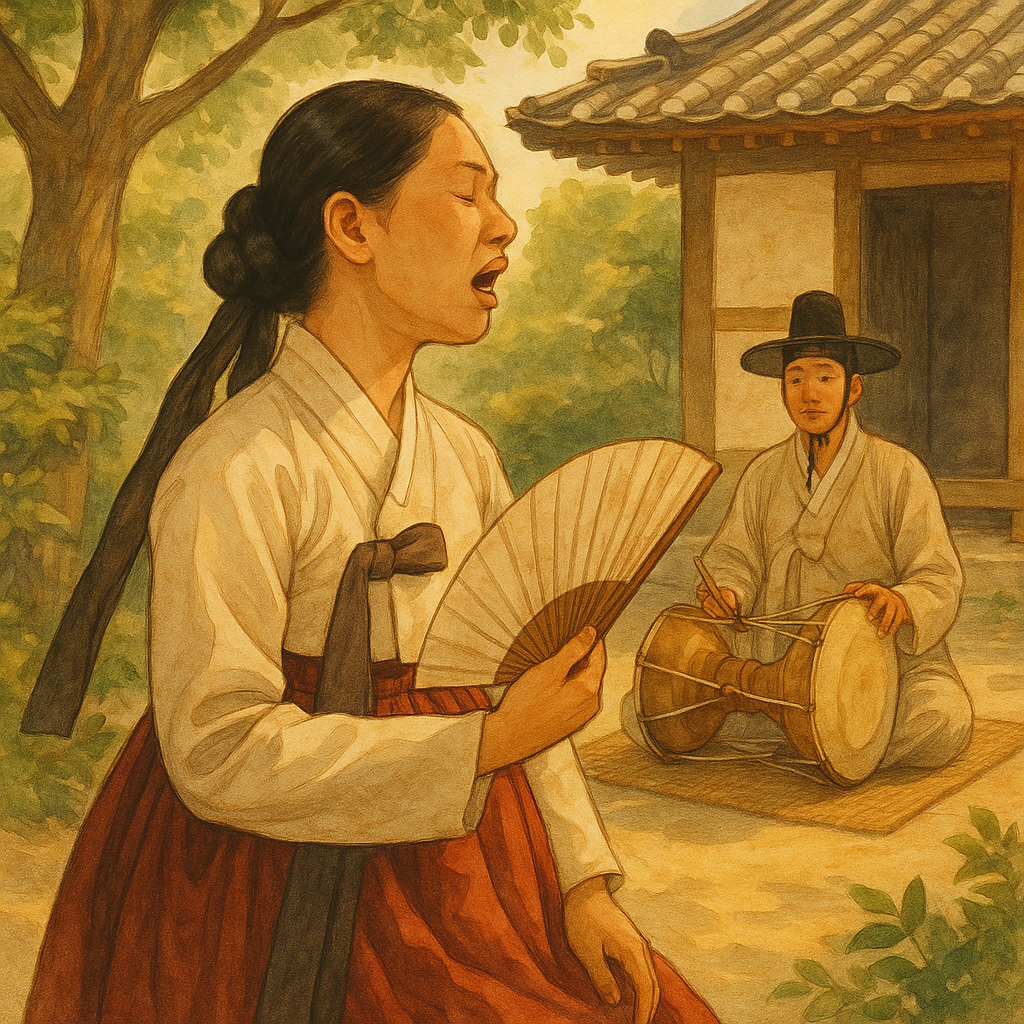
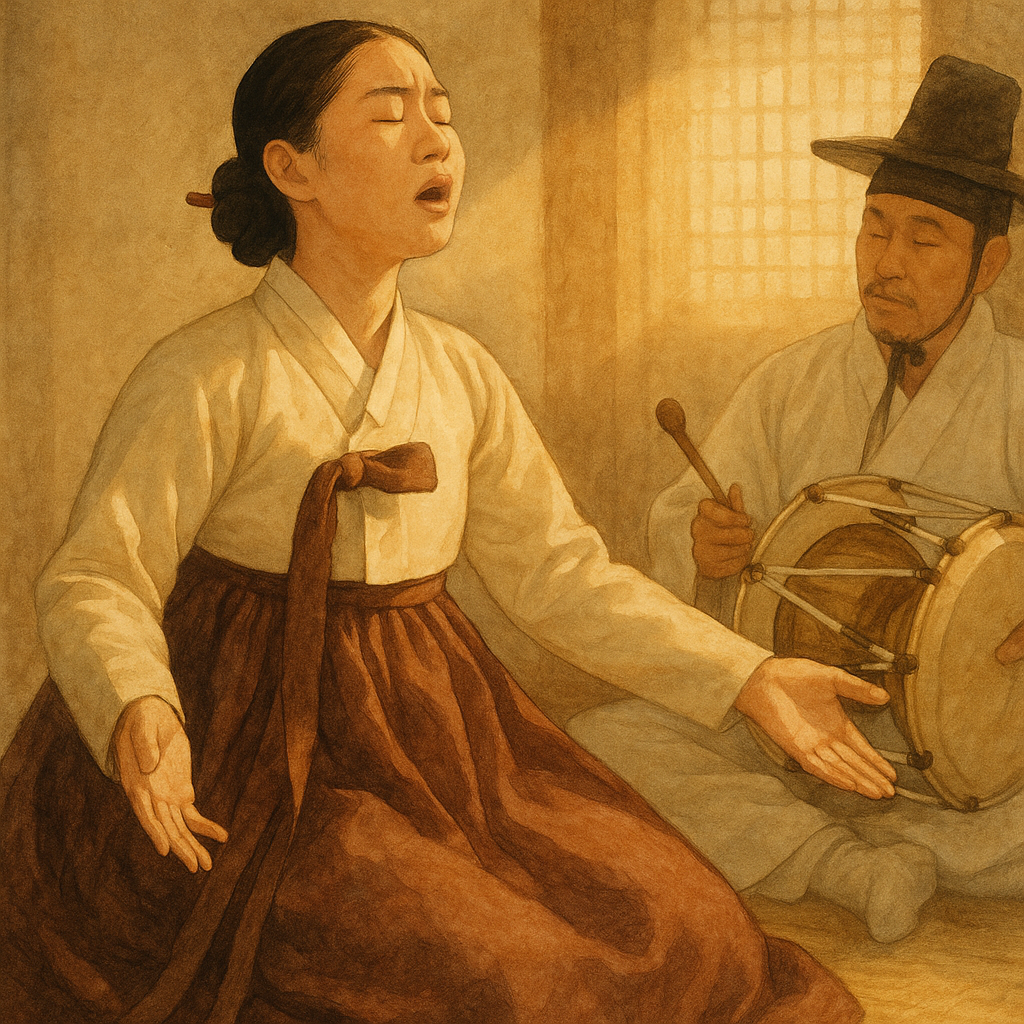
    Strip away everything ornamental and pansori reduces to two people: a sorikkun (singer) and a gosu (drummer playing the barrel-shaped buk). No orchestra, no stage set, sometimes not even a proper stage — just a mat, a fan in the singer’s hand, and a drum.

    A full madang can run anywhere from three to eight hours, performed in a single sitting with only brief pauses. The singer alternates between singing and speaking, switching characters and narrating action, all while the drummer tracks rhythm patterns (jangdan) that shift with the emotional temperature of the story.

    There’s something almost defiant about this minimalism. In an era of elaborate court music and ensemble performance, pansori insisted that one trained voice and one drum were enough to hold a room for an entire afternoon.

    The Audience Is Part of the Band

    Here’s what surprises most first-time listeners: the audience is expected to shout back. Interjections called chuimsae — words like “eol씨구,” “jota,” or “geureochi” — are called out at key moments, not as interruptions but as required participation.

    A silent audience is considered a failed performance, not a respectful one. The drummer often leads these shouts too, functioning less like a metronome and more like a conversation partner egging the singer forward.

    This changes the whole dynamic. Pansori was never a one-way transmission from performer to passive listener — it was built as a call-and-response event where the room’s energy shapes how the story unfolds that particular day.

    Three Ways to Tell a Story at Once

    A single pansori performance actually layers three distinct techniques. There’s aniri, the spoken narration that moves the plot along; sori, the sung passages that carry emotional weight; and ballim, the physical gesture and fan movement that acts out scenes.

    Photo by Sean Lee on Unsplash

    A singer might narrate a character crossing a river in aniri, then shift into sori to voice that character’s grief, then snap open a fan to mimic a sail or a sword. Watching a skilled performer move between these three modes without any visible seam is where the craft becomes visible.

    It’s closer to a one-person theatrical production than a concert, which explains why training a sorikkun traditionally takes over a decade before they’re considered ready to perform a full madang alone.

    Where to Hear It Now

    Pansori was recognized by UNESCO as an Intangible Cultural Heritage in 2003, a designation that helped fund preservation efforts as fewer young performers were choosing the decade-long training path. Today, the National Gugak Center in Seoul hosts regular performances, and several conservatories keep the five surviving madang alive through formal instruction.

    Contemporary artists have also started pulling pansori structures into film scores and experimental theater, introducing the vocal style to audiences who’d never seek out a traditional performance on their own. The cracked voice that once echoed off a waterfall now shows up, oddly enough, in modern Korean cinema soundtracks.

    None of this softened the art form’s core demand, though. Whether performed in a royal court two centuries ago or a concert hall this month, pansori still asks listeners to lean in, not sit back.

    Try This Today

    Search for a recording of Chunhyangga on the National Gugak Center’s online archive and listen to just the first fifteen minutes — no video, audio only. Notice the exact moment the singer’s voice roughens, and pay attention to when the drummer’s shouts land.

    That’s the whole tradition in miniature: one voice, one drum, and a story that only exists because someone insisted on telling it out loud.

    A voice worth hearing is one that has been broken and rebuilt by the telling itself.

  • The Slow Craft of Japanese Shibori: Dyeing Cloth with Nature’s Patterns

    Photo by Jimmy Liu on Unsplash

    The Cloth That Refuses to Lie Flat

    Pick up a piece of authentic shibori and you’ll notice it first with your fingers, not your eyes. The surface puckers and ripples like skin that’s been in water too long. Even after pressing, the cloth holds a faint memory of the knots and folds that shaped it. That texture is the whole point—it’s not decoration applied to fabric, it’s a record of pressure and resistance.

    Most people encounter shibori as a flat photograph: a swirl of indigo and white, framed and hung on a wall. But the technique was never meant to be still. It’s a negotiation between cloth, thread, and dye, and the results carry small variations that no machine could replicate twice.

    Not Tie-Dye—A Different Logic Entirely

    Westerners often assume shibori is Japan’s version of tie-dye, and the comparison does it a disservice. Tie-dye tends toward randomness; shibori is closer to sculpture. Artisans bind, stitch, fold, twist, or clamp cloth into a three-dimensional form before it ever touches dye.

    Kanoko shibori uses tiny bound points to create scattered dot patterns, each one tied by hand with thread pulled tight enough to leave calluses. Arashi shibori wraps cloth diagonally around a wooden pole, then compresses it like an accordion to produce diagonal streaks resembling rain. Itajime shibori sandwiches folded fabric between carved wooden boards, so the dye only reaches the exposed edges. Each method demands a different physical vocabulary, and a skilled dyer can often identify the technique just by running a palm across the finished cloth.

    A Craft Born From Necessity

    Shibori traditionally traces back well over a thousand years in Japan, with early examples associated with Nara-period textiles used in temple offerings and court garments. Indigo, the dye most closely tied to shibori’s identity, was prized not just for its color but for its practical qualities—it repelled insects and was believed to have antibacterial properties, useful for farmers and laborers who wore indigo-dyed cotton daily.

    Photo by Jimmy Liu on Unsplash

    The technique found its most famous home in Arimatsu and Narumi, two post towns along the old Tokaido road connecting Kyoto and Edo. Travelers passing through would stop to buy shibori-dyed cloth as souvenirs, and local families developed and guarded specific binding techniques as trade secrets passed down within households. What began as a rural craft tied to travel commerce slowly became a regional identity.

    The Hands Remember What the Eyes Cannot Plan

    A single piece of high-quality shibori can take weeks to complete, and much of that time isn’t spent dyeing at all—it’s spent in preparation. Binding a large bolt of cloth in the kanoko style might require tens of thousands of individual knots, each one tied at a consistent tension so the dye resists evenly.

    The indigo vat itself demands its own attention. Traditional natural indigo dye baths are alive in a sense—fermented from indigo leaves, lime, and wheat bran, and maintained through careful monitoring of pH and temperature over days or weeks before they’re ready to use. Dip cloth into a mismanaged vat and the color turns muddy instead of the deep blue-violet that defines fine shibori work. Experienced dyers judge readiness by smell and the surface sheen of the liquid, a kind of knowledge that resists being written down in exact measurements.

    Why Arimatsu Still Matters

    Today, the number of artisans who can execute the most demanding shibori techniques by hand has shrunk considerably. Many binding techniques require years of practice to achieve consistent tension, and younger generations have largely moved toward less physically punishing work. Some workshops in Arimatsu have adapted by offering shorter courses and smaller-scale projects, hoping to keep at least partial knowledge of the craft in circulation.

    Photo by Clay Banks on Unsplash

    There’s also been a quiet resurgence of interest from outside Japan, particularly among textile artists drawn to the unpredictability that machine printing can’t offer. This isn’t nostalgia for its own sake—it’s a recognition that certain kinds of beauty only emerge from processes that can’t be rushed or perfectly controlled.

    Bringing the Pattern Into Your Own Life

    You don’t need an indigo vat or a decade of practice to understand what makes shibori compelling. A simple itajime experiment with rubber bands, wooden clothespins, and a small piece of white cotton can be done in an afternoon using pre-mixed indigo dye kits sold online.

    Fold the fabric into a fan or triangle, clamp it between two flat objects, and submerge it briefly. The result won’t match a master dyer’s decades of muscle memory, but it will teach you something no article can: how much of the final pattern depends on decisions made before the dye ever touches the cloth.

    If a hands-on project feels like too much this week, start smaller. Look up a shibori textile piece online and spend two full minutes studying just the edges where the pattern fades into white—that transition zone is where the entire technique reveals itself.

    Some patterns can only be made by hands willing to let the cloth decide part of the outcome.

  • The Woven Heritage of Korean Hanji Paper: Craftsmanship in Every Fiber

    The Paper That Outlives Its Makers

    Run your fingers across a sheet of hanji and you’ll notice something odd: it doesn’t feel like paper at all. It feels closer to cloth, slightly rough, with a faint sheen that catches light unevenly.

    Some Buddhist sutras written on hanji during the Goryeo period have survived for centuries, their fibers still intact while wood-pulp paper from a hundred years ago crumbles at the edges. Conservators often cite this longevity as one of hanji’s defining traits, though exact aging estimates vary depending on storage conditions and materials used.

    That contrast raises an obvious question. What makes a sheet of paper strong enough to hold up entire dynasties of documentation?

    From Mulberry Bark to Sheet: The Dak Tree’s Journey

    The answer starts with a tree, not a factory. Hanji is made from the inner bark of the paper mulberry, locally called dak namu, which grows abundantly on Korean hillsides.

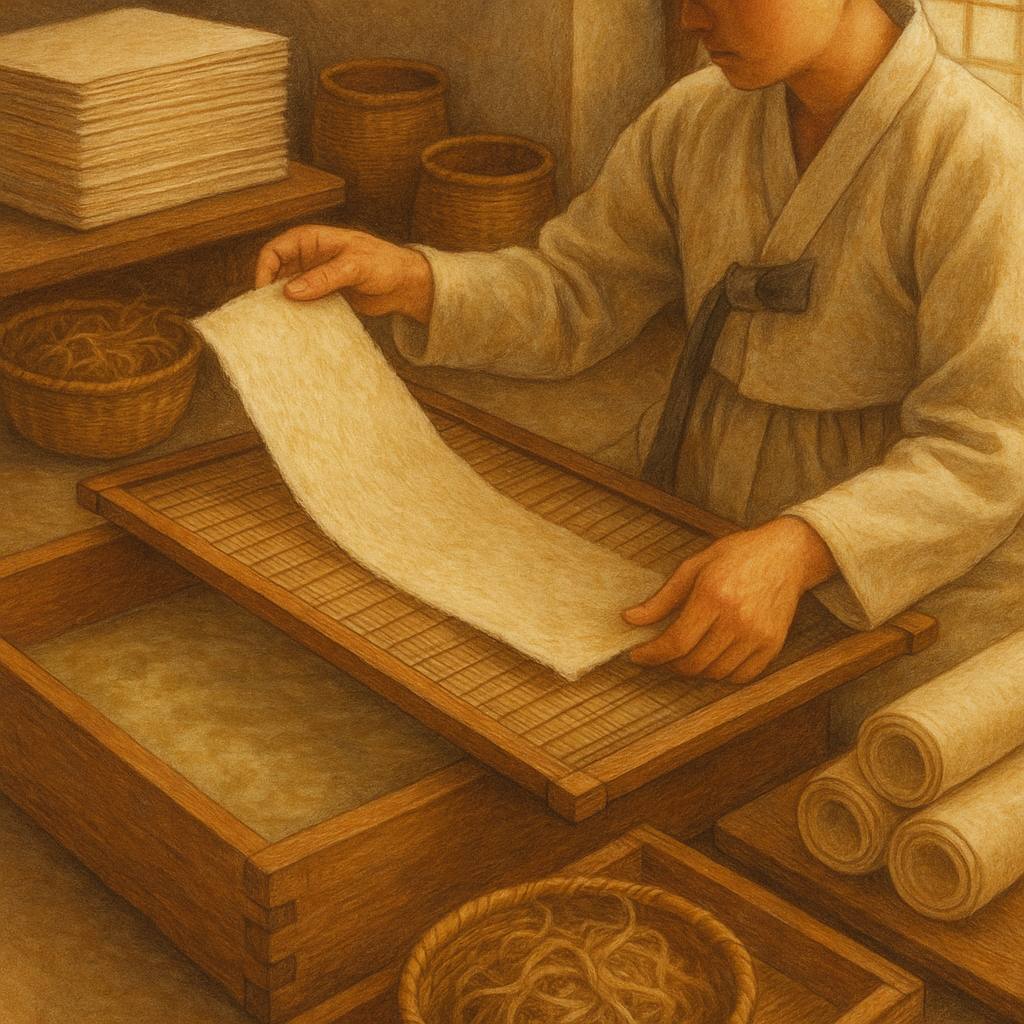
    Artisans strip the bark, boil it with wood ash lye, then beat the fibers by hand until they separate into long, thread-like strands. This step matters more than people assume — the length of the fiber is what gives hanji its unusual tensile strength, unlike shorter wood-pulp fibers used in most commercial paper today.

    The pulp is then mixed with a mucilage extracted from hibiscus root, which helps the fibers spread evenly in water. Using a bamboo screen, the papermaker sweeps the pulp back and forth in a technique called oe-ol-tteugi, layering fibers in crisscrossing directions rather than a single pass.

    That crosshatching is the real secret. It’s why hanji resists tearing along any one direction, unlike paper made with fibers aligned only one way.

    Photo by Chang Patrick on Unsplash

    Ink, Sutras, and the Weight of Dynasties

    Historically, hanji carried more than words — it carried diplomatic weight. During the Joseon dynasty, Korean paper was sent as tribute to the Chinese imperial court, where it was reportedly prized above local varieties for its smoothness and durability.

    Buddhist temples relied on hanji to copy sutras that needed to survive for generations, not just years. Government offices used it for official records, understanding that ink sat differently on hanji than on other papers — absorbing just enough to stay crisp without bleeding through the sheet.

    This reputation wasn’t accidental. Papermaking villages developed specialized knowledge passed through families, with certain regions like Jeonju becoming known for particular grades of hanji suited to calligraphy versus everyday use.

    Beyond the Page: Windows, Armor, Everyday Life

    Here’s what surprises most visitors to a hanok, a traditional Korean house: the windows aren’t glass. They’re covered in changhoji, a thin hanji stretched over wooden lattice frames.

    Light passing through changhoji softens into a warm, diffused glow rather than a harsh beam — something residents describe as changing the entire mood of a room throughout the day. Layered thickly, hanji was also used for flooring in a technique called jangpanji, coated with bean oil until it became waterproof and surprisingly durable underfoot.

    Less known is hanji’s role in protective gear. Records describe paper armor, jibgap, made from multiple compressed layers of hanji, light enough to wear yet dense enough to blunt an arrow’s impact. Clothing, fans, umbrellas, and even burial shrouds were made from treated hanji, each application demanding a slightly different thickness or coating.

    Photo by Sean Lee on Unsplash

    Craftsmen Today: A Fragile Continuity

    Fewer than a handful of workshops in Korea still produce hanji entirely by hand using traditional methods. Wonju and Jeonju remain centers where this knowledge persists, often passed down through master papermakers who trained for years before touching a finished product on their own.

    The work is physically demanding — hours spent standing in cold water, beating fiber, repeating the same sweeping motion with a bamboo screen hundreds of times a day. Younger generations show interest but the economics are difficult, since machine-made paper is far cheaper and faster to produce.

    Some artisans have adapted by creating hanji art pieces, lamps, and home décor for international markets, finding new relevance for an old material. Others focus on restoration work, since museums worldwide still need hanji to repair centuries-old Korean documents properly.

    Try It Yourself

    You don’t need to visit Korea to feel the difference hanji makes. Several online shops ship hanji sheets, notebooks, and lamp shades internationally, often at reasonable prices for small quantities.

    Order a single sheet, hold it up to a window, and watch how the light moves through the fibers unevenly, almost like watching cloud shadows cross a field. That small moment might tell you more about six centuries of craftsmanship than any museum placard could.

    In every fiber of hanji lies a patience machines have never learned to imitate.