[작성자:] chaewon

  • The Woven Legacy of Japanese Kumihimo: Braided Cords as Silken Craft

    Photo by sıtkı aksoy on Unsplash

    Look closely at the cord sealing a lacquer box in a Kyoto tea shop, and you’ll notice something odd: it isn’t tied in a simple knot. It’s a tight, geometric braid, dozens of silk threads locked into a pattern that looks almost machine-printed but was made entirely by hand on a wooden stand.

    That cord has a name — kumihimo — and it has been quietly holding together Japanese armor, prayer scrolls, and kimono sashes for centuries. Most visitors walk past it without a second glance. Once you know what you’re looking at, you can’t unsee it.

    Origin: Japan, with early forms traditionally linked to Buddhist and court use

    Region: Kyoto and Iga are historically associated with kumihimo production

    Era: Traditionally traced to the Nara and Heian periods, refined through the samurai era

    Best known for: Braided silk cords used in armor lacing, sword fittings, and obi-jime

    Core value: Structural strength paired with disciplined, repetitive handcraft

    Why did braided cords become essential to samurai armor?

    Samurai armor was never a single rigid shell. It was built from small lacquered plates, and those plates needed something flexible enough to move with the body yet strong enough to survive a blade strike. Braided silk cords, known as odoshi, threaded through the plates and held the whole structure together.
    A single suit of armor could require an enormous length of cord, dyed in colors that signaled a clan or a rank. The braid had to resist fraying under repeated stress, which meant the twisting pattern mattered as much as the silk itself. This is where kumihimo stopped being decorative and became load-bearing engineering.

    How does the kumihimo disk shape every thread’s path?

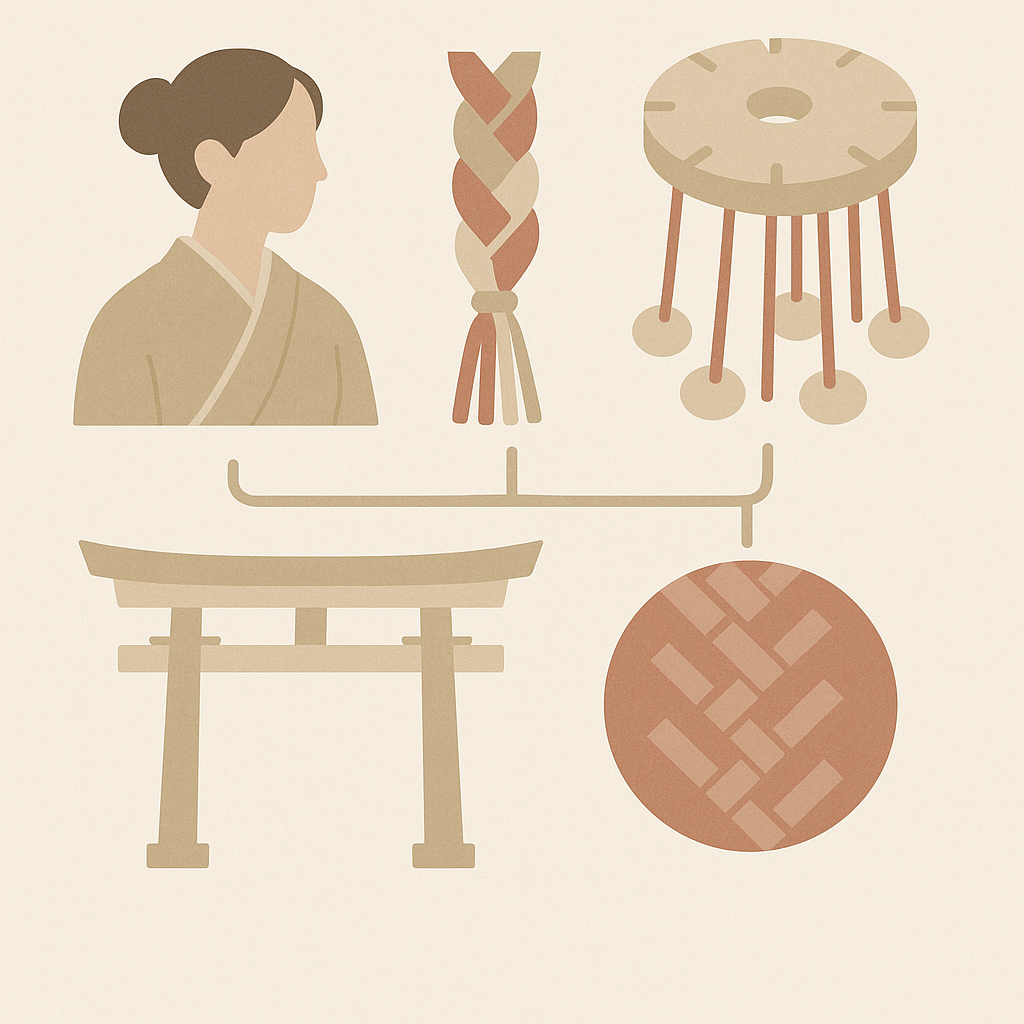
    Traditional kumihimo is made on a stand called a marudai, a round wooden disk balanced on four legs with a hole in the center. Silk threads, wound onto small bobbins called tama, hang around the disk’s edge, each one weighted just enough to keep tension even.

    The braider moves the bobbins in a fixed sequence, crossing threads over and under according to the pattern being made. There’s no shortcut here — every centimeter of cord passes through the same deliberate hand motion, repeated thousands of times until the braid reaches its finished length.

    Change the crossing sequence, and you get a different structure entirely: flat, round, or hollow, each suited to a different use. A flat braid drapes differently around an obi than a round one does around a sword hilt, so the choice was never arbitrary.

    What makes silk the material of choice for kumihimo?

    Silk threads have a particular sheen and give that cotton or hemp simply don’t replicate. When light hits a finished kumihimo cord, the twisted fibers catch it at slightly different angles, creating a subtle shimmer along the braid’s length rather than a flat surface.

    Silk also holds dye with unusual depth, which mattered enormously in a craft where color coded meaning. A particular shade of purple or crimson in an obi-jime wasn’t just an aesthetic choice — it could signal the season, the occasion, or the wearer’s taste in a way that was instantly legible to anyone trained to read it.

    How did kumihimo move from armor to everyday dress?

    As Japan’s periods of large-scale warfare gave way to longer stretches of peace, demand for armor lacing declined. The same braiding skill didn’t disappear, though — it shifted toward the textile needs of daily life, particularly the kimono.

    Photo by Clay Banks on Unsplash

    The obi-jime, a narrow braided cord tied over the obi sash, became one of kumihimo’s most visible everyday applications. It does real work, keeping the obi’s knot secure through a full day of movement, but it also became a small canvas for color and texture against the broader expanse of fabric.

    Sword fittings, tea ceremony tools, and Buddhist ritual objects kept other branches of the craft alive during this same period. The techniques stayed remarkably consistent even as their purpose changed.

    What should you look for in a well-made kumihimo cord?

    Run your fingers along a genuine handmade cord and you’ll feel a faint, regular texture — the ridges where threads cross — that machine-made braid tends to smooth over. The tension should feel even along the entire length, with no loose or overly tight sections.

    Color transitions, if the cord has them, should shift gradually rather than in an abrupt block. That gradual blending is a signature of skilled bobbin sequencing, not something added after the braid is finished.

    Weight matters too. A well-braided silk cord has a slight substantial feel in the hand, neither limp nor stiff, because the crossing pattern itself gives it structure.

    How can you start noticing kumihimo in daily life?

    You don’t need a kimono or a katana to begin paying attention. Reusable gift cords, phone straps, and even some jewelry now use simplified kumihimo techniques, and small braiding disks are sold for beginners who want to try a basic four-thread pattern at home.

    Next time you’re near a Japanese textile shop or museum display, look for the braid before you look at the fabric it’s attached to. Ask what the cord is holding together, and how many threads went into making it. That single question tends to unravel a much longer story than the cord itself ever suggests.

    A single cord, twisted thread by thread, can hold together an entire history.

  • The Fragrant Craft of Korean Najeonchilgi: Mother-of-Pearl Inlay as Living Light

    Photo by Sou Jest on Unsplash

    Hold a small wooden box under a single lamp and tilt it slowly. The surface doesn’t just reflect light—it seems to release it, shifting from blue-green to a pale rose as your hand moves. That box is likely covered in mother-of-pearl fragments thinner than a fingernail, set into black lacquer by someone who spent weeks on a single panel.

    This is najeonchilgi, and the shimmer isn’t decoration layered on top of an object. It is the surface itself, built shell by shell until an entire picture of cranes or peonies or waves catches the room’s light.

    Origin: Korea, developed from earlier lacquerware traditions on the peninsula

    Region: Historically concentrated around Tongyeong and other southern coastal areas rich in abalone

    Era: Traditionally traced back over a thousand years, refined significantly during the Goryeo period

    Material: Abalone and other iridescent shell inlaid into layers of natural lacquer (ottchil)

    Best known for: Furniture, jewelry boxes, and ceremonial objects with cut-shell imagery

    Core value: Patience rendered visible—light itself becomes part of the design

    Why did shell become light in Korean lacquerware?

    Abalone shell has a quality no pigment can fake. Cut it thin enough and it stops behaving like a solid material; it starts behaving like a lens, splitting white light into color depending on the angle of view.

    Photo by zero take on Unsplash

    Korean lacquer artisans noticed this centuries ago and built an entire craft around exploiting it. Rather than painting a bird onto a surface, they cut its feathers from shell and let the shell do the coloring, so the image changes as the viewer moves rather than staying fixed.

    This is why najeonchilgi objects feel alive in a way flat decoration doesn’t. The design isn’t finished until someone actually looks at it under real light, from a real angle, in a real room.

    How does the process turn shellfish into shimmering surfaces?

    The work begins long before any shell touches wood. A wooden or bamboo-woven base is coated with multiple layers of ottchil, natural lacquer drawn from the sap of the lacquer tree, and each layer must dry and be sanded before the next goes on.

    Only after this foundation is stable does the shell work start. Craftspeople slice abalone shell into sheets sometimes less than half a millimeter thick, then cut those sheets into the exact shapes a design requires—a petal, a wingtip, a curve of a wave.

    Each piece is set into a groove carved to its precise shape, then sealed under further coats of lacquer, and finally polished down until the shell sits flush with the surface. A single box can require dozens of individual shell pieces, and a large panel can take a craftsperson many weeks from first sanding to final polish.

    Nothing about this process rewards speed. A rushed groove means a loose piece years later, and a lacquer layer applied before its predecessor fully cured can cloud or crack. Traditionally, workshops measured progress in seasons rather than days.

    What makes Korean najeonchilgi different from lacquer traditions elsewhere?

    East Asian lacquer cultures share a common material base but diverge sharply in technique and intent. Korean najeonchilgi is distinguished by its emphasis on cut-shell inlay set directly into thick lacquer grounds, producing designs where the shell itself carries the image rather than serving as accent alongside painted or gilded elements.

    The color palette also reads differently. Korean pieces often favor the natural iridescence of the shell against deep black lacquer, letting the material’s own color range—blues, greens, faint pinks—stand in for a painter’s palette entirely.

    Photo by zero take on Unsplash

    Motifs matter too. Cranes, plum blossoms, peonies, and the ten symbols of longevity recur across Korean najeonchilgi, tying individual objects to a broader visual vocabulary that Korean audiences would recognize instantly, from a jewelry box to a ceremonial table.

    How did this craft survive centuries of change?

    Najeonchilgi moved through Korean history attached to daily life rather than sealed away in temples or palaces alone. Wedding chests, document boxes, and small personal cases carried the technique into ordinary households, which meant the skill had to be passed down continuously to meet real demand.

    Regional workshops, particularly around the southern coast where abalone was abundant, became known for specific styles and quality standards. Apprentices traditionally trained for years under a master before touching a client’s commission, learning first how to cut a straight groove before ever cutting shell.

    That apprenticeship model still exists in a smaller number of workshops today, where the same sequence of lacquer, shell, lacquer, polish continues largely unchanged. What has shifted is scale—fewer full-time workshops remain compared to earlier eras, though those that do often produce work of remarkable precision.

    What should you look for when you see najeonchilgi today?

    Tilt the object, don’t just look at it head-on. Genuine hand-cut inlay shifts color unevenly across a design because each shell fragment was cut and placed individually, unlike machine-uniform patterns that shift in flatter, more regular bands.

    Run a fingertip lightly across the surface if you’re permitted to. A well-finished piece feels seamless, with no ridge where shell meets lacquer, because the final polish is meant to erase any sense of two separate materials.

    Look closely at fine details like feather barbs or flower veins. These are often where you can see the actual width of individual shell cuts, sometimes narrower than a strand of thread, which tells you how much time went into that specific section.

    If you ever find a najeonchilgi piece in a museum collection or a specialty shop, spend a full minute with it rather than a glance. Move your head slowly from side to side and watch how the same surface produces different colors from different angles—that shift is the entire craft revealing itself to you in real time.

    Light doesn't decorate this craft—cut thin enough, shell becomes the very language it speaks in.

  • The Candle Warmer Lamp That’s Making My Living Room Smell Like Fall Without the Fire Risk

    Photo by swabdesign on Unsplash

    It’s 9pm, you’re wrapped in a blanket watching something on the couch, and you’d love that pumpkin-spice candle burning on the side table. But you also know you’ll fall asleep before it burns out, and an open flame plus a sleepy household is never a great combo. This is exactly the kind of moment the GODONLIF Candle Warmer Lamp was made for.

    What It Actually Is

    Instead of a wick and flame, this lamp uses gentle heat from a bulb underneath to melt the top layer of your candle or wax melt, releasing the scent without any burning. You get the fragrance and the cozy glow, minus the soot, the smoke, and the worry about leaving something lit unattended.

    The 24-Hour Timer Is the Real Star

    This isn’t just an on/off switch — it has a full 24-hour cycle timer, so you can set it to automatically turn on and off at whatever times fit your routine. Want it warming your favorite candle every evening from 6 to 9pm without you lifting a finger? Set it once and forget it. For anyone who’s ever left a candle burning by accident, this feature alone is worth the peace of mind.

    It also comes with two bulbs, which matters more than it sounds like. Bulbs in warmers do eventually burn out, and having a spare on hand means you’re not left scent-less while you wait for a replacement to ship.

    Dimmable for Mood, Not Just Function

    The dimmable feature lets you adjust the glow depending on the moment — bright enough to double as a small accent light, or low and warm for a relaxed evening vibe. It’s a nice touch for a product that’s clearly designed to double as home decor, not just a wax-melting gadget hidden in a corner.

    Where It Fits in a Home

    Aesthetically, this fits right into the current wave of warm, minimalist fall and Halloween decor that’s been popular in living rooms lately. It’s understated enough to sit on a console table year-round, but the glow and timer function make it especially appealing heading into the cooler months when candle season really kicks in. It’s also being marketed as a birthday or “gift for Mom” item, and honestly, that tracks — it’s the kind of practical-but-thoughtful gift that doesn’t feel like an obligation purchase.

    One Honest Caveat

    Because it relies on bulb heat rather than an open flame, the way it melts wax is naturally gentler and slower than a traditional candle flame — so if you’re used to a candle filling a room with scent within minutes, temper your expectations slightly. It’s a trade-off for the safety and convenience, and one most flameless-candle fans consider worth it, but it’s worth knowing going in.

    The Bottom Line

    With a 4.6-star rating across nearly 11,000 reviews, this isn’t a niche product — plenty of people have already put it through its paces in real homes. Between the programmable timer, the dimmable glow, and the inclusion of two bulbs, it feels like a thoughtful, low-maintenance way to bring warmth and scent into a space without the usual candle anxieties.

    If you’ve been looking for a flameless way to enjoy your candle collection, you can check out the GODONLIF Candle Warmer Lamp here: https://amzn.to/3VpGSAP

    This post contains an affiliate link. If you purchase through it, we may earn a small commission at no extra cost to you.

    Sometimes the coziest upgrades to a home are the quiet ones you barely notice until they’re missing.

    🛒 Check the Current Price on Amazon

  • The Layered Craft of Chinese Dough Lantern Carving: Bamboo and Silk in Festival Light

    Photo by Flowdzine Creativity on Unsplash

    In a workshop in Zigong, an artisan presses a thumbnail-sized figure of a carp into being from a ball of dyed wheat dough, then sets it aside to dry before pinning it onto a lantern frame no bigger than a lunchbox. Nearby, another worker stretches raw silk over a bamboo skeleton so thin it flexes like a wrist. Neither task looks related to the other until the lantern is lit, and the carp seems to swim inside a glowing paper pond.

    This is the layered logic behind Chinese festival lanterns that combine three separate crafts into one object: bent bamboo for structure, stretched silk for skin, and sculpted dough for ornament. Few visitors to a lantern fair realize how many hands and how many different materials passed through a single piece before it ever reached a pole or a doorway.

    Origin: Rooted in Chinese folk craft traditions combining lantern-making and dough sculpture (miandiao)

    Region: Widely practiced in Sichuan, Shandong, and parts of North China, with Zigong especially known for elaborate lantern displays

    Era: Lantern-making traditionally traced to the Han and Tang dynasties; dough figure ornamentation added over later centuries

    Materials: Split bamboo frames, silk or thin cotton covering, dyed wheat-flour dough for figures

    Best known for: Festival lanterns displayed during the Lantern Festival and other seasonal celebrations

    Core value: Layering separate crafts—structure, light, and figure—into a single unified object

    Photo by Nguyễn Hiệp on Unsplash

    Why did bamboo become the skeleton of choice for Chinese lanterns?

    Bamboo grows fast, splits cleanly along its grain, and bends without snapping when soaked or heated. For lantern makers working before modern materials existed, this combination mattered more than almost anything else. A frame needed to hold its curve for years, survive humid storage between festivals, and still weigh little enough to hang from a single string.

    Craftsmen traditionally split bamboo into narrow strips, then shaved each strip thinner near the joints where bending would occur. This uneven thinning is deliberate. A strip left too thick at a bend point will crack under tension, while one shaved evenly along its full length loses the stiffness needed to hold shape once the frame is tied.

    What results is a structure that looks fragile but resists collapse remarkably well. The same bamboo logic underlies furniture, boat hulls, and scaffolding across Chinese building traditions, so lantern frames were never an isolated invention—they borrowed from skills already common in daily life.

    How does silk transform a bamboo frame into a glowing form?

    Once a frame is tied and dried, silk gets stretched over it in overlapping panels rather than one single sheet. This matters because silk shrinks slightly when it dries after being dampened for shaping, and a single oversized panel would pull unevenly across curved bamboo ribs.

    Artisans traditionally brush a thin rice-paste adhesive along the bamboo ribs before pressing silk into place, working from the center of each panel outward to avoid trapping air bubbles. The silk chosen for lanterns tends to be thinner and less tightly woven than silk meant for clothing, since light needs to pass through without being fully blocked.

    Color enters here as well. Dyed silk in red, amber, or pale yellow doesn’t just decorate the lantern—it shifts how the light inside reads once a candle or bulb is lit, turning a plain glow into something with warmth and depth that a bare frame could never produce on its own.

    What role does dough sculpture play inside a festival lantern?

    Dough sculpture, known as miandiao, developed separately from lantern-making as a folk practice tied to offerings and festival food. Wheat flour dough, sometimes mixed with a small amount of honey or oil to keep it pliable, gets shaped by hand into figures of animals, deities, or seasonal symbols, then colored with natural or food-safe dyes before air-drying.

    Photo by zhang kaiyv on Unsplash

    When these figures moved from tabletops into lantern interiors, the craft had to adapt. Dough meant for eating or short-term display doesn’t need to survive heat from a lit candle, but dough placed near a light source inside a lantern does. Artisans traditionally dried the figures longer and sealed them with a light coating to keep them from softening near warmth.

    Placed just behind the silk skin, a dough figure throws a shadow or a colored silhouette that shifts as the light flickers. A carp, a rabbit, or a small figure of a folk character seems to hover inside the lantern rather than sit flat against it, which is really the entire point of combining these three crafts in the first place.

    Why do these three crafts need each other to work at all?

    None of the three elements—bamboo, silk, dough—can produce the finished effect alone. A bamboo frame without silk is just a cage. Silk without a frame has no shape to hold. A dough figure without light passing through silk is a static object sitting in the dark, no different from a shelf ornament.

    This interdependence is why lantern workshops traditionally organized labor around specialists rather than generalists. One person spent years learning to split and bend bamboo correctly; another focused entirely on silk stretching and dyeing; a third trained in dough sculpture separately, often within a family lineage passed down through festival seasons rather than formal schooling.

    The layering isn’t just physical—it’s also a layering of separate skill traditions that happened to find a shared purpose in festival light. That convergence, more than any single technique, is what makes these lanterns worth looking at closely rather than walking past.

    How can you see this layered craft up close today?

    Regional lantern festivals, particularly larger displays in Sichuan, still commission handmade lanterns that use this bamboo-silk-dough method rather than mass-produced alternatives. Walking slowly around a lantern rather than viewing it from one angle reveals the dough figures’ shadows shifting as you move relative to the light source inside.

    If you want a hands-on entry point, look for a local workshop or cultural center offering a basic miandiao dough-sculpting session. Even without the bamboo and silk stages, shaping a small dough figure yourself gives a physical sense of why this material was chosen for delicate festival ornamentation in the first place.

    Three crafts, three hands, one flicker of light—that is how a festival lantern learns to breathe.

  • The Sculptural Poise of Japanese Noh Masks: Carving Emotion into Wood

    Photo by Paul Yong on Unsplash

    Hold a Noh mask at eye level and tilt it down half an inch. The mouth seems to fall, the eyes darken, and a face that looked serene a moment ago now carries something close to grief. Tilt it back up, and the sorrow lifts as if it were never there. No paint changed. No muscle moved. Only the angle of wood against light.

    This is the trick — if you can call centuries of craft a trick — at the center of Noh mask carving. The masks, called omote, are not meant to perform emotion outright. They are built to let emotion happen in the space between the mask and the viewer’s eye.

    Origin: Developed alongside Noh theater in medieval Japan

    Region: Japan, with major carving lineages historically based in Kyoto and Nara

    Era: Traditionally traced to the 14th century, refined over subsequent centuries

    Material: Primarily Japanese cypress (hinoki), hand-carved and pigmented

    Best known for: Neutral-expression masks like Ko-omote and demonic forms like Hannya

    Core value: Emotion suggested through form and light, not fixed expression

    How did Noh masks emerge from ritual into refined theater?

    Noh theater is traditionally understood to have taken shape in the 14th century, shaped in large part by the performer and theorist Zeami. Before that, mask-wearing already existed in Japan through sacred dance forms tied to Shinto ritual and court performance.

    Photo by Finan Akbar on Unsplash

    Zeami and his contemporaries did not invent the mask. They refined its purpose, pulling it away from pure ritual function and toward a tool for dramatic suggestion. A mask no longer just marked a role — it became a surface built to hold ambiguity.

    That shift mattered. Ritual masks often aim for clarity: this is the god, this is the demon. Noh masks, by contrast, were carved to resist a single fixed reading, which is part of why they still feel alive on stage centuries later.

    Why does the “neutral” mask take the longest to carve?

    Ask a mask carver which type is hardest, and many will point not to demons or ghosts but to Ko-omote, the young woman’s mask. Its expression sits at rest — no visible smile, no visible sorrow.

    That neutrality is deceptive. A fraction of a millimeter’s difference in how the cheek curves or how deep the eye socket is cut can push the whole face toward looking either warm or cold. There is nowhere to hide a mistake behind an obvious expression.

    Carvers traditionally spend years, sometimes over a decade, before attempting a Ko-omote on their own. The demon masks, oddly enough, forgive more error, because their exaggerated features already carry strong emotional signals.

    How does the angle of the head change what a mask feels like?

    Performers and mask-makers describe two basic movements: terasu, tilting the face slightly upward toward the light, and kumorasu, tilting it slightly down into shadow. The words translate roughly to “to shine” and “to cloud.”

    When a Noh actor tilts a mask upward under stage lighting, the carved cheekbones catch illumination and the expression reads as lighter, sometimes even pleased. Tilt the same mask down, and shadow pools in the eye sockets and around the mouth, and the same carved wood reads as mournful or withdrawn.

    This is why a mask carver cannot simply carve “a happy face” or “a sad face.” They carve a form capable of producing both, depending on how it meets the light. The performer, not the sculptor alone, completes the expression in real time.

    Photo by Clay Banks on Unsplash

    Why do carvers still copy masks that are centuries old?

    New Noh mask carvers do not usually start by designing original faces. They begin with utsushi, a practice of copying revered historical masks as closely as possible, sometimes ones kept by specific Noh schools or temples for generations.

    This might look like a lack of creative ambition from the outside. It is closer to the opposite. Reproducing an existing mask’s exact curvature forces a carver to understand, physically, why that curve produces the emotional effect it does — knowledge that cannot be taught only through description.

    Some lineages guard their master masks carefully, allowing only measured study rather than casual handling. The mask itself becomes a kind of teacher, passing on proportions that took earlier carvers a lifetime to work out.

    What does the wood itself contribute to the performance?

    Hinoki, the cypress traditionally used for Noh masks, is chosen partly for its fine, tight grain, which holds crisp edges under the carving knife. But its lightness matters just as much — a performer may wear a mask through an entire performance lasting well over an hour.

    The wood also ages. Over decades of use, the painted surface of a mask can develop fine cracks and a change in tone, and rather than being treated as damage, this aging is often valued as part of the mask’s accumulated presence.

    A mask that has been worn on stage for generations is not simply an object anymore. It carries the residue of every performance it has been part of, which is difficult to explain to someone who has only seen one in a museum case, sitting still under glass.

    How can you start noticing this craft today?

    You do not need a theater ticket to begin looking at Noh masks differently. Search for a single mask type — Ko-omote is a good start — and look at photographs of it taken from slightly different angles.

    Notice how the mouth and eyes seem to shift mood as the angle changes, even though it’s the same static object. That small exercise is the closest most people will get, outside Japan, to understanding what centuries of carving were actually solving for.

    A face carved without expression can hold more feeling than one carved with it.

  • The Ceremonial Pour of Chinese Gongfu Tea: Mastering Time in Every Cup

    Photo by 五玄土 ORIENTO on Unsplash

    Watch a Chaozhou tea master’s hands for the first thirty seconds and you’ll see something that looks like waste. She pours hot water over the leaves, swirls the pot twice, and tips the entire infusion into a discard bowl without tasting a drop. Nobody drinks that first pour. It exists only to wake the leaves up.

    This is gongfu tea, and the word itself holds the clue to everything that follows. Gongfu (功夫) doesn’t mean “ceremony” — it means skill built through time and repetition, the same term used for martial arts training. Here, the discipline isn’t kicks or punches. It’s seconds, temperature, and the angle of a wrist.

    Origin: Chaoshan region, Guangdong Province, with strong ties to Fujian’s tea culture

    Region: Southern China, later adopted nationwide and among overseas Chinese communities

    Era: Traditionally linked to the Ming and Qing dynasties, alongside the rise of oolong tea

    Best known for: Rapid, repeated short infusions in small clay or porcelain vessels

    Core value: Precision and attentiveness — treating tea-making as a practiced skill, not a recipe

    Photo by Sergey N on Unsplash

    Why does gongfu tea treat time as the main ingredient?

    In most brewing traditions, time is a background variable. In gongfu tea, it’s the whole point. A single leaf might be steeped ten or more times in one sitting, each infusion lasting only a few seconds longer than the last.

    The tea doesn’t change — the water’s contact with it does. Ten seconds might taste floral and thin; twenty seconds later, the same leaf turns dense and mineral. Mastering gongfu tea means learning to read a single ingredient across a dozen different moments.

    How did gongfu tea take shape in Chaoshan’s tea houses?

    Gongfu tea traditionally developed in the Chaoshan area of Guangdong, a region famous for its oolong varieties like Phoenix Dan Cong. As oolong processing grew more refined during the Ming and Qing periods, tea drinkers needed a brewing method that could match the leaf’s complexity.

    Small Yixing clay teapots from Jiangsu Province became central to this shift. Their porous, unglazed clay absorbed tea oils over years of use, and their small size — often holding less than 150 milliliters — allowed for the rapid, concentrated infusions the method demanded. What started as a regional practice among merchants and scholars eventually spread far beyond Chaoshan’s borders.

    What tools turn a simple pot into a full session?

    A gongfu setup rarely uses just one vessel. There’s the brewing pot or gaiwan, a fairness pitcher (cha hai) that evens out the strength of the tea before pouring, and a set of small cups no larger than a shot glass.

    The tea tray beneath it all isn’t decorative — it has a hidden reservoir or drainage system, because rinsing water and spent infusions get poured directly onto the tray’s surface. Nothing here is symbolic filler. Every object serves the speed the method requires.

    Photo by Arisa Chattasa on Unsplash

    How does the pour itself communicate respect between host and guest?

    Cups are filled only halfway to two-thirds, following an old idea that a full cup signals rudeness rather than generosity — it leaves no room for the drinker to hold it without burning their fingers. The host pours in a continuous back-and-forth motion across several cups rather than filling one completely before moving to the next.

    This ensures every guest gets tea of the same strength and temperature, since the first cup poured would otherwise be weaker than the last. It’s a small gesture, but it quietly says the host is paying attention to fairness, not just hospitality.

    What do first-time brewers usually get wrong?

    The most common mistake is over-steeping the very first real infusion, treating gongfu tea like a single long brew instead of a sequence of short ones. Five seconds can be the difference between a bright second infusion and a bitter one.

    Another misunderstanding is assuming more leaves automatically means stronger tea. In gongfu brewing, the leaf-to-water ratio is already high — often filling a third of the pot — so the variable to adjust is always time, not quantity.

    If you want to feel this for yourself, you don’t need Yixing clay or a full tea tray to start. Pick any oolong you have, use a small pot or even a mug, and try three infusions of the same leaves at 10, 20, and 30 seconds. Taste each one side by side and notice how differently the same leaf can speak, depending only on how long you let it wait.

    Gongfu tea doesn't measure skill in leaves or water, but in the seconds you're willing to notice.

  • The Layered Craft of Korean Chaekgeori: Painting the Scholar’s Treasured Objects

    Photo by The New York Public Library on Unsplash

    Look closely at a nineteenth-century Korean folding screen and you might mistake it for a photograph of someone’s overstuffed study. Stacked books lean at odd angles, their spines catching light that seems to come from nowhere. A brass compass sits beside a jade seal, and somehow the whole arrangement feels more alive than a real desk ever could.

    That illusion is the entire point of chaekgeori, one of the more curious inventions in Korean painting history. It is not a still life in the Western sense, nor a simple decoration. It is a portrait of a mind, told through objects instead of a face.

    Origin: Korean court and scholar-class painting tradition

    Region: Korean peninsula, centered on Seoul (then Hanseong)

    Era: Traditionally flourished during the later Joseon dynasty

    Also known as: Chaekgado (책가도), when shown on a bookshelf frame

    Best known for: Trompe-l’oeil arrangements of books and scholar’s objects on folding screens

    Core value: Learning, discipline, and quiet material aspiration

    Why did Korean scholars want paintings of their own bookshelves?

    In Joseon society, books were not just tools for study. They were proof of a household’s commitment to Confucian learning, the very foundation of social standing for the yangban scholar class. Owning shelves of texts signaled discipline, ambition, and moral seriousness.

    Photo by Clark Gu on Unsplash

    But books were expensive, and shelf space was limited. A painted screen could suggest a library far grander than the one a family actually owned. It let a modest study room borrow the visual weight of a scholar’s ideal life.

    There is also a gentler explanation tied to the royal court. King Jeongjo, who reigned in the late eighteenth century, was known for his passion for books and is traditionally credited with encouraging court painters to depict his own collection. From there, the taste spread outward to noble households and eventually into homes with more modest means.

    How did painters build such convincing depth on a flat screen?

    Chaekgeori artists borrowed a loose sense of Western-style perspective, likely absorbed through diplomatic and trade contact that brought foreign prints into Korea. They did not copy that system exactly, though. Instead they bent it to their own visual logic.

    Shelves recede at angles that don’t quite agree with each other. A single screen might show one bookcase from the front and another from slightly above, as if the painter walked around the room while working. The effect feels less like optical trickery and more like layered memory.

    Color choices were deliberate rather than naturalistic. Deep indigo book covers sit beside warm ochre wood grain, and small red seals punctuate the composition like punctuation marks in a sentence. Nothing is left to chance, even though the final image reads as casual clutter.

    What objects beyond books appear in a chaekgeori screen?

    Books dominate, but they rarely appear alone. Scholars’ brushes, ink stones, and water droppers show up constantly, since these were the daily instruments of writing and self-cultivation. Porcelain vases holding a single peony or chrysanthemum branch soften the geometry of stacked volumes.

    Fruit appears often too, particularly pomegranates and citrons, chosen for their symbolic associations with abundance and many descendants. A pair of eyeglasses or a folding fan might rest casually across a shelf edge, small human touches inside an otherwise formal arrangement.

    Some screens include tribute-style curiosities like a coral branch or a small clock, objects that hint at trade contact and worldly awareness. These additions remind viewers that scholarly life, for all its discipline, still had room for curiosity about the wider world.

    Photo by zero take on Unsplash

    How did chaekgeori move from palace walls into ordinary homes?

    Court production set the standard, but demand did not stay confined to the palace. Wealthy merchant families, eager to project the same scholarly respectability as the yangban class, commissioned their own versions. Painters outside the court workshop system began producing screens in a looser, more folk-inflected style.

    These later works, sometimes grouped under the broader minhwa or folk painting tradition, traded strict perspective for playful exaggeration. Books tilt more dramatically, colors turn bolder, and the mood shifts from solemn to almost cheerful. The core idea survived even as the technique loosened.

    By placing a chaekgeori screen in a home, a family was making a quiet public statement. It said: we value study, we value order, and we understand what a cultivated life should look like, even if our own shelves are thinner than the painted ones.

    Why does chaekgeori still matter to collectors and designers today?

    Contemporary Korean designers keep returning to chaekgeori motifs on wallpaper, ceramics, and textiles, drawn to its unusual mix of order and asymmetry. The genre offers something rare: a decorative pattern with real intellectual weight behind it.

    Museums in Korea continue to display original screens as evidence of Joseon visual culture at its most personal. Unlike court portraiture, which flattered a specific ruler, chaekgeori speaks to an entire class’s shared values and quiet anxieties about status.

    For anyone building a reading nook or home library today, the underlying instinct still applies. Surround yourself with the objects of a life you’re trying to live, and let the room say what you might not say out loud.

    Search for a chaekgeori screen image tonight and spend five real minutes tracing a single shelf from corner to corner. Notice where the perspective quietly breaks, and ask yourself what object on your own desk might deserve that kind of attention.

    A shelf of painted books can reveal more devotion to learning than a library ever could.

  • The Rhythmic Craft of Korean Ottogi Dolls: Resilience Rolled into Folk Toy Form

    Photo by Bao zi on Unsplash

    Why does the Ottogi doll always return to standing?

    Push it, tip it sideways until it nearly touches the table, and let go. Within a second, the little rounded figure rocks back and forth and settles upright again, as if nothing happened. This isn’t a trick—it’s physics built into the doll’s shape.

    The secret sits at the bottom, where a weighted, rounded base keeps the center of gravity low no matter which way the toy tips. Korean toymakers understood this instinctively, long before anyone explained it in terms of physics. They shaped clay, paper, and wood so that gravity itself would do the work of “healing” the toy after every fall.

    That single mechanical fact became the seed of an entire cultural metaphor. A toy that cannot stay down turned into a stand-in for a person who refuses to stay down either.

    Origin: Traditional Korean folk toy, name derived from “ottok,” describing a sudden upright motion

    Region: Found across the Korean peninsula, especially in rural and agrarian communities

    Era: Traditionally rooted in pre-modern folk toy culture, popularized further in the 20th century

    Best known for: Self-righting weighted base symbolizing resilience

    Core value: Perseverance and recovery after hardship

    Photo by Frank Ng on Unsplash

    Materials: Traditionally papier-mâché, clay, or wood; later mass-produced in plastic

    How did the Ottogi become a symbol of resilience in Korean folk culture?

    In agrarian Korea, life ran on cycles of drought, flood, poor harvests, and slow recovery. Farmers and families needed a language for endurance that didn’t rely on words. A toy that fell and rose again, over and over, without complaint, offered exactly that.

    Parents traditionally gave Ottogi dolls to children not just as playthings but as small lessons. The message was simple and physical: setbacks are inevitable, but staying down is a choice, not a fact of life.

    This idea wasn’t confined to nurseries. Proverbs and everyday speech in Korea still reference the Ottogi spirit when describing someone who bounces back from failure, illness, or financial ruin. The doll became shorthand for a very human trait, expressed through an object a child could hold in one palm.

    What materials and craftsmanship go into a traditional Ottogi doll?

    Older Ottogi dolls were typically built from layers of paper pulp or papier-mâché, dried and hardened around a weighted core, often sand, clay, or small stones packed into the rounded base. This gave the toy just enough heft at the bottom to guarantee the self-righting motion.

    The outer surface was usually painted by hand, often depicting a round, cheerful face with exaggerated features—wide eyes, a stubby nose, sometimes a topknot or traditional hairstyle referencing folk characters. Colors leaned toward warm reds, yellows, and whites, echoing broader Korean folk art palettes.

    Because each doll was shaped and painted individually, no two traditional Ottogi looked exactly alike. Slight asymmetries in the base actually mattered less than they might seem; as long as the weight sat low and centered, the wobble-and-recover motion worked regardless of minor imperfections in form.

    Photo by zero take on Unsplash

    How did the Ottogi doll travel from folk toy to modern icon?

    By the mid-20th century, the Ottogi’s symbolism had grown sturdy enough to leave the toy chest entirely. Businesses and brands began borrowing the image, betting that customers would recognize the shorthand for resilience without needing it explained.

    The most visible example is a well-known Korean food company that adopted “Ottogi” as its name, using the doll’s silhouette as part of its identity. The choice wasn’t decorative—it was a deliberate nod to steadiness and recovery, qualities a food brand wanted associated with its products during a period of postwar rebuilding.

    Beyond commerce, the doll’s shape has echoed into design details on stationery, ceramics, and children’s media, usually stripped of extra ornamentation but keeping the round, self-righting base intact. Even simplified, the form is instantly readable to anyone raised with the toy nearby.

    What can the Ottogi teach us about facing setbacks today?

    Strip away the folklore, and the Ottogi’s lesson is almost embarrassingly literal: build your center of gravity low enough, and falling over stops being catastrophic. It becomes routine, expected, survivable.

    That’s a strange kind of comfort to find in a children’s toy. It doesn’t promise that tipping over won’t happen—it assumes it will, repeatedly, and designs for that reality instead of pretending otherwise.

    For a culture shaped by long stretches of hardship and rebuilding, that assumption made sense. The Ottogi never asked to avoid falling; it just made sure getting up again was never in question.

    How can you bring this idea into your own routine?

    Find or make a simple roly-poly figure—craft kits and traditional toy shops both carry versions—and place it somewhere visible, like a desk or windowsill. Each time you notice it, give it a small push and watch it recover.

    Let that ten-second ritual serve as a physical reminder rather than an abstract slogan. The doll doesn’t lecture; it just demonstrates, quietly, that recovery can be built into the shape of a thing—and maybe into the shape of a day.

    A low center, a steady fall, and the quiet certainty of standing up again.

  • The Ancestral Craft of Chinese Dough Figurines: Miansu and the Art of Edible Sculpture

    Photo by Nguyễn Hiệp on Unsplash

    Watch closely and you’ll miss it: a woman in a Shandong village presses a wooden comb into a lump of wheat dough, gives it two twists, and a rooster’s tail feathers appear before the dough has time to dry. She hasn’t used a mold. She hasn’t used a recipe written down anywhere. Her hands simply know the shape.

    This is miansu, sometimes called mianren or “dough people,” and despite the name “edible sculpture,” most of what she makes will never be eaten at all.

    Origin: Rural wheat-farming communities in northern China

    Region: Especially Shandong, Shanxi, and Henan provinces

    Era: Traditionally traced back over a thousand years, tied to agricultural and ancestor-worship customs

    Best known for: Small painted dough figures of deities, animals, and opera characters

    Core value: Marking life events—weddings, funerals, festivals—through handmade offerings

    Materials: Wheat flour, glutinous rice flour, natural pigments, alum for preservation

    Why did farmers start shaping dough into gods and animals?

    Wheat, not rice, has always been the staple grain of northern China, and flour was one of the few materials a farming household had in abundance. When there was nothing left over to carve in wood or cast in metal, dough became the substitute.

    Photo by Nguyễn Hiệp on Unsplash

    Villagers traditionally shaped steamed dough into animals and human figures for ancestor worship, for Qingming Festival tomb offerings, and for the Lunar New Year table. A dough rooster might sit beside the incense burner; a dough fish, standing in for abundance, might be steamed and displayed rather than sliced and served.

    Over generations, this practical habit of shaping offering food split into two branches. One stayed purely culinary, producing steamed buns shaped like animals that families genuinely ate. The other became decorative and symbolic, using dough that was never meant for the table at all—this second branch is what grew into miansu as an art form.

    How is miansu dough actually made?

    The dough itself is not the soft, yeasted kind used for buns. Miansu artisans mix wheat flour with glutinous rice flour, water, and a small amount of honey or glycerin to keep it pliable for weeks rather than hours.

    Alum is kneaded in as well, a detail that surprises people who assume this is simply bread dough with food coloring. Alum discourages mold and cracking, letting a finished figure last for years on a shelf instead of collapsing within days like ordinary dough would.

    Color comes next, mixed directly into small batches of dough rather than painted on afterward in most traditional workshops. A sculptor keeps a row of these tinted balls—reds, indigos, ochres, deep greens—lined up like a painter’s palette, ready to be pinched into petals or robes.

    What tools turn a plain dough ball into a sculpture?

    A miansu artisan’s kit is small enough to fit in a wooden box, which matters because many of these craftspeople traditionally worked as traveling sculptors, setting up folding stalls at temple fairs and market days.

    A thin bamboo knife shapes robes and flower petals with a single pull. A fine-toothed comb presses in feather patterns or hair strands in seconds. A bone or metal awl carves eyes, wrinkles, and the folds of an opera costume’s sleeve.

    What looks like spontaneous flourish is actually a fixed sequence practiced thousands of times. The body is built first from a cone or ball of dough, then facial features, then costume details, then finally the smallest accents like a fan, a sword, or a strand of beard fixed on with a drop of water.

    Photo by zhang kaiyv on Unsplash

    Why do these figurines rarely get eaten?

    Here is the detail that trips up most newcomers to the craft: miansu is described as “edible sculpture” because it is made from food-grade ingredients and technically could be consumed, not because anyone intends to eat it.

    The alum content alone makes eating these figures unappealing and, in any real quantity, unwise. More importantly, once a piece is finished, its purpose shifts from food to symbol—it becomes an offering, a gift, or a display piece meant to be looked at and eventually retired, sometimes burned as part of a ritual, sometimes simply kept on a shelf until it crumbles with age.

    This is a meaningful distinction from steamed dough animals still served at some festival tables. Those are food first. Miansu figures are sculpture first, and their edible origin is more a statement about material and humility than an invitation to a snack.

    How has miansu survived into the modern era?

    Industrialization and urban migration pulled many young people away from the villages where miansu was traditionally passed from parent to child, and for a stretch of the twentieth century the craft narrowed to a smaller number of dedicated families.

    It has since been recognized in China as part of the country’s intangible cultural heritage, which brought renewed attention from cultural institutions and a new generation of apprentices. Contemporary miansu artisans now sell finished pieces at tourist markets and cultural fairs, often depicting characters from Chinese opera, folklore heroes, or the twelve zodiac animals rather than only religious figures.

    Some artisans have also begun teaching short workshops, turning what was once a closely guarded family skill into something visitors can try with their own hands, even if their first attempt looks nothing like a rooster.

    How can you start noticing this craft today?

    You don’t need a plane ticket to begin paying attention to miansu. Search for footage of a working artisan—many short videos exist online—and watch just the hands, not the finished piece, for one full minute.

    Notice the order of operations: body, then face, then costume, then the smallest final touch. That sequence is the actual inheritance being passed down, more than any single finished figure ever could be.

    If you want to go further, pick up plain flour and water this weekend and try shaping one simple form—a fish, a bird, nothing ambitious. The point isn’t a good result. It’s understanding, in your own fingers, why this craft demanded patience long before it demanded skill.

    A craft meant to be looked at, not eaten, still feeds something in the people who make it.

  • The Fermented Depth of Japanese Miso: A Craft Passed Through Generations

    Photo by Nicholas Ng on Unsplash

    In a wooden shed behind a farmhouse in Nagano, a grandmother lifts the lid off a cedar barrel and the smell hits before anything else—something between roasted nuts, wet earth, and the faint sweetness of caramel left too long on a stove. She presses two fingers into the paste, checks its give, and says nothing. She has done this every winter for over fifty years, and the barrel has been in the family for longer than that.

    This is miso before it becomes a soup base or a marinade. It is, at this stage, still alive—a slow chemical conversation between soybeans, salt, koji mold, and time. Understanding that conversation explains why miso tastes the way it does, and why no two barrels, even from the same kitchen, ever taste quite identical.

    Origin: Japan, adapted from earlier fermented soybean pastes introduced from the Asian mainland

    Region: Nationwide, with strong regional variation between Kyoto, Nagoya, and northern Japan

    Era: Traditionally refined from the Nara and Heian periods onward, becoming a household staple by the Edo period

    Main ingredients: Soybeans, salt, koji (rice, barley, or soybean mold culture)

    Best known for: Miso soup, marinades, and glazes in Japanese home cooking

    Core value: Patience—flavor built through months or years of controlled fermentation

    How did miso first arrive in Japanese kitchens?

    Fermented bean pastes were not born in Japan; they traveled there, likely through contact with the Asian mainland, and were gradually reshaped to fit local tastes and available grains. Early versions were coarser, saltier, closer to a preserved condiment than the smooth paste people know today.

    Photo by Thomas Marban on Unsplash

    Over centuries, Japanese producers began experimenting with koji—a mold culture traditionally cultivated on steamed rice—to soften the fermentation and coax out deeper sweetness. By the time of the Edo period, miso had settled into something recognizably domestic: a daily-use staple rather than an imported curiosity.

    That shift mattered. Once miso became ordinary enough for every household to make its own, regional water, climate, and grain habits started shaping distinct local styles. This is why a jar of miso from Kyoto and one from Sendai can taste like entirely different foods.

    Why does the aging barrel matter more than the recipe?

    Ask a miso maker for their recipe and they will often shrug. The ratios of soybean to salt to koji matter, yes, but the barrel itself does most of the work. Wood breathes, it holds resident microbes from decades of use, and it releases those microbes slowly into each new batch.

    This is why some households refuse to switch to stainless steel, even though it is easier to clean and more consistent. A cedar barrel carries a kind of memory—strains of bacteria and yeast that have colonized its grain over generations, invisible but active every time a new batch goes in.

    Temperature and season play their part too. A barrel left through a humid summer develops differently from one that ages mostly through cold months, and experienced makers can taste the difference between a “summer-heavy” miso and one that matured slowly through winter.

    What separates white, red, and mixed miso from one another?

    The color of miso tells you almost everything about how long it fermented and what it was fermented with. Shiro miso, pale and mild, ferments for a matter of weeks and leans on a higher proportion of koji, which produces a gentler, almost dessert-like sweetness.

    Aka miso, dark and assertive, needs far longer—often a year or more—and develops a deep, almost smoky bitterness from the extended Maillard-like browning that happens slowly at room temperature. Between these two extremes sits awase miso, a blend that home cooks favor precisely because it balances sweetness against depth.

    None of these types are “better” in an absolute sense. A cook reaching for shiro miso to glaze grilled fish is making a different flavor decision than one reaching for aka miso to season a hearty winter stew, and both choices are correct in their own context.

    Photo by Clay Banks on Unsplash

    How do family workshops keep the tradition alive today?

    Industrial miso production exists at massive scale, using climate-controlled tanks and standardized koji cultures. But small family workshops, often just one or two rooms attached to a house, still operate the way they did generations ago, relying on inherited barrels and a maker’s judgment rather than a thermometer.

    These workshops rarely advertise. Customers find them through word of mouth, through a neighbor who swears the local miso tastes nothing like what is sold in supermarkets. The maker adjusts salt levels slightly each year depending on how humid the season was, a decision made by feel rather than formula.

    What keeps this craft alive is not nostalgia alone. Restaurants seeking a specific depth of umami, one that mass-produced miso cannot replicate, actively seek out these small producers, creating just enough demand to keep the barrels in use.

    Why does miso still matter in modern Japanese cooking?

    Miso soup remains the most visible use, appearing at breakfast tables and end-of-meal courses alike. But contemporary cooks increasingly treat miso as a seasoning agent well beyond soup—whisked into salad dressings, rubbed onto vegetables before roasting, stirred into butter for grilled fish.

    This flexibility comes from miso’s chemistry: the glutamates produced during fermentation deliver umami in a way few other ingredients can match without added sugar or excessive salt. A small spoonful can round out a dish that otherwise tastes flat.

    For a country where fermentation touches so much of the diet, miso holds a particular emotional weight. It represents food that cannot be rushed, made by people willing to wait months for a result they cannot fully control.

    What can you try with miso this week?

    Buy two types—one white, one red—from an Asian grocery store rather than a generic supermarket shelf, and taste them side by side with a spoon before cooking with either. Notice how differently they hit your tongue: one soft and rounded, the other sharp and lingering.

    Then try something outside soup. Whisk a spoonful of red miso into softened butter, spread it on a piece of toast, and taste what a fermented paste can do for something as plain as bread.

    Miso teaches patience: real depth of flavor only comes to those willing to wait for it.