[작성자:] chaewon

  • The Weathered Wisdom of Japanese Yakisugi: Charring Wood to Preserve a Thousand Years

    Photo by Art Institute of Chicago on Unsplash

    Drive through certain rural pockets of western Japan and you’ll notice something odd: entire facades the color of coal, houses that look scorched rather than built. Nobody is rebuilding after a fire. This is intentional. The wood was burned on purpose, decades ago, and it’s still standing.

    The technique is called yakisugi, and it flips a basic assumption about wood care on its head. Instead of protecting timber from flame, you introduce flame first, deliberately, to make the wood outlast almost anything else you could build with.

    Origin: Rural Japan, traditionally associated with the Kansai region

    Material: Sugi (Japanese cedar), charred on the surface

    Era: Traditionally dates to the Edo period, used widely into the 20th century

    Technique: Controlled surface burning, brushing, then oiling

    Best known for: Weatherproofing exterior siding without paint or chemical sealant

    Core value: Durability achieved through destruction, not despite it

    Photo by Nichika Sakurai on Unsplash

    Why did Japanese builders start burning their own building material?

    Farmhouses in Japan’s countryside were, for centuries, built almost entirely from what was locally available: cedar, bamboo, clay, rice straw. Paint was expensive and imported chemical sealants didn’t exist yet. Something cheaper had to keep the walls from rotting in a climate that swings between humid summers and damp, mold-friendly winters.

    Farmers and carpenters noticed that wood exposed to fire, even briefly, resisted insects and decay far longer than untreated boards. Traditionally, this observation turned into practice sometime during the Edo period, when charred cedar planks began appearing as exterior siding on homes, storehouses, and barns across rural regions.

    It wasn’t an aesthetic choice at first. It was maintenance math. A charred board needed re-oiling once every decade or two; an unfinished one needed constant patching, replacing, and worrying.

    How does charring actually protect wood for decades?

    The science, once you see it, feels almost too simple. When the surface of cedar is burned to a controlled depth, the layer of char that forms is mostly carbon, and carbon doesn’t rot. Insects that would normally bore into soft cedar find nothing edible in that blackened crust.

    Underneath the char, the wood is also partially dehydrated by the heat, which makes it less hospitable to the fungi responsible for wood rot. Rain still hits the surface, but it beads and runs off the carbon layer rather than soaking in the way it would with raw timber.

    There’s a second layer of protection most people miss: natural oil, traditionally something like rapeseed oil, brushed on after charring. The oil fills whatever hairline cracks the burning created and adds a water-resistant sheen. Together, char and oil do the job that paint and sealant do elsewhere, without either.

    What does the process look like today?

    Traditionally, three cedar boards were bound together into a triangular flue, and fire was fed up through the middle until each interior face blackened evenly. This chimney method controlled the burn without needing constant supervision of an open flame across a flat board.

    Photo by Clay Banks on Unsplash

    Once the char reached the right depth, judged by eye and by the sound the wood made when tapped, the boards were pulled apart, cooled, and brushed to knock off loose soot. A light coat of oil sealed the surface and deepened the color from gray-black to something closer to a dark, faintly reflective charcoal.

    Modern workshops still follow roughly this sequence, though propane torches have replaced open bonfires in many cases. The judgment calls, how long to burn, how hard to brush, haven’t changed much since farmers were doing it by hand.

    Why has this technique caught global design attention?

    Architects outside Japan started noticing yakisugi cladding maybe two decades ago, drawn to a material that needs no paint, resists fire spread better than untreated wood, and ages by weathering rather than deteriorating. A charred cedar wall left unmaintained doesn’t collapse into disrepair; it just fades to a soft silver-gray over years, the way driftwood does.

    That low-maintenance durability appealed to a design world increasingly tired of high-upkeep facades. Firms in Europe and North America began commissioning charred timber siding for private homes and small public buildings, sometimes under the term “shou sugi ban,” a phrase that circulated in Western trade publications though it doesn’t match standard Japanese usage.

    What gets lost in translation, often, is the philosophy underneath the technique. This isn’t wood dressed up to look rustic. It’s wood made tougher by a process that looks, on the surface, like damage.

    How can you bring this philosophy home?

    You don’t need a cedar house to borrow the idea. Start smaller: a wooden cutting board, an old fence post, a plain pine shelf. Char the surface lightly with a kitchen torch, brush off the loose ash with a stiff brush, then wipe on a food-safe or general-purpose oil.

    Watch what happens to the grain. The soft early-growth wood burns faster than the dense late-growth rings, so the surface texture shifts under your hand, ridges and valleys where there used to be flat board. That’s the wood telling you its own age, decade by decade, ring by ring.

    Try it this weekend on something you were about to throw away. You might end up with the one piece in the room that improves with weather instead of surrendering to it.

    Some things last longest not by escaping fire, but by being changed by it first.

  • The Layered Silence of Japanese Shoji Screens: Light and Privacy in Traditional Design

    Photo by Ryunosuke Kikuno on Unsplash

    Four in the afternoon in a Kyoto machiya, and the light doesn’t so much fall as diffuse—no hard edges, no glare, just a soft glow that seems to originate from the paper itself rather than pass through it. Step outside and the sun feels sharp, almost aggressive. Step back in, and something has clearly been translated along the way.

    That translation is the entire point of a shoji screen. It’s not glass, and it was never meant to imitate glass. It does something glass cannot: it lets light in while keeping the world at a respectful distance.

    Origin: Japan, developed from earlier sliding door forms

    Region: Widespread across Japanese domestic architecture, especially traditional homes and tea rooms

    Era: Traditionally traced to the Heian period, refined through the Muromachi period

    Materials: Wooden lattice frame (kumiko) covered with washi paper

    Best known for: Diffusing natural light while creating a soft visual boundary

    Core value: Privacy achieved through separation, not concealment

    Why did shoji screens emerge as a solution to a specific architectural problem?

    Traditional Japanese houses were built with structural columns and beams, not load-bearing walls. This meant interior space could be divided flexibly, but it also meant early builders needed something lightweight to define rooms without blocking air circulation or sunlight in a climate where summer humidity is punishing.

    Photo by Marek Okon on Unsplash

    Shoji answered that problem directly. A frame of thin wood, a lattice pattern called kumiko, and a single sheet of washi paper stretched over it—nothing about the construction is heavy. It could slide, be lifted out entirely, or replaced section by section.

    Fusuma, the opaque sliding panels often confused with shoji, solved a related but different problem: full visual separation. Shoji specifically addressed the question of how to admit daylight without admitting a direct view. That distinction is easy to miss but central to why the design persisted for centuries.

    How does washi paper transform sunlight into something else?

    Washi is made from long plant fibers, traditionally kozo, that are beaten and layered rather than pressed the way industrial paper is. The resulting sheet is fibrous and slightly uneven under close inspection, which is exactly why light behaves so differently when it passes through it.

    Direct sunlight hitting washi scatters across those irregular fibers instead of traveling straight through. The result isn’t shade in the way a curtain produces shade—it’s closer to a shift in the light’s temperament. Harsh becomes even. Focused becomes ambient.

    Anyone who has sat in a room lit only through shoji in the late afternoon knows the effect is almost tactile. Shadows of tree branches or a passing figure appear as soft silhouettes, present but unresolved, like information deliberately left incomplete.

    What does privacy mean in a house without solid walls?

    In a culture where thin partitions were structurally common, privacy could not rely purely on physical blocking. It had to be partly social—an agreed-upon respect for the boundary a screen represented, even when that boundary was translucent paper.

    A silhouette moving behind a shoji signals presence without revealing detail. You know someone is there, perhaps what they’re doing in broad strokes, but not the specifics of their expression or activity. This is privacy through suggestion rather than through concealment.

    That idea extends into etiquette. Speaking loudly near a shoji, or lingering too close to one from the outside, was traditionally understood as a breach of the same courtesy a locked door demands elsewhere. The screen asked for cooperation, not just distance.

    Photo by Clay Banks on Unsplash

    How did shoji shape the rhythm of daily life?

    Because shoji panels slide rather than swing, they invite gradual adjustment instead of an abrupt open-or-shut choice. A homeowner could open a room halfway to let in morning air, then close it fully as evening cooled, tuning the interior throughout the day.

    This incremental control shaped how people related to weather and time indoors. A rainy afternoon read differently through wet, gray-tinted washi light than a clear morning did through the same panel. The house wasn’t sealed off from the outside world so much as tuned to it.

    Maintenance played into this rhythm too. Washi panels traditionally required periodic replacement as they yellowed, tore, or absorbed years of smoke and dust, making the screens part of an ongoing, seasonal relationship with the home rather than a fixed, permanent fixture.

    Why do shoji still matter in contemporary design?

    Modern architects working in minimalist or biophilic design frequently return to shoji-inspired partitions, and the reason isn’t nostalgia. It’s that the core problem shoji solved—how to admit light without sacrificing separation—remains unresolved by most contemporary materials.

    Frosted glass gets partway there but lacks the warmth and irregularity of fiber. Fabric curtains block light unevenly and offer no rigidity. Shoji’s specific combination of structure, translucency, and texture still occupies a design space nothing else quite fills.

    There’s also a quieter argument for its relevance: in spaces saturated with screens and constant visibility, a material that offers presence without full exposure feels less like tradition and more like a genuinely useful counterpoint.

    If you want to feel this for yourself, you don’t need a renovation. Find a piece of washi paper or even a thin rice-paper lampshade, hold it up against a window at different times of day, and watch how it changes the quality of the light passing through. Notice what it reveals, and just as importantly, what it withholds.

    True privacy isn't a wall that blocks the world, but a screen that gently asks it to keep its distance.

  • The Fragrant Steam of Chinese Tea Smoking: How Lapsang Souchong Captures Fire and Forest

    How did soldiers marching through a Fujian village create this tea by accident?

    Crack open a tin of Lapsang Souchong and the first thing that hits you isn’t tea at all. It’s woodsmoke, thick and resinous, like standing too close to a campfire in a pine forest. For a tea that now sits in specialty shops next to delicate greens and floral oolongs, its origin story is refreshingly unglamorous.

    Traditionally, the tea is said to have emerged in the Wuyi Mountains of Fujian province, where local tea makers found their drying sheds occupied by passing troops during a period of unrest. With no time to wait for the usual slow drying process, farmers reportedly built fires from local pine to speed things along and get the leaves out the door before the buyers arrived.

    The result surprised everyone. Instead of ruining the batch, the pine smoke had infused the leaves with a flavor nobody had tasted before—sweet, tarry, faintly like dried longan fruit wrapped in campfire ash. What began as an emergency workaround became, over generations, a deliberate craft.

    Origin: Tongmu village, Wuyi Mountains, Fujian province

    Region: Southern China, particularly Fujian’s mountainous tea belt

    Era: Traditionally dated to the late Ming or early Qing period

    Best known for: Its distinctive pinewood-smoked aroma and taste

    Core value: Transforming a practical necessity into a defining regional flavor

    Photo by Max Chen on Unsplash

    Processing method: Withering, rolling, oxidation, then smoking over pine fire

    Why does pine smoke specifically define this tea’s character?

    Not just any wood will do. The pine used in traditional Lapsang Souchong production grows locally in the Wuyi range, and its resin content matters as much as its scent. Burning pine releases oils that cling to the tea leaves during the drying stage, embedding a flavor that black tea alone could never produce.

    This is where the tea earns its subtitle—fire and forest in a single cup. The forest supplies the raw material and the mountain air that shapes the tea bushes; the fire supplies transformation. Neither element works without the other, which is part of why this tea resists easy imitation elsewhere.

    Farmers outside the original growing region have tried smoking other black teas with pine to replicate the effect. The results are often close but rarely identical, since the local pine variety and the mineral-rich mountain soil both leave fingerprints that are difficult to separate from geography.

    How is the tea actually smoked, step by step?

    The process begins like most black tea production: leaves are withered, rolled, and allowed to oxidize until they darken. What sets Lapsang Souchong apart happens after oxidation, when the leaves move into a smoking room built above a pine fire.

    Here, the leaves rest on bamboo trays suspended over smoldering pinewood, absorbing smoke slowly over several hours. Workers monitor the fire carefully, since too much heat can scorch the leaves while too little leaves the smoke flavor thin and unconvincing.

    Once the smoking finishes, the leaves are left to rest so the smoky notes settle rather than overwhelm. A well-made batch balances the char with the tea’s natural sweetness, rather than tasting like pure ash.

    Photo by zhang kaiyv on Unsplash

    What makes brewing Lapsang Souchong different from brewing other black teas?

    Because the smoke flavor is strong, restraint matters more here than with most teas. A shorter steep, around three minutes in water just off the boil, lets the tea’s sweetness and smoke sit together instead of one drowning out the other.

    Some drinkers prefer a smaller amount of leaf per cup than they would use for a standard black tea, simply because the smokiness carries so much weight on its own. Milk is optional, though many purists skip it entirely to let the pine notes stand unfiltered.

    Reusing the leaves for a second steep is common practice, and interestingly, the second cup often reveals a gentler, more layered flavor once the initial smoke has softened.

    Why did this tea find such an unlikely following in the West?

    Lapsang Souchong reached European traders centuries ago, and its bold, unfamiliar profile made it stand out among the more delicate teas being shipped from China at the time. Some historians suggest its smoky punch traveled well over long sea voyages, retaining flavor even after months in a ship’s hold.

    That same boldness later made it a favorite ingredient in blended teas and even in certain whisky and cocktail recipes, where its campfire quality adds depth without needing much else. It’s a strange kind of crossover appeal for a tea that started as a practical shortcut in a mountain village.

    Today, drinking it feels less like sipping tea and more like tasting a specific place—the pine forests, the smoke rooms, the mountain air of Wuyi all compressed into a single steaming cup.

    What’s the best way to start exploring this tea yourself?

    If you’ve never tried Lapsang Souchong, start small. Buy a modest quantity from a shop that can tell you which region it comes from, since quality and authenticity vary widely under this name.

    Brew a single cup on its own, without food or distractions, and pay attention to how the smoke fades into sweetness by the time you finish. That shift—from fire to something almost fruity—is the whole point of this tea, and it’s easy to miss if you’re not paying attention the first time.

    Some teas taste of gardens; this one tastes of the fire that saved the harvest.

  • The Woven Shade of Korean Daenggi: Ribboned Braids as Cultural Identity

    Photo by Elist Nguyen on Unsplash

    A girl in a Joseon-era village sits still while her mother combs her hair a hundred strokes before dawn. The hair is gathered into a single thick braid running straight down the spine, and at its very end, a strip of dyed silk is tied into a knot that will stay there all day. That strip is not an accessory chosen for flair — it is a public statement about who this girl is, how old she might be, and whether she is available for marriage.

    Origin: Traditional Korean hair ribbon used to bind braided hair

    Region: Korean peninsula, worn across social classes with regional variation

    Era: Traditionally associated with the Joseon period, though braid-tying customs predate it

    Best known for: Signaling age, marital status, and ceremonial role through color and style

    Core value: Identity communicated through appearance rather than speech

    How did a length of ribbon come to define a Korean identity?

    Before marriage, both girls and boys in traditional Korea typically wore their hair in a single long braid rather than the coiled buns associated with married adults. The daenggi was tied at the tip of that braid, and its presence alone marked someone as unmarried. Removing it and changing the hairstyle was not a fashion choice — it was a life-stage transition.

    This is what makes the daenggi different from ordinary hair accessories. It did not decorate an already-fixed identity. It participated in constructing that identity, visible to anyone passing on the street.

    Photo by Photos of Korea on Unsplash

    Why did the color of a daenggi say what words did not?

    A young child might wear a simple black or dark daenggi for everyday life, functional and unremarkable. As a girl grew older and approached the age when marriage became a real prospect, red was traditionally favored, a color linked to vitality and to warding off misfortune.

    Certain ceremonial forms carried more specific meaning. The dwikkoji, worn at the nape rather than the very end of the braid, and other regional variants added layers of nuance that a local observer could read instantly — age bracket, family standing, even the occasion being marked that day.

    None of this required a single spoken word. The ribbon did the introducing.

    What role did the daenggi play on a Korean wedding day?

    The most elaborate version of the ribbon appeared only once in a woman’s life, at her wedding. The dotturak daenggi was wide, richly embroidered, and long enough to drape down the back over the bridal robe, worn alongside the tall jokduri headpiece.

    This was not the same modest strip a girl wore as a child. It was heavier, more ornamented, almost architectural in how it framed the body from behind. Guests watching the ceremony understood exactly what was happening the moment they saw it.

    How did marriage change a woman’s relationship to the daenggi?

    After the wedding, the single braid disappeared entirely. Hair was coiled into a low bun called jjokjin-meori and fixed in place with a binyeo, a long ornamental pin, often made of silver or jade depending on the family’s means.

    The daenggi era of her life was, quite literally, tied off. This shift mattered enough that a woman’s hairstyle alone could tell a stranger her marital status without any further inquiry — a system of visual shorthand that ran through much of traditional Korean dress.

    Photo by zero take on Unsplash

    How does the daenggi live on in Korea today?

    Few people braid their hair with a daenggi as daily practice now, but the ribbon has not disappeared. Folk festivals, hanbok experience studios, and Dano-related celebrations still feature it, often worn by children or performers reenacting village life.

    Historical dramas have also brought renewed attention to the daenggi, prompting younger viewers to search out what the different colors and styles actually meant. Some modern hanbok designers now reinterpret the ribbon as a subtle accessory for contemporary outfits, keeping the shape recognizable while loosening its old social rules.

    What survives is not the strict signaling system, but the idea behind it: that something as simple as a ribbon can hold a full narrative about a person’s stage of life.

    What can the daenggi teach us about reading identity through appearance?

    Modern fashion often treats accessories as purely aesthetic, chosen for how they look rather than what they announce. The daenggi worked the opposite way — its beauty existed alongside a clear social function.

    Looking closely at an object like this changes how you notice details in old photographs, museum textiles, or historical films. A ribbon tied one way instead of another was never accidental.

    If you want to experience this firsthand, look up a hanbok rental studio in Korea that offers traditional hairstyling with a daenggi, or search for footage of a Dano festival where the ribbon still appears in braided hairstyles. Pay attention to the color and placement — then you’ll be reading the same signals a Korean villager once read at a glance.

    A single ribbon once told strangers who you were before you spoke a word.

  • This Woven 3-Tier Hanging Basket Is Quietly Solving Our Small-Space Storage Struggles

    Photo by Daniel von Appen on Unsplash

    Ever stood in front of a cluttered bathroom door or a tiny nursery closet, wondering where on earth you’re supposed to put anything else? That was us a few weeks ago, staring at a growing pile of rolled towels and diaper essentials with zero flat surfaces left to work with. That’s when the TeoKJ Over the Door Hanging Storage Basket landed on our radar.

    A Storage Solution That Doesn’t Touch the Floor

    The whole appeal here is simple: it hangs over your door instead of taking up floor or shelf space. For dorm rooms, nurseries, or small bathrooms where every square foot counts, that’s not a small thing. You get three separate woven tiers stacked vertically, which means you’re storing more without spreading out horizontally.

    We used ours in a laundry room to corral rolled washcloths, dryer sheets, and a stray box of dryer balls that used to just sit on top of the machine. Having three distinct compartments meant we could actually sort items instead of tossing everything into one bin and digging around later.

    The Boho Jute Look Actually Fits Real Rooms

    The woven jute and cotton construction gives it that relaxed, boho texture that’s easy to work into a lot of different decor styles, not just one narrow aesthetic. It doesn’t scream “storage bin” the way a plastic organizer does. In a nursery or bedroom, it reads more like a decor piece that happens to be functional, which is a nice bonus if you don’t want your storage to look purely utilitorian.

    It’s the kind of detail that makes a shared space, like a dorm room or a small bathroom, feel a little more intentional instead of just crammed with bins.

    Adjustable Rope and Multiple Hooks Matter More Than You’d Think

    One feature we didn’t expect to appreciate as much: the adjustable rope. Doors vary in thickness and height, and not every closet or bathroom door is standard. Being able to adjust the length means you’re not stuck with tiers dangling too low or bunched up too high near the top of the door.

    The multiple hooks are also a practical touch. Instead of relying on a single point of contact that can shift or twist under weight, the design distributes the load, which helps the whole thing hang more evenly and stay put once you’ve got it positioned.

    One Thing Worth Knowing Before You Buy

    Here’s the honest caveat: this is a woven fabric organizer, not a rigid shelf system. That means it’s best suited for lighter, everyday items like linens, toiletries, toys, or laundry accessories rather than heavy or bulky objects. If you’re picturing stacking heavy boxes or large jars in each tier, this probably isn’t the right tool for that job. Think “soft organization” rather than heavy-duty storage.

    That said, for the kinds of things most of us actually need to corral in a bathroom, nursery, or dorm room, the weight range fits pretty naturally.

    Where It Makes the Most Sense

    Based on our experience, this basket earns its spot in smaller or shared spaces where a dresser or extra shelf isn’t an option. Nurseries benefit from having diapers, small toys, or burp cloths within arm’s reach without adding furniture. Dorm rooms benefit from the vertical storage without needing to drill anything into the door or wall.

    It’s also just genuinely satisfying to open a door and see everything sorted into its own tier instead of one messy catch-all bin.

    This post contains an affiliate link. If you purchase through it, we may earn a small commission at no extra cost to you.

    If you’re curious to see the details for yourself, you can check out the TeoKJ Over the Door Hanging Storage Basket here.

    Sometimes the best storage fix isn’t a bigger space, but a smarter use of the one you already have.

    🛒 Check the Current Price on Amazon

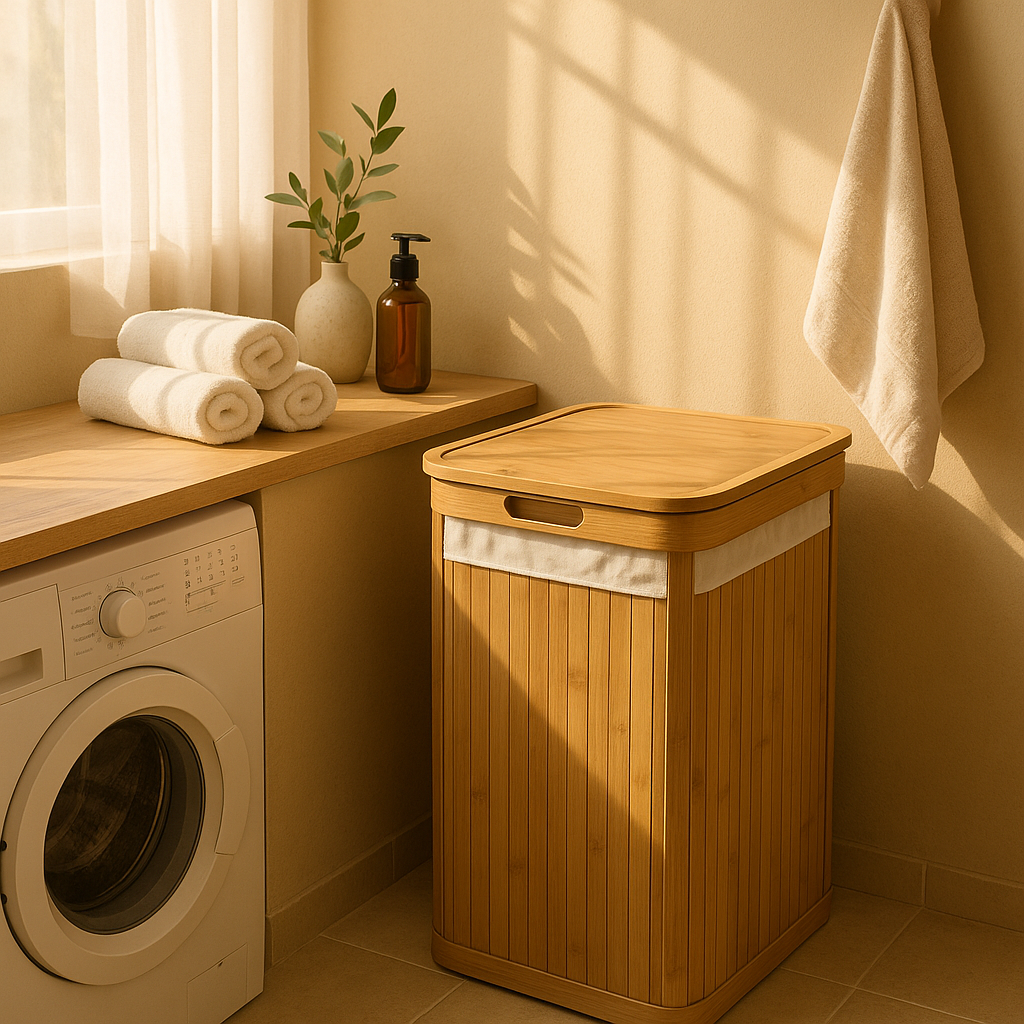
  • A Spa Day for Your Laundry Room: Oceanstar’s Bamboo Hamper Review

    Ever walk past your laundry pile and wish it looked less like a chore and more like part of the room’s décor? That’s the exact itch the Oceanstar Spa-Style Bamboo Laundry Hamper seems designed to scratch. It’s one of those small upgrades that quietly changes how a space feels, without demanding a full room redo.

    First Impressions: Function Meets Calm

    The “spa-style” label isn’t just marketing fluff — it points to a genuine design philosophy. Instead of a plastic bin shoved in a corner, you get something that looks like it belongs next to a stack of folded towels and a diffuser. That matters if your laundry area doubles as a bathroom or an open closet space visible from the hallway.

    Bamboo as a material choice also does real work here. It brings a warm, natural texture that softens a utilitarian space, and it tends to hold up well over time compared to flimsier storage materials. For anyone leaning into a minimalist or Japandi-inspired home aesthetic, this hamper reads more like furniture than laundry equipment.

    Why the Details Matter

    A hamper is one of those items you interact with daily — tossing in clothes, hauling it to the washer, lifting the lid one-handed while balancing a basket. When the basic experience feels smooth and sturdy, it removes one small friction point from your routine. That’s the kind of “boring but important” upgrade that’s easy to overlook until you’ve lived with a wobbly, cheap hamper for a few years.

    The current rating — 4.6 out of 5 stars from 1,162 reviews — suggests that a large number of buyers have found it reliable enough to recommend. That’s a meaningful sample size, and consistency at that volume is worth noting when you’re comparing it to lesser-known alternatives.

    One Honest Caveat

    Here’s the thing worth flagging: exact dimensions and capacity aren’t something we’re guessing at in this review, so if you have a very specific space in mind — a tight bathroom corner, a narrow closet — it’s worth checking the product listing carefully before you buy. Hampers can look deceptively large or small in photos, and bamboo construction, however well-made, isn’t something you want to measure wrong on the first try.

    Where It Fits in a Real Home

    This isn’t a hamper you’d hide in a closet out of embarrassment — it’s one you might actually leave out. That’s really the appeal: laundry storage that doesn’t fight against the rest of your home’s look, whether your style leans coastal, minimalist, or quietly Asian-inspired.

    If you’re the type who notices when a room feels slightly “off” because of one clashing item, this is the kind of small fix that can quietly resolve that. It won’t do your laundry for you, but it might make doing laundry feel a little less like a task and a little more like part of a calmer routine.

    You can take a closer look at the Oceanstar Spa-Style Bamboo Laundry Hamper right here to see if it fits your space.

    This post contains an affiliate link. If you purchase through it, we may earn a small commission at no extra cost to you.

    Sometimes the smallest corners of a home deserve just as much thought as the ones everyone sees.

    🛒 Check the Current Price on Amazon

  • The Sculpted Calm of Japanese Zen Garden Bridges: Crossing as a Path to Reflection

    Photo by Arinal Izzah on Unsplash

    Step onto a stone bridge at a temple garden in Kyoto and you might notice something odd: it doesn’t really go anywhere. The path on the other side simply ends at a wall of moss, or curves back toward where you started. This isn’t poor design. It’s the point.

    In Japanese Zen gardens, bridges rarely exist for pure function. They exist to slow you down, to mark a threshold between one state of mind and another. Before you even reach the other side, something in your pace has already changed.

    Origin: Rooted in Chinese landscape philosophy, adapted into distinctly Japanese garden forms

    Region: Kyoto and surrounding temple regions, later spread nationwide

    Era: Traditionally associated with the Muromachi period, refined through later centuries

    Best known for: Stone slab bridges (ishibashi) and arched wooden bridges (taikobashi) in temple gardens

    Core value: The crossing itself as a form of quiet mental transition

    Why do Japanese Zen garden bridges often lead to nowhere?

    Many visitors expect a bridge to connect two useful points. In a karesansui, or dry landscape garden, that logic often breaks down entirely.

    A stone bridge might span a “river” made of raked gravel, never touching actual water. The far bank might hold nothing but a single rock or a patch of moss, offering no practical destination at all.

    Photo by Arinal Izzah on Unsplash

    This absence of purpose is deliberate. The garden designers wanted visitors to focus on the act of crossing, not the reward waiting on the other side. Removing the destination forces attention back onto the present step.

    How did the bridge become a symbol of transition in Japanese garden design?

    Zen Buddhist thought, imported and reshaped in Japan from around the twelfth century onward, treated physical space as a mirror for inner states. Gardens built around temples were never meant purely as scenery.

    Traditionally, a bridge represented the passage between the ordinary world and a more contemplative one. Crossing from a garden’s outer section into its inner core often meant crossing an actual bridge, reinforcing that this was a boundary worth noticing.

    Some temple gardens placed bridges near the entrance to a meditation hall specifically so that visitors would pause mid-crossing. The bridge became a soft instruction: leave something behind before you go further.

    Over time, this idea extended beyond temples into private strolling gardens of the Edo period, where wealthy patrons commissioned similar crossings purely for the reflective pause they created, even without any religious ceremony attached.

    What materials and forms define a traditional Zen garden bridge?

    Stone slab bridges, or ishibashi, are among the most common. A single flat stone, sometimes rough-edged and uneven, is set directly across a gap in the gravel or a narrow pond.

    Their imperfection matters. A slightly uneven surface asks your feet to pay attention, which pulls your mind out of autopilot and into the moment.

    Arched wooden bridges, or taikobashi, take the opposite approach. Painted or left in natural cedar tone, their steep curve means you can’t see the far side while climbing, only sky and the garden falling away beneath you.

    Photo by Clay Banks on Unsplash

    That brief loss of destination, even for a few seconds, mirrors what the whole garden is trying to teach: attention belongs on the step you’re taking, not the one after it.

    How does crossing a bridge function as a meditative practice?

    Walking meditation isn’t unique to gardens, but a bridge adds a physical structure to an otherwise abstract exercise. The edges narrow your path, removing the option to wander or rush past distractions.

    Each stone or plank sets a small decision: where exactly to place your foot next. This tiny repeated choice keeps the mind anchored to the body instead of drifting toward whatever errand waits after the garden visit.

    Traditionally, some garden paths were designed so a bridge appears right after a particularly dense or shaded section, creating contrast. You emerge from shadow onto open stone, and that shift in light alone can feel like a small reset.

    None of this requires religious belief to work. The bridge simply gives your attention a place to land, one plank or slab at a time, and that structure is often enough to quiet a busy mind.

    What can this teach us about pausing in daily life?

    Most of us don’t have a stone garden bridge nearby, but the underlying idea travels well beyond Kyoto. Any threshold, a doorway, a stairwell, a hallway between rooms, can serve the same function if you let it.

    The Zen garden bridge isn’t magic. It’s a designed reminder that transitions deserve a moment of awareness before you rush through them.

    Try this the next time you cross an actual bridge, indoors or out: slow your pace by half for just those few steps. Notice your feet, notice the air changing slightly as you move from one space to another. That’s the entire practice, no gravel garden required.

    A bridge asks nothing of you except to notice the step you are taking right now.

  • The Fragrant Alchemy of Korean Hwajeon: Eating Flowers Through the Seasons

    Why did Koreans start eating flowers instead of just admiring them?

    The rice cake batter hits a hot, oiled griddle with a soft hiss, and before it firms into shape, someone presses three azalea petals into the pale surface. Not for decoration. The flower is the point—edible, fragrant, and gone in a bite.

    This is hwajeon, a pan-fried rice cake studded with real blossoms, and it asks a question most modern cooking has forgotten to ask: what does a season actually taste like?

    Traditionally, the practice is tied to agrarian life, where the arrival of a flower meant something specific about the soil, the temperature, the turning point of the year. Eating it was a way of absorbing that information, not just admiring it from a distance.

    Origin: Korea, with roots traditionally traced to the Goryeo and Joseon dynasties

    Region: Practiced nationwide, with strong associations to rural and royal court traditions

    Era: Traditionally linked to seasonal festivals, most notably Samjinnal in early spring

    Best known for: Azalea hwajeon in spring, rose hwajeon in summer, chrysanthemum hwajeon in autumn

    Core value: Eating in rhythm with the natural calendar rather than against it

    How does Samjinnal shape the timing of hwajeon making?

    Samjinnal, the third day of the third lunar month, is traditionally regarded as the day swallows return and flowers begin to open in earnest. It marks the unofficial start of hwajeon season.

    Women in villages would gather outdoors near streams or under blossoming trees, a custom sometimes called hwajeon-nori, or “flower cake play.” Cooking became inseparable from conversation, music, and simply sitting outside after a long winter indoors.

    What’s worth noting is that this wasn’t a solitary kitchen task. It was a social event built around a single fragile ingredient that would only be available for a week or two.

    What flowers go into hwajeon across the seasons?

    Spring belongs to the azalea, known in Korean as jindallae, whose petals are thin enough to nearly melt into the rice cake once fried. Their color bleeds slightly into the batter, leaving faint pink veins across the surface.

    Summer shifts to rose petals, sturdier and more fragrant, standing up better to the heat of a Korean summer kitchen. Their perfume tends to dominate, so cooks traditionally use fewer petals per cake.

    By autumn, chrysanthemum takes over, giving rise to gukhwajeon, a version tied closely to the harvest season and to Chuseok-adjacent gatherings. The petals are smaller, more numerous, and scattered rather than pressed whole.

    Each flower is not interchangeable. A cook choosing rose in spring or azalea in autumn would be seen as working against the calendar itself.

    How is hwajeon actually made, petal by petal?

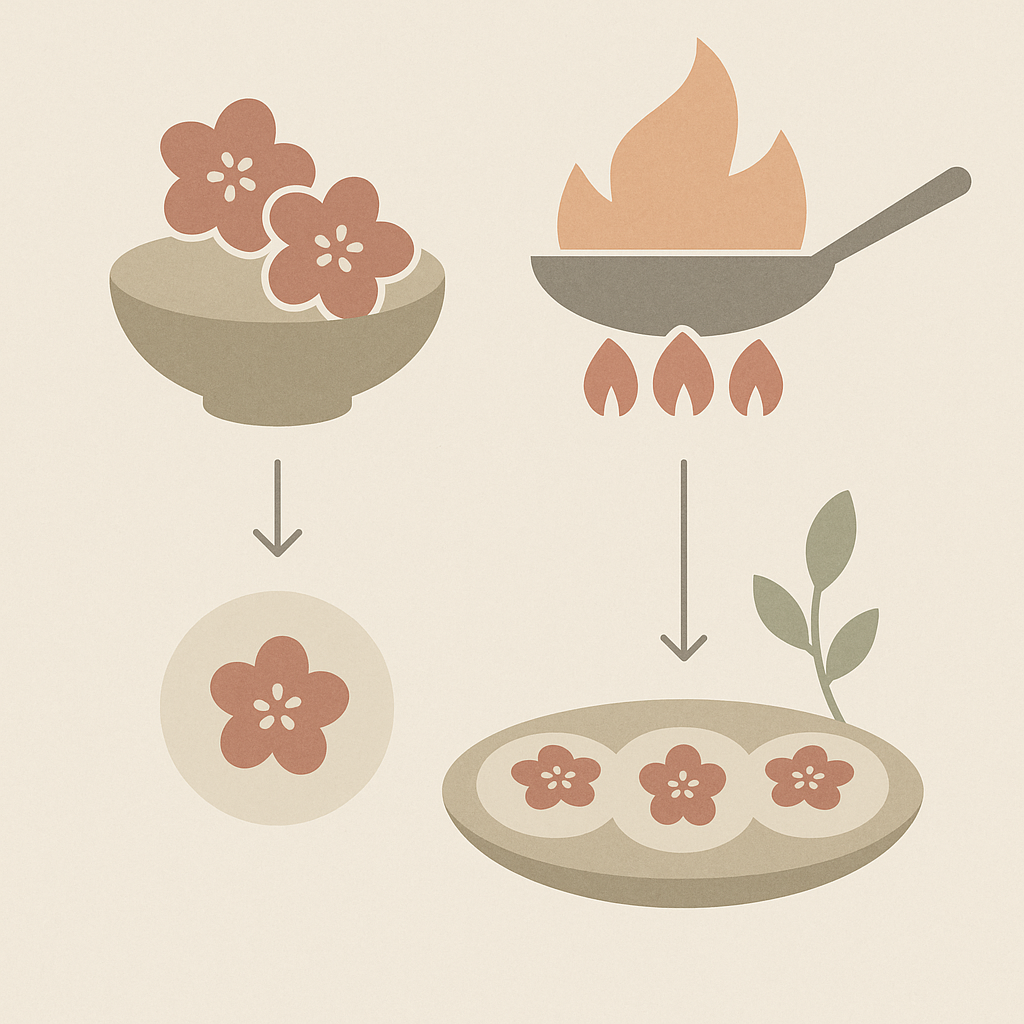
    The base is glutinous rice flour, kneaded with hot water into a smooth, slightly sticky dough. Small rounds are flattened by hand, not rolled, so the thickness stays uneven and forgiving.

    These discs go onto a lightly oiled pan over low heat, where they turn translucent at the edges within a minute or two. This is the exact moment the petals are pressed in, while the surface is still soft enough to hold them without tearing.

    Photo by zero take on Unsplash

    Once the underside sets, the cake is flipped briefly, just long enough to warm the flower without scorching it. A light syrup of honey or sugar water is often drizzled on top afterward, giving the finished cake a faint sheen.

    Texture matters as much as appearance here. A properly made hwajeon should be chewy at the center, slightly crisp at the rim, and cool enough that the petal keeps its shape rather than wilting into mush.

    Why does hwajeon still matter in modern Korean kitchens?

    Contemporary Korean cooking has largely moved toward speed and convenience, which makes hwajeon feel almost deliberately inconvenient by comparison. You cannot rush a flower into bloom, and you cannot substitute one season’s petal for another’s.

    Some Korean cafes and traditional tea houses have reintroduced hwajeon, often paired with herbal teas like omija or citron, as a way of slowing down a meal rather than filling a stomach. It functions less as a dessert and more as a small ceremony marking that the season has changed.

    There’s also a quieter cultural argument embedded in the dish: that beauty and nourishment don’t have to be separate categories. The flower isn’t garnish sitting on top of the food. It is the food.

    That distinction is easy to miss until you’ve actually eaten one and realized the fragrance lingers slightly on your tongue, well after the rice cake itself is gone.

    What’s the simplest way to try this at home?

    You don’t need a griddle full of rare blossoms to start understanding hwajeon. A small batch of glutinous rice flour, a pan, and a handful of pesticide-free edible flowers—violets or pansies work well outside of Korea—are enough for a first attempt.

    Press one petal into one small cake before committing to a full batch. Notice how it changes with heat, how the color shifts, how the smell rises differently than it did raw.

    That single experiment tells you more about hwajeon than any description can: it is a dish built entirely around paying attention to a moment that won’t last.

    A flower eaten in season says more about time than any calendar hanging on the wall.

  • The Gentle Precision of Japanese Temari: Embroidered Spheres of Friendship and Fortune

    Photo by Bernd 📷 Dittrich on Unsplash

    Pick up an old temari and shake it gently—you’ll hear something rattle inside. That sound is often a bell, or in older examples, a coin or a bit of paper with a wish written on it. Before it was an art form displayed under glass, this was a toy children threw against porch floors, and the sound was part of the game.

    Origin: Traditionally rooted in everyday households across Japan, evolving from simple play balls into decorative embroidery

    Region: Practiced widely, with distinct regional styles in areas such as Sanuki (Kagawa) and Matsumoto

    Era: Traditionally traced back several centuries, with the embroidered form flourishing from the Edo period onward

    Best known for: Geometric thread patterns wound and stitched over a round core

    Core value: A handmade token of friendship, protection, and good fortune, often exchanged rather than sold

    Why did temari begin as scraps of leftover thread?

    Long before silk embroidery floss was designed specifically for temari, mothers reached for whatever thread remained after making or repairing kimono. Cotton scraps got wound into a dense ball, then wrapped again with brighter leftover thread to hold everything together. Nothing was wasted; the toy itself was a byproduct of textile thrift.

    This origin matters because it explains why temari feels so intimate as a craft. It wasn’t commissioned or produced for sale in its earliest form. It was made at home, often by a mother for a daughter, using the literal remnants of the family’s clothing.

    Photo by Thomas Marban on Unsplash

    How is a single temari sphere actually constructed?

    The base, called a shin, was traditionally formed from rice husks or cotton wadding, tightly bound with thread until it held a stable round shape. Over that base, plain thread is wound in even layers to create a smooth, firm sphere—this stage alone can take hours before a single decorative stitch appears.

    Only then does the embroidery begin. The maker divides the sphere into sections using pins and thin guide threads, the way you might mark longitude lines on a globe. Colored silk or cotton thread is then stitched along these guides, building geometric patterns entirely by counting stitches, without drawing anything on the surface first.

    There’s no room for correction once the thread is set. A miscounted stitch throws off the entire symmetry, so temari making rewards patience over speed in a way few crafts do.

    What do the geometric patterns actually mean?

    Many traditional motifs echo natural forms—chrysanthemum petals, pine needles, interlocking diamonds resembling rice fields seen from above. These aren’t random decoration; specific patterns carry specific associations, such as long life or abundant harvest, passed down through regional families of makers.

    Color choices matter just as much as pattern. A maker in one region might favor deep indigo and cream for a restrained, formal look, while another region’s temari bursts with magenta, gold, and green in tightly packed bands.

    Because the patterns rely on mathematical division of the sphere into equal sections, the same base structure can produce dramatically different results depending on how many divisions the maker chooses. Six, eight, or sixteen sections all yield distinct visual rhythms from the same starting technique.

    Why did temari become tied to New Year’s wishes?

    Temari traditionally circulate at the turn of the year, given as gifts meant to carry a quiet wish for the recipient’s coming months. The hidden bell or rattle inside connects to this—an object with something moving inside it, sealed away, echoes the idea of a wish held safely within.

    Photo by Clay Banks on Unsplash

    Grandmothers giving temari to grandchildren, or friends exchanging them between households, reinforced a social thread as much as a decorative one. The gift wasn’t valued for material cost; a temari made from scrap thread carried the same weight as one made from fine silk, because the labor and intention were the point.

    How do modern makers keep this craft alive?

    Contemporary temari artists now use synthetic foam or styrofoam cores instead of rice husks, and commercially dyed silk thread instead of kimono scraps. The construction principle, though, hasn’t changed—wind, divide, count, stitch.

    Workshops and small regional guilds continue teaching the base-stitch patterns to newer generations, often through hands-on repetition rather than written instruction. Because the technique depends so heavily on counting and muscle memory, it’s traditionally learned by sitting beside someone who already knows it, not from a diagram alone.

    Some makers now sell finished temari as decorative objects rather than toys or gifts, which has shifted how elaborate the patterns have become. A sphere meant to be displayed on a stand invites far more intricate stitching than one meant to survive being tossed around a yard.

    What does temari ask of the person making it?

    Unlike embroidery on flat fabric, a curved surface offers no straight lines to guide the eye. Every stitch has to account for the sphere’s roundness, which means the maker is constantly adjusting tension and spacing by feel rather than by ruler.

    That demand for attentiveness is arguably the real inheritance of temari—not the finished object, but the discipline of slow, exact hands. A single sphere might represent twenty or thirty hours of stitching before it’s ever given away.

    If you want to feel a small piece of that discipline yourself, try this: find a round object—an old ball, a foam sphere, even a tightly wound ball of yarn—and wrap a single contrasting thread around it in an even spiral, counting each wrap out loud. Notice how quickly your count slips if your attention wanders, and how much steadier your hand gets by the twentieth wrap.

    A wish stitched slowly into thread holds its shape longer than one merely spoken.

  • The Sacred Geometry of Chinese Bagua Mirrors: Warding Off Fortune’s Edge

    Photo by Victoria Wang on Unsplash

    Walk through an old hutong in Beijing and look up at the lintels. Above certain doorways hangs a small octagonal disc, sometimes convex, sometimes flat, its surface catching fragments of sky and passersby in a slightly warped reflection. No one explains it to you. The neighbors just know it’s there for a reason, and that reason is older than the buildings themselves.

    Origin: Rooted in Taoist cosmology and the I Ching (Yijing)

    Region: China, especially southern and coastal regions with strong feng shui practice

    Era: Traditionally traced to early Taoist philosophical development, refined over centuries

    Best known for: Deflecting negative energy (sha qi) from doorways and windows

    Core value: Balance between visible architecture and unseen cosmic forces

    Common form: Octagonal frame, eight trigrams, central mirror (convex, flat, or concave)

    Why do Chinese homes hang a mirror that reflects nothing back clearly?

    A bagua mirror isn’t meant to help you check your reflection. Its surface is often convex, bending light and distorting whatever stands in front of it. This distortion is the point: the mirror is designed to disrupt, not to flatter.

    Photo by 嘲 风 on Unsplash

    In feng shui thinking, sharp angles, oncoming roads, or a neighbor’s protruding wall corner can direct what’s called sha qi, a kind of aggressive or stagnant energy, toward a home’s entrance. The mirror’s job is to scatter that energy before it settles inside.

    How did the bagua mirror originate in Taoist cosmology?

    The mirror’s design traces back to the Yijing, the Book of Changes, a text that organized the universe into eight fundamental principles called trigrams. Taoist scholars traditionally built entire systems of divination and spatial arrangement around these eight configurations.

    Over time, artisans and geomancers began mounting mirrors at the center of an octagonal frame inscribed with the trigrams. The combination merged two older beliefs: mirrors as reflective, energy-repelling objects, and the trigrams as symbols mapping the structure of change itself.

    By the time this practice became common in home construction across southern China, the bagua mirror had shifted from a purely divinatory tool into an architectural one, hung outward-facing above doors and windows rather than kept as a handheld object.

    What do the eight trigrams actually represent?

    Each trigram is built from three stacked lines, either broken or unbroken, representing yin and yang in combination. Together they stand for natural forces: heaven, earth, thunder, wind, water, fire, mountain, and lake.

    Arranged in a circle around the mirror, these eight symbols aren’t decorative filler. Practitioners read them as a complete cosmological map, meaning the mirror at the center sits inside a miniature model of the universe’s balancing forces.

    How is a bagua mirror different from an ordinary mirror?

    Size matters less than intention here. A bagua mirror is almost never placed indoors for daily use like a bathroom or bedroom mirror. Its orientation is strictly outward, facing whatever is believed to be sending harmful energy toward the home.

    Photo by zhang kaiyv on Unsplash

    The curvature also carries meaning. A convex mirror is thought to push energy away, a concave one to draw energy in, and a flat mirror simply to reflect it back toward its source. Choosing the wrong type, practitioners say, can reverse the intended effect entirely.

    Why does placement matter more than the mirror itself?

    Hang a bagua mirror facing a neighbor’s front door, and you risk redirecting whatever you’re deflecting straight at them. This is why traditional feng shui consultants are often more concerned with angle and target than with the mirror’s craftsmanship.

    Some households avoid the practice altogether for exactly this reason, preferring interior remedies like plants or wind chimes that don’t project outward at all. The mirror is considered a more assertive, almost confrontational tool compared to these gentler alternatives.

    How do modern households use this ancient tool today?

    Contemporary apartment dwellers in cities like Guangzhou or Xiamen still buy bagua mirrors, though often smaller and mass-produced rather than hand-carved from wood. The belief persists even as the objects themselves have become simplified.

    Some buyers pair the mirror with a red ribbon or tassel, a detail believed to activate its protective function. Others consult a feng shui practitioner before installation, since improper placement is taken seriously enough that guesswork is discouraged.

    What hasn’t changed is the underlying logic: architecture and energy are treated as inseparable, and a small object above a door is trusted to mediate between the two.

    What can you take from this the next time you walk past a doorway?

    You don’t need to hang a mirror to appreciate the thinking behind it. Notice, instead, how much attention traditional Chinese design pays to thresholds, the exact point where outside becomes inside.

    If you want to experience this firsthand, look for a bagua mirror in a shop specializing in feng shui items and examine the trigram arrangement up close. Ask the seller which curvature they’d recommend for a specific doorway, and you’ll get a quick, practical lesson in a cosmology that’s still very much alive.

    Some doors need more than a lock; they need a mirror that knows which way to bend the light.