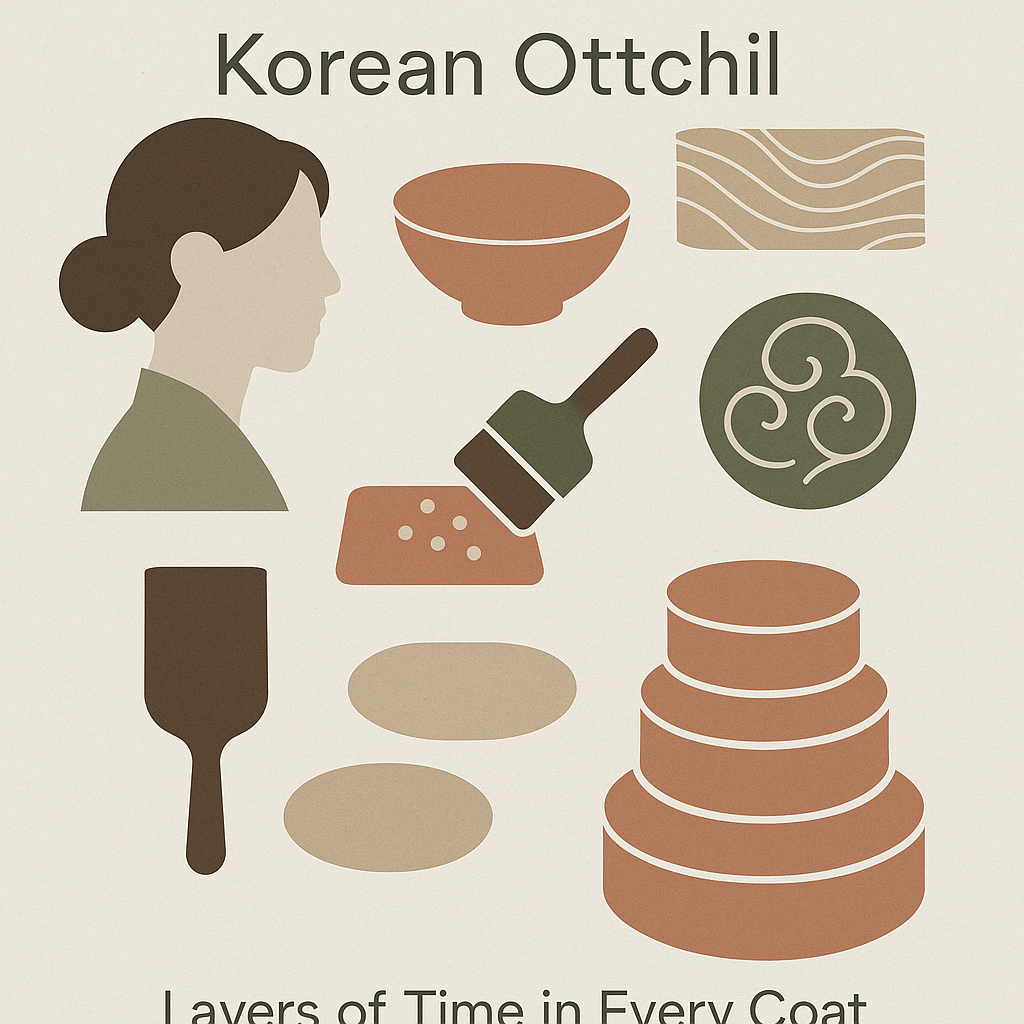
The first time raw lacquer sap touches unprotected skin, it raises a red, itching welt within hours. That is why artisans who work with Ottchil wear long sleeves even in August heat, wrap their hands, and turn their faces from the mixing bowl. This is not a craft that forgives shortcuts, and it never has been.
Ottchil, Korea’s traditional lacquer, is made from the sap of the otnamu tree and applied in dozens of near-invisible coats. What looks like a simple black bowl or a small box may hold months of a craftsman’s patience inside its surface. That patience is the whole point.
Origin: Sap of the native otnamu (lacquer tree), traditionally tapped by hand
Region: Korean peninsula, historically concentrated around Tongyeong and other southern coastal areas
Era: Traditionally traced to ancient tomb artifacts, with major flourishing during the Goryeo dynasty
Best known for: Najeon chilgi, lacquerware inlaid with cut mother-of-pearl
Core value: Layered patience — durability and depth built through repetition, not speed
Why does a single bowl take months, not days, to finish?
A finished Ottchil piece can carry twenty, thirty, sometimes closer to forty layers of lacquer, each one applied only after the last has fully cured. Rushing the process does not just risk a poor finish; it risks the whole object cracking apart within a year.
Between coats, the piece rests in a controlled drying space, often for a full day or more, before being sanded back down to near-invisible smoothness. Then the next coat goes on. The craftsman is not decorating an object so much as growing it, coat by coat, the way sediment builds a riverbed.
How did Ottchil become bound to Korea’s royal and religious life?
Lacquered objects have turned up in ancient Korean tomb sites, suggesting the technique traditionally reaches back well over a thousand years. But it was during the Goryeo dynasty that Ottchil found its most celebrated expression, in najeon chilgi pieces made for Buddhist sutra boxes and courtly use.
These weren’t decorative luxuries for their own sake. A lacquered sutra box protected sacred texts from humidity and insects for generations, which made the craft as much about preservation as beauty. That practical root still shapes how Ottchil is valued today.
What makes the raw sap so difficult to tame?
Otnamu sap is harvested in careful seasonal windows, usually collected in small quantities that make it precious from the very start. Once collected, it must be filtered to remove impurities and then blended, sometimes with iron oxide or other natural pigments, to reach the deep black or reddish-brown tones associated with the craft.
Handling it wrong doesn’t just ruin a batch — it can leave a mark on the artisan’s own skin for days. This is one reason lacquer training in Korea has traditionally passed slowly, master to apprentice, rather than through quick instruction.

Why does humidity, not heat, control the outcome?
Unlike paint or varnish, Ottchil doesn’t dry through evaporation. It cures through a slow oxidation process that actually requires a humid, relatively cool environment to harden properly.
Too dry a room, and the lacquer stays tacky for weeks. Too much direct heat, and the surface can crack before it ever hardens. Artisans learn to read the air in their workshop almost the way a farmer reads the sky before harvest.
What role does mother-of-pearl play in this tradition?
Najeon chilgi takes the base craft one step further, setting thin, cut pieces of iridescent shell into the lacquered surface before additional coats seal them in place. The shell is shaped with fine saws, fitted into the surface, and only then buried under more layers of lacquer and polish.
The final polish reveals the shell glowing faintly through the black, shifting color as the light and viewing angle change. It’s a quiet effect, closer to catching a glimpse of something than seeing it outright.
How is this craft continuing in Korea today?
A shrinking number of workshops, many concentrated in coastal towns with long lacquerware histories, still train apprentices in the traditional method. Some contemporary designers have begun pairing Ottchil techniques with simpler, more modern forms, aiming to keep the material relevant without abandoning its slow process.
Craft museums and cultural centers across Korea now offer occasional demonstrations, letting visitors watch a single coat go on and understand, in real time, just how much waiting stands behind every finished piece.
If you’re curious to experience this in a small way, look for a Korean craft museum or cultural center near you that features lacquerware demonstrations, or seek out a small najeon chilgi piece from a maker who documents their process. Spend a few minutes really looking at the surface before you touch it — count the depth in the shine, not just the shell.
True depth is never applied all at once; it is built, one patient coat at a time.