[태그:] traditional crafts

  • The Woven Legacy of Japanese Kumihimo: Braided Cords as Silken Craft

    Photo by sıtkı aksoy on Unsplash

    Look closely at the cord sealing a lacquer box in a Kyoto tea shop, and you’ll notice something odd: it isn’t tied in a simple knot. It’s a tight, geometric braid, dozens of silk threads locked into a pattern that looks almost machine-printed but was made entirely by hand on a wooden stand.

    That cord has a name — kumihimo — and it has been quietly holding together Japanese armor, prayer scrolls, and kimono sashes for centuries. Most visitors walk past it without a second glance. Once you know what you’re looking at, you can’t unsee it.

    Origin: Japan, with early forms traditionally linked to Buddhist and court use

    Region: Kyoto and Iga are historically associated with kumihimo production

    Era: Traditionally traced to the Nara and Heian periods, refined through the samurai era

    Best known for: Braided silk cords used in armor lacing, sword fittings, and obi-jime

    Core value: Structural strength paired with disciplined, repetitive handcraft

    Why did braided cords become essential to samurai armor?

    Samurai armor was never a single rigid shell. It was built from small lacquered plates, and those plates needed something flexible enough to move with the body yet strong enough to survive a blade strike. Braided silk cords, known as odoshi, threaded through the plates and held the whole structure together.
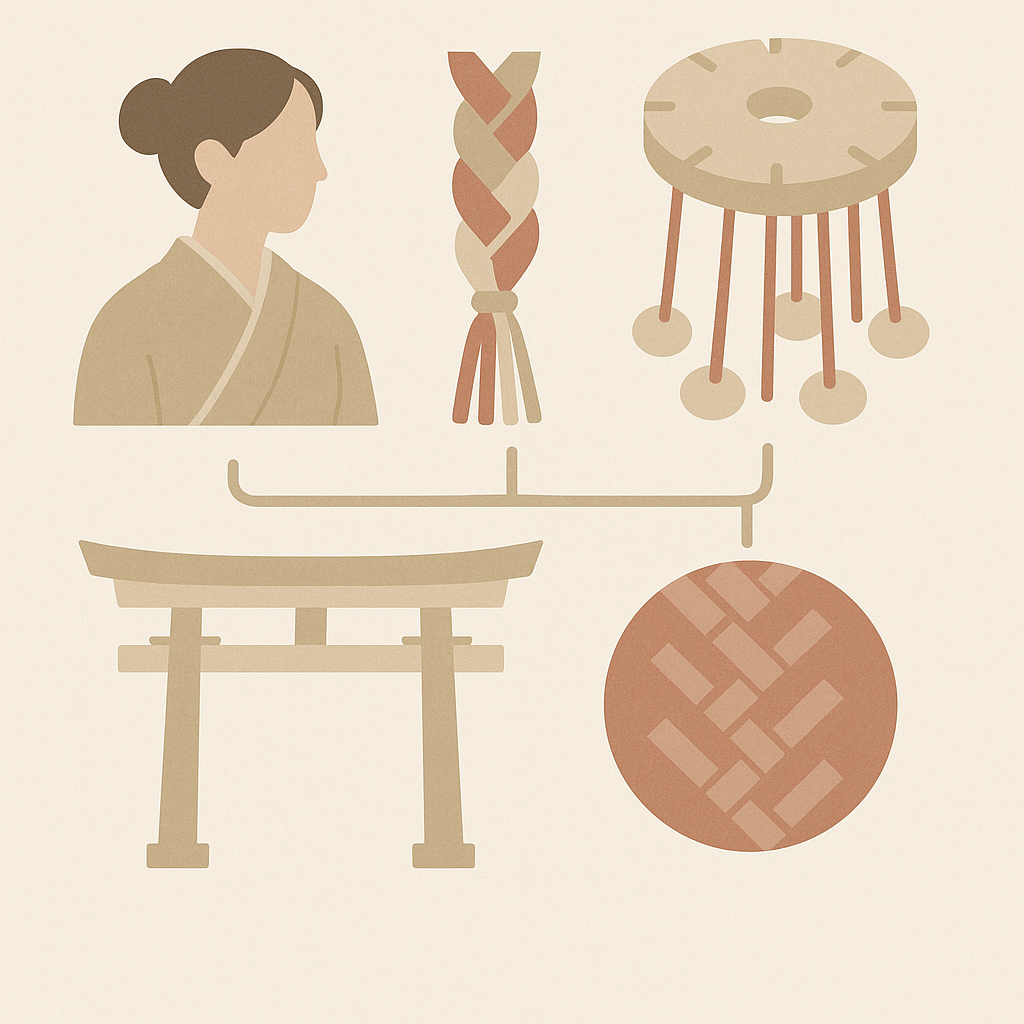
    A single suit of armor could require an enormous length of cord, dyed in colors that signaled a clan or a rank. The braid had to resist fraying under repeated stress, which meant the twisting pattern mattered as much as the silk itself. This is where kumihimo stopped being decorative and became load-bearing engineering.

    How does the kumihimo disk shape every thread’s path?

    Traditional kumihimo is made on a stand called a marudai, a round wooden disk balanced on four legs with a hole in the center. Silk threads, wound onto small bobbins called tama, hang around the disk’s edge, each one weighted just enough to keep tension even.

    The braider moves the bobbins in a fixed sequence, crossing threads over and under according to the pattern being made. There’s no shortcut here — every centimeter of cord passes through the same deliberate hand motion, repeated thousands of times until the braid reaches its finished length.

    Change the crossing sequence, and you get a different structure entirely: flat, round, or hollow, each suited to a different use. A flat braid drapes differently around an obi than a round one does around a sword hilt, so the choice was never arbitrary.

    What makes silk the material of choice for kumihimo?

    Silk threads have a particular sheen and give that cotton or hemp simply don’t replicate. When light hits a finished kumihimo cord, the twisted fibers catch it at slightly different angles, creating a subtle shimmer along the braid’s length rather than a flat surface.

    Silk also holds dye with unusual depth, which mattered enormously in a craft where color coded meaning. A particular shade of purple or crimson in an obi-jime wasn’t just an aesthetic choice — it could signal the season, the occasion, or the wearer’s taste in a way that was instantly legible to anyone trained to read it.

    How did kumihimo move from armor to everyday dress?

    As Japan’s periods of large-scale warfare gave way to longer stretches of peace, demand for armor lacing declined. The same braiding skill didn’t disappear, though — it shifted toward the textile needs of daily life, particularly the kimono.

    Photo by Clay Banks on Unsplash

    The obi-jime, a narrow braided cord tied over the obi sash, became one of kumihimo’s most visible everyday applications. It does real work, keeping the obi’s knot secure through a full day of movement, but it also became a small canvas for color and texture against the broader expanse of fabric.

    Sword fittings, tea ceremony tools, and Buddhist ritual objects kept other branches of the craft alive during this same period. The techniques stayed remarkably consistent even as their purpose changed.

    What should you look for in a well-made kumihimo cord?

    Run your fingers along a genuine handmade cord and you’ll feel a faint, regular texture — the ridges where threads cross — that machine-made braid tends to smooth over. The tension should feel even along the entire length, with no loose or overly tight sections.

    Color transitions, if the cord has them, should shift gradually rather than in an abrupt block. That gradual blending is a signature of skilled bobbin sequencing, not something added after the braid is finished.

    Weight matters too. A well-braided silk cord has a slight substantial feel in the hand, neither limp nor stiff, because the crossing pattern itself gives it structure.

    How can you start noticing kumihimo in daily life?

    You don’t need a kimono or a katana to begin paying attention. Reusable gift cords, phone straps, and even some jewelry now use simplified kumihimo techniques, and small braiding disks are sold for beginners who want to try a basic four-thread pattern at home.

    Next time you’re near a Japanese textile shop or museum display, look for the braid before you look at the fabric it’s attached to. Ask what the cord is holding together, and how many threads went into making it. That single question tends to unravel a much longer story than the cord itself ever suggests.

    A single cord, twisted thread by thread, can hold together an entire history.

  • The Woven Warmth of Korean Nubi Quilting: Stitching Comfort into Tradition

    Photo by K Adams on Unsplash

    The Sound Before the Softness

    Before you ever touch a nubi quilt, you hear it. Run your palm across the surface and there’s a faint, rhythmic ridge pattern beneath your fingers—rows upon rows of tiny parallel stitches, so dense they feel almost like corduroy.

    This isn’t decoration. Each line of stitching is doing real work, trapping pockets of air between layers of fabric and cotton batting. That’s the whole secret of nubi: warmth engineered one needle-pull at a time.

    Where the Technique Comes From

    Nubi quilting traditionally traces back centuries in Korea, originally developed as a practical solution to brutal winters on the peninsula. Farming and working-class families needed bedding and clothing that could withstand harsh cold without the expense of thick fur or heavy layers.

    The technique likely spread from royal courts and Buddhist temples, where monks needed durable, warm garments for meditation in unheated halls, down into everyday households. Over generations, what started as a survival necessity became a refined craft, with regional variations in stitch width and pattern density.

    Some of the finest surviving examples show stitches so fine and evenly spaced that they resemble machine work—except every single one was done by hand, often by women working through winter evenings by candlelight.

    The Math Hidden in the Stitches

    Here’s something most people don’t realize: the width between nubi stitch lines isn’t random. Traditionally, makers followed measurements based on finger-widths or simple ratios, spacing rows anywhere from a few millimeters to about a centimeter apart depending on the intended use.

    Tighter stitching meant a stiffer, more durable fabric suited for outerwear or floor cushions that would see heavy daily use. Looser stitching produced a softer drape, better for blankets meant to be wrapped around the body at night.

    Photo by K Adams on Unsplash

    This wasn’t guesswork passed down through trial and error alone—it was a kind of textile engineering, refined by people who understood exactly how much air a body needs trapped against it to stay warm.

    Cotton, Not Silk, Was the Point

    Unlike some East Asian textile traditions that prized silk brocade for warmth items, nubi quilting historically centered on cotton. Cotton batting sandwiched between two layers of plain-weave cotton fabric, then stitched through all three layers at once.

    This made nubi items accessible. A family didn’t need imported silk or elaborate dye work to stay warm—they needed skill, patience, and a needle.

    That egalitarian quality is part of why nubi survived so widely across social classes. It shows up in humble sleeping mats and simple vests just as often as in more elaborate ceremonial pieces.

    Why It Still Matters in a World of Synthetic Insulation

    You can buy a down jacket rated to negative twenty degrees at any outdoor store. So why does nubi persist?

    Partly it’s texture—the specific weight and give of hand-quilted cotton feels different against skin than synthetic fill, less slippery, more grounded. Partly it’s breathability; cotton batting handles moisture in a way that synthetic insulation sometimes struggles with, which matters if you’re wrapped in a blanket all night.

    Photo by zero take on Unsplash

    But there’s also something less measurable happening. A nubi quilt carries visible evidence of hours of human attention. Every stitch line is a small record of someone’s patience, and that’s not something a factory-sealed insulated jacket can replicate.

    Finding Nubi Today

    Contemporary Korean designers have started reinterpreting nubi for modern life—quilted jackets with cleaner silhouettes, home goods that keep the stitch pattern but simplify the color palette. You’ll find it in boutique shops in Seoul’s Insadong district or increasingly through independent makers selling online.

    The craft hasn’t fossilized into museum-piece status. It’s still being made, worn, and slept under.

    Try This Today

    You don’t need a full quilt to understand nubi’s logic. Take any scrap fabric and a piece of thin batting, sandwich them, and hand-stitch three or four parallel lines a centimeter apart.

    Feel how the fabric stiffens slightly and gains loft where you’ve stitched. That small experiment tells you more about why this technique kept generations warm than any photograph ever could.

    Warmth, it turns out, can be stitched—one patient line at a time.

  • The Layered Art of Japanese Furoshiki: Wrapping as a Way of Life

    Photo by Sandra Harris on Unsplash

    The Cloth That Remembers Its Folds

    In a small grocery in Kyoto, an elderly clerk once wrapped a single watermelon in a square of indigo cotton, tucked the corners into a knot, and handed it over with a built-in handle. No tape, no box, no plastic net. The whole transaction took maybe fifteen seconds.

    That square of cloth is called furoshiki, and it does something most modern packaging can’t: it disappears back into your bag when you’re done, ready to become something else tomorrow. A grocery wrap today, a gift cover next week, a picnic mat after that.

    From the Bathhouse Floor to the Merchant’s Cart

    The name itself tells a story. “Furo” means bath, “shiki” means to spread out, and the cloth traditionally got its name from the mats bathers used to stand on while undressing at communal bathhouses, keeping their belongings separate from everyone else’s.

    Cloth wrapping in Japan goes back further still, with fabric used to bundle and protect valuables traditionally dating to the Nara period, when temple treasures were kept folded in cloth for storage. But it was during the Edo period, as bathhouse culture spread through the growing city of Edo, that the practical habit of wrapping one’s clothes and toiletries in a square cloth turned into something closer to a design tradition.

    Merchants noticed. A wrapped parcel was easier to carry through crowded streets than a rigid box, and a printed cloth signaled who you were, what shop you patronized, even what season it was.

    A Different Knot for Every Shape

    What makes furoshiki genuinely clever is that the cloth adapts to the object instead of the other way around. A book gets a simple diagonal fold called otsukai-zutsumi, tight and flat. A bottle of sake gets bin-zutsumi, where two corners twist upward into a carrying loop that also cushions the glass.

    Photo by Sandra Harris on Unsplash

    Watermelons, awkward and round, have their own method entirely: the cloth cradles the fruit like a sling, knotted at the top so the weight distributes evenly across your palm instead of straining your fingers. There are traditionally dozens of named wraps, each solving a specific problem of shape, weight, or fragility.

    Learning even three or four of these folds changes how you look at a square of fabric. It stops being decorative and starts being a tool.

    Plastic Bags, and Why the Cloth Came Back

    Furoshiki nearly vanished after the war, pushed aside by cheap paper bags and then plastic. For a few decades, wrapping cloth felt like something only grandmothers still bothered with.

    That changed as Japan’s Ministry of the Environment began actively promoting furoshiki in the 2000s as a low-effort alternative to single-use bags, distributing instructional pamphlets and holding public demonstrations. The timing lined up with a broader unease about packaging waste, and suddenly a centuries-old habit looked less nostalgic and more practical.

    Textile designers responded by printing furoshiki with contemporary patterns, bold geometric prints alongside the traditional cranes and waves, so the cloth could sit on a office desk without looking like a museum piece.

    Photo by Clay Banks on Unsplash

    Wrapping as an Act of Attention

    There’s a concept in Japanese called mottainai, a sense of regret over waste, and furoshiki carries that idea in its very construction. You don’t throw away a wrapping cloth after one use; you fold it flat and use it again next week, in a completely different shape.

    Gift-giving makes this especially visible. Wrapping a present in furoshiki takes longer than taping paper around a box, and that extra time is part of the message. You’re telling the recipient the object mattered enough to handle carefully, and the cloth itself becomes a second gift once the first one is unwrapped.

    Compare that to gift wrap destined for the trash within minutes, and the philosophy behind furoshiki starts to feel less quaint and more like a quiet argument about what things are worth.

    Try This Today

    Find any square scarf or bandana in your closet, roughly 20 inches across. Place a book or a bottle in the center, fold two opposite corners over the top, then tie the remaining two corners into a simple knot on top.

    Carry it that way for one errand this week instead of reaching for a bag. Notice how the cloth folds flat in your pocket afterward, ready for whatever you need to carry next.

    A single cloth, folded differently each time, can hold almost anything you're willing to carry with care.