[태그:] traditional craft

  • The Rhythmic Craft of Korean Ottogi Dolls: Resilience Rolled into Folk Toy Form

    Photo by Bao zi on Unsplash

    Why does the Ottogi doll always return to standing?

    Push it, tip it sideways until it nearly touches the table, and let go. Within a second, the little rounded figure rocks back and forth and settles upright again, as if nothing happened. This isn’t a trick—it’s physics built into the doll’s shape.

    The secret sits at the bottom, where a weighted, rounded base keeps the center of gravity low no matter which way the toy tips. Korean toymakers understood this instinctively, long before anyone explained it in terms of physics. They shaped clay, paper, and wood so that gravity itself would do the work of “healing” the toy after every fall.

    That single mechanical fact became the seed of an entire cultural metaphor. A toy that cannot stay down turned into a stand-in for a person who refuses to stay down either.

    Origin: Traditional Korean folk toy, name derived from “ottok,” describing a sudden upright motion

    Region: Found across the Korean peninsula, especially in rural and agrarian communities

    Era: Traditionally rooted in pre-modern folk toy culture, popularized further in the 20th century

    Best known for: Self-righting weighted base symbolizing resilience

    Core value: Perseverance and recovery after hardship

    Photo by Frank Ng on Unsplash

    Materials: Traditionally papier-mâché, clay, or wood; later mass-produced in plastic

    How did the Ottogi become a symbol of resilience in Korean folk culture?

    In agrarian Korea, life ran on cycles of drought, flood, poor harvests, and slow recovery. Farmers and families needed a language for endurance that didn’t rely on words. A toy that fell and rose again, over and over, without complaint, offered exactly that.

    Parents traditionally gave Ottogi dolls to children not just as playthings but as small lessons. The message was simple and physical: setbacks are inevitable, but staying down is a choice, not a fact of life.

    This idea wasn’t confined to nurseries. Proverbs and everyday speech in Korea still reference the Ottogi spirit when describing someone who bounces back from failure, illness, or financial ruin. The doll became shorthand for a very human trait, expressed through an object a child could hold in one palm.

    What materials and craftsmanship go into a traditional Ottogi doll?

    Older Ottogi dolls were typically built from layers of paper pulp or papier-mâché, dried and hardened around a weighted core, often sand, clay, or small stones packed into the rounded base. This gave the toy just enough heft at the bottom to guarantee the self-righting motion.

    The outer surface was usually painted by hand, often depicting a round, cheerful face with exaggerated features—wide eyes, a stubby nose, sometimes a topknot or traditional hairstyle referencing folk characters. Colors leaned toward warm reds, yellows, and whites, echoing broader Korean folk art palettes.

    Because each doll was shaped and painted individually, no two traditional Ottogi looked exactly alike. Slight asymmetries in the base actually mattered less than they might seem; as long as the weight sat low and centered, the wobble-and-recover motion worked regardless of minor imperfections in form.

    Photo by zero take on Unsplash

    How did the Ottogi doll travel from folk toy to modern icon?

    By the mid-20th century, the Ottogi’s symbolism had grown sturdy enough to leave the toy chest entirely. Businesses and brands began borrowing the image, betting that customers would recognize the shorthand for resilience without needing it explained.

    The most visible example is a well-known Korean food company that adopted “Ottogi” as its name, using the doll’s silhouette as part of its identity. The choice wasn’t decorative—it was a deliberate nod to steadiness and recovery, qualities a food brand wanted associated with its products during a period of postwar rebuilding.

    Beyond commerce, the doll’s shape has echoed into design details on stationery, ceramics, and children’s media, usually stripped of extra ornamentation but keeping the round, self-righting base intact. Even simplified, the form is instantly readable to anyone raised with the toy nearby.

    What can the Ottogi teach us about facing setbacks today?

    Strip away the folklore, and the Ottogi’s lesson is almost embarrassingly literal: build your center of gravity low enough, and falling over stops being catastrophic. It becomes routine, expected, survivable.

    That’s a strange kind of comfort to find in a children’s toy. It doesn’t promise that tipping over won’t happen—it assumes it will, repeatedly, and designs for that reality instead of pretending otherwise.

    For a culture shaped by long stretches of hardship and rebuilding, that assumption made sense. The Ottogi never asked to avoid falling; it just made sure getting up again was never in question.

    How can you bring this idea into your own routine?

    Find or make a simple roly-poly figure—craft kits and traditional toy shops both carry versions—and place it somewhere visible, like a desk or windowsill. Each time you notice it, give it a small push and watch it recover.

    Let that ten-second ritual serve as a physical reminder rather than an abstract slogan. The doll doesn’t lecture; it just demonstrates, quietly, that recovery can be built into the shape of a thing—and maybe into the shape of a day.

    A low center, a steady fall, and the quiet certainty of standing up again.

  • The Fermented Depth of Japanese Miso: A Craft Passed Through Generations

    Photo by Nicholas Ng on Unsplash

    In a wooden shed behind a farmhouse in Nagano, a grandmother lifts the lid off a cedar barrel and the smell hits before anything else—something between roasted nuts, wet earth, and the faint sweetness of caramel left too long on a stove. She presses two fingers into the paste, checks its give, and says nothing. She has done this every winter for over fifty years, and the barrel has been in the family for longer than that.

    This is miso before it becomes a soup base or a marinade. It is, at this stage, still alive—a slow chemical conversation between soybeans, salt, koji mold, and time. Understanding that conversation explains why miso tastes the way it does, and why no two barrels, even from the same kitchen, ever taste quite identical.

    Origin: Japan, adapted from earlier fermented soybean pastes introduced from the Asian mainland

    Region: Nationwide, with strong regional variation between Kyoto, Nagoya, and northern Japan

    Era: Traditionally refined from the Nara and Heian periods onward, becoming a household staple by the Edo period

    Main ingredients: Soybeans, salt, koji (rice, barley, or soybean mold culture)

    Best known for: Miso soup, marinades, and glazes in Japanese home cooking

    Core value: Patience—flavor built through months or years of controlled fermentation

    How did miso first arrive in Japanese kitchens?

    Fermented bean pastes were not born in Japan; they traveled there, likely through contact with the Asian mainland, and were gradually reshaped to fit local tastes and available grains. Early versions were coarser, saltier, closer to a preserved condiment than the smooth paste people know today.

    Photo by Thomas Marban on Unsplash

    Over centuries, Japanese producers began experimenting with koji—a mold culture traditionally cultivated on steamed rice—to soften the fermentation and coax out deeper sweetness. By the time of the Edo period, miso had settled into something recognizably domestic: a daily-use staple rather than an imported curiosity.

    That shift mattered. Once miso became ordinary enough for every household to make its own, regional water, climate, and grain habits started shaping distinct local styles. This is why a jar of miso from Kyoto and one from Sendai can taste like entirely different foods.

    Why does the aging barrel matter more than the recipe?

    Ask a miso maker for their recipe and they will often shrug. The ratios of soybean to salt to koji matter, yes, but the barrel itself does most of the work. Wood breathes, it holds resident microbes from decades of use, and it releases those microbes slowly into each new batch.

    This is why some households refuse to switch to stainless steel, even though it is easier to clean and more consistent. A cedar barrel carries a kind of memory—strains of bacteria and yeast that have colonized its grain over generations, invisible but active every time a new batch goes in.

    Temperature and season play their part too. A barrel left through a humid summer develops differently from one that ages mostly through cold months, and experienced makers can taste the difference between a “summer-heavy” miso and one that matured slowly through winter.

    What separates white, red, and mixed miso from one another?

    The color of miso tells you almost everything about how long it fermented and what it was fermented with. Shiro miso, pale and mild, ferments for a matter of weeks and leans on a higher proportion of koji, which produces a gentler, almost dessert-like sweetness.

    Aka miso, dark and assertive, needs far longer—often a year or more—and develops a deep, almost smoky bitterness from the extended Maillard-like browning that happens slowly at room temperature. Between these two extremes sits awase miso, a blend that home cooks favor precisely because it balances sweetness against depth.

    None of these types are “better” in an absolute sense. A cook reaching for shiro miso to glaze grilled fish is making a different flavor decision than one reaching for aka miso to season a hearty winter stew, and both choices are correct in their own context.

    Photo by Clay Banks on Unsplash

    How do family workshops keep the tradition alive today?

    Industrial miso production exists at massive scale, using climate-controlled tanks and standardized koji cultures. But small family workshops, often just one or two rooms attached to a house, still operate the way they did generations ago, relying on inherited barrels and a maker’s judgment rather than a thermometer.

    These workshops rarely advertise. Customers find them through word of mouth, through a neighbor who swears the local miso tastes nothing like what is sold in supermarkets. The maker adjusts salt levels slightly each year depending on how humid the season was, a decision made by feel rather than formula.

    What keeps this craft alive is not nostalgia alone. Restaurants seeking a specific depth of umami, one that mass-produced miso cannot replicate, actively seek out these small producers, creating just enough demand to keep the barrels in use.

    Why does miso still matter in modern Japanese cooking?

    Miso soup remains the most visible use, appearing at breakfast tables and end-of-meal courses alike. But contemporary cooks increasingly treat miso as a seasoning agent well beyond soup—whisked into salad dressings, rubbed onto vegetables before roasting, stirred into butter for grilled fish.

    This flexibility comes from miso’s chemistry: the glutamates produced during fermentation deliver umami in a way few other ingredients can match without added sugar or excessive salt. A small spoonful can round out a dish that otherwise tastes flat.

    For a country where fermentation touches so much of the diet, miso holds a particular emotional weight. It represents food that cannot be rushed, made by people willing to wait months for a result they cannot fully control.

    What can you try with miso this week?

    Buy two types—one white, one red—from an Asian grocery store rather than a generic supermarket shelf, and taste them side by side with a spoon before cooking with either. Notice how differently they hit your tongue: one soft and rounded, the other sharp and lingering.

    Then try something outside soup. Whisk a spoonful of red miso into softened butter, spread it on a piece of toast, and taste what a fermented paste can do for something as plain as bread.

    Miso teaches patience: real depth of flavor only comes to those willing to wait for it.

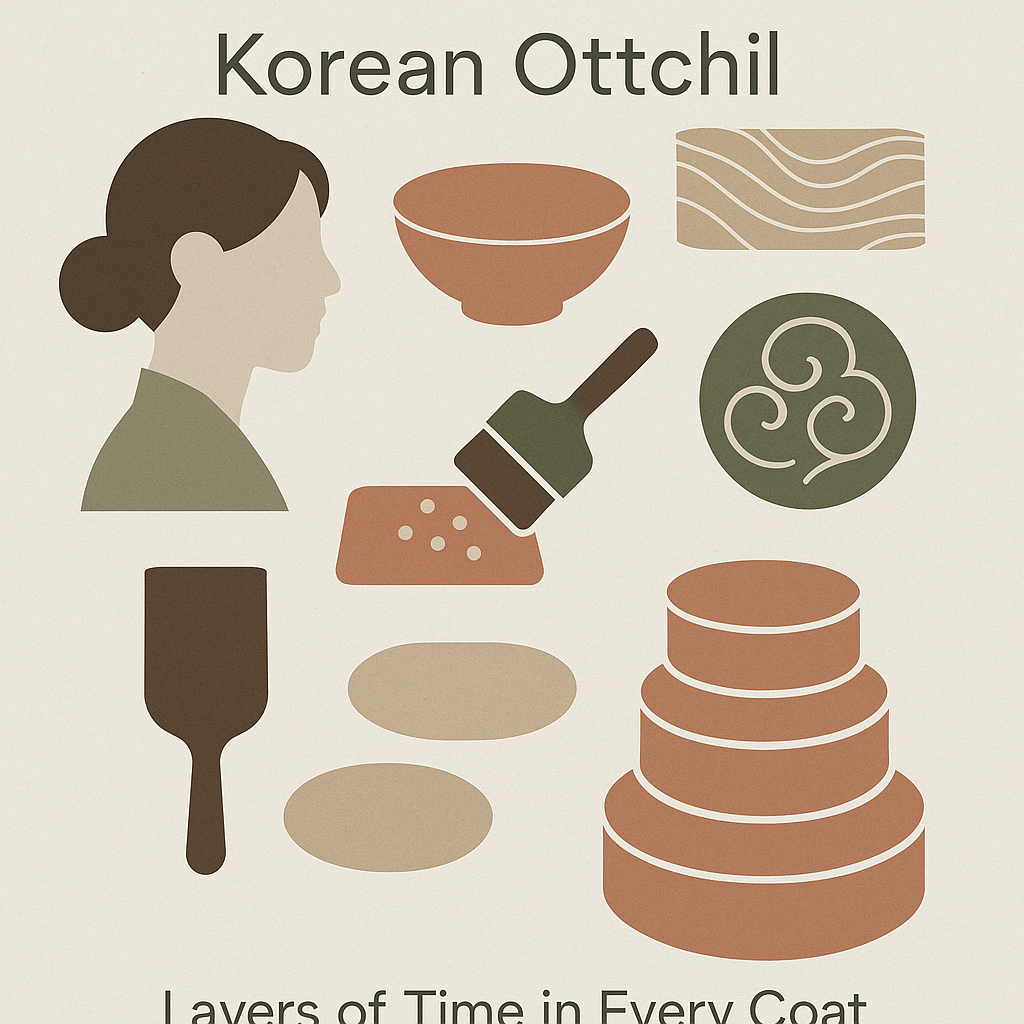
  • The Whispering Craft of Korean Ottchil Lacquerware: Layers of Time in Every Coat

    The first time raw lacquer sap touches unprotected skin, it raises a red, itching welt within hours. That is why artisans who work with Ottchil wear long sleeves even in August heat, wrap their hands, and turn their faces from the mixing bowl. This is not a craft that forgives shortcuts, and it never has been.

    Ottchil, Korea’s traditional lacquer, is made from the sap of the otnamu tree and applied in dozens of near-invisible coats. What looks like a simple black bowl or a small box may hold months of a craftsman’s patience inside its surface. That patience is the whole point.

    Origin: Sap of the native otnamu (lacquer tree), traditionally tapped by hand

    Region: Korean peninsula, historically concentrated around Tongyeong and other southern coastal areas

    Era: Traditionally traced to ancient tomb artifacts, with major flourishing during the Goryeo dynasty

    Best known for: Najeon chilgi, lacquerware inlaid with cut mother-of-pearl

    Core value: Layered patience — durability and depth built through repetition, not speed

    Why does a single bowl take months, not days, to finish?

    A finished Ottchil piece can carry twenty, thirty, sometimes closer to forty layers of lacquer, each one applied only after the last has fully cured. Rushing the process does not just risk a poor finish; it risks the whole object cracking apart within a year.

    Between coats, the piece rests in a controlled drying space, often for a full day or more, before being sanded back down to near-invisible smoothness. Then the next coat goes on. The craftsman is not decorating an object so much as growing it, coat by coat, the way sediment builds a riverbed.

    How did Ottchil become bound to Korea’s royal and religious life?

    Lacquered objects have turned up in ancient Korean tomb sites, suggesting the technique traditionally reaches back well over a thousand years. But it was during the Goryeo dynasty that Ottchil found its most celebrated expression, in najeon chilgi pieces made for Buddhist sutra boxes and courtly use.

    These weren’t decorative luxuries for their own sake. A lacquered sutra box protected sacred texts from humidity and insects for generations, which made the craft as much about preservation as beauty. That practical root still shapes how Ottchil is valued today.

    What makes the raw sap so difficult to tame?

    Otnamu sap is harvested in careful seasonal windows, usually collected in small quantities that make it precious from the very start. Once collected, it must be filtered to remove impurities and then blended, sometimes with iron oxide or other natural pigments, to reach the deep black or reddish-brown tones associated with the craft.

    Handling it wrong doesn’t just ruin a batch — it can leave a mark on the artisan’s own skin for days. This is one reason lacquer training in Korea has traditionally passed slowly, master to apprentice, rather than through quick instruction.

    Photo by zero take on Unsplash

    Why does humidity, not heat, control the outcome?

    Unlike paint or varnish, Ottchil doesn’t dry through evaporation. It cures through a slow oxidation process that actually requires a humid, relatively cool environment to harden properly.

    Too dry a room, and the lacquer stays tacky for weeks. Too much direct heat, and the surface can crack before it ever hardens. Artisans learn to read the air in their workshop almost the way a farmer reads the sky before harvest.

    What role does mother-of-pearl play in this tradition?

    Najeon chilgi takes the base craft one step further, setting thin, cut pieces of iridescent shell into the lacquered surface before additional coats seal them in place. The shell is shaped with fine saws, fitted into the surface, and only then buried under more layers of lacquer and polish.

    The final polish reveals the shell glowing faintly through the black, shifting color as the light and viewing angle change. It’s a quiet effect, closer to catching a glimpse of something than seeing it outright.

    How is this craft continuing in Korea today?

    A shrinking number of workshops, many concentrated in coastal towns with long lacquerware histories, still train apprentices in the traditional method. Some contemporary designers have begun pairing Ottchil techniques with simpler, more modern forms, aiming to keep the material relevant without abandoning its slow process.

    Craft museums and cultural centers across Korea now offer occasional demonstrations, letting visitors watch a single coat go on and understand, in real time, just how much waiting stands behind every finished piece.

    If you’re curious to experience this in a small way, look for a Korean craft museum or cultural center near you that features lacquerware demonstrations, or seek out a small najeon chilgi piece from a maker who documents their process. Spend a few minutes really looking at the surface before you touch it — count the depth in the shine, not just the shell.

    True depth is never applied all at once; it is built, one patient coat at a time.

  • The Fluttering Threshold: How Japanese Noren Curtains Frame the Art of Welcome

    Photo by urusy on Unsplash

    The Sound Before You See the Room

    You hear it before your eyes adjust: a soft snap of fabric against your shoulder, then the murmur of a kitchen spilling out from behind cloth. Push open the door of a small ramen shop in Osaka and there’s no door at all—just a rectangle of indigo cotton, slit up the middle, swaying slightly from someone’s exit two minutes ago.

    This is the noren, and it does something no solid door can. It announces a threshold without sealing it, inviting you in while still holding the room’s warmth, steam, and privacy just barely intact.

    From Sun Shield to Shop Sign

    Noren trace back to the Heian period, when merchants and homeowners traditionally hung simple cloth panels over entryways to block wind, dust, and harsh sunlight from open-air shopfronts. The earliest versions were plain and practical, dyed in whatever indigo or muted tones a household could manage.

    By the Edo period, something shifted. Shopkeepers began painting or stitching their family crest, shop name, or trade symbol directly onto the fabric, and the noren became a kind of walking business card that never had to walk anywhere—it just hung there, doing the introducing for you.

    A sake brewer’s noren might carry a stylized cedar ball motif; a tofu shop’s might show a single character in bold white against navy. Passersby could read a street’s entire commercial life just by scanning the fabric hanging from each doorway, without a single spoken word exchanged.

    Why Cloth, Not Wood

    A wooden door commits. It says open or closed, welcome or not, with no room for nuance. Noren refuse that binary, and that refusal is the point.

    When a shop’s noren hangs outside, it signals “we’re open, come in.” When the owner takes it down at closing time, that’s the entire announcement—no sign flipped, no light switched off, just an absence of cloth where there used to be presence. Regular customers learn to read this rhythm the way you’d read a friend’s mood from their posture.

    Photo by Rain Y on Unsplash

    The gap at the bottom, usually split into two or three panels, also lets a shopkeeper glance out at approaching customers without fully exposing the interior. It’s privacy with permeability built in, which is a strange thing for a piece of fabric to achieve so effortlessly.

    Indigo, Weight, and the Physics of Welcome

    Traditional noren favor indigo dye, partly because the pigment was believed to repel insects, and partly because the deep blue held up against sun fading better than lighter dyes of the era. Restaurants serving raw fish still lean toward this same blue-black palette, an aesthetic choice that’s outlasted its original practical reasoning.

    The fabric itself carries weight in more than one sense. A heavier hemp or thick cotton noren moves slower, giving a kind of unhurried gravity to a doorway, while a lighter linen panel flutters at the smallest breeze, almost nervous in its motion.

    Sushi counters often choose the heavier cloth, letting the noren swing shut behind a customer with a soft, deliberate thud of fabric meeting fabric. That small sound closes the transition from street to seat more completely than most doors manage.

    Reading the Colors and Seasons

    Walk through certain neighborhoods in early autumn and you’ll notice something: the noren have changed. Many shops swap their curtains seasonally, moving from cooling blues and whites in summer to deeper reds, browns, and golds as the weather turns.

    A hot pot restaurant might hang a noren in warm rust tones through winter, then switch to a pale, breathable indigo the moment cherry blossoms start dropping outside. This isn’t decoration for its own sake—it’s the building itself acknowledging the calendar, the way a person might switch from wool to linen without announcing it.

    Photo by Clay Banks on Unsplash

    Some households extend this practice indoors too, hanging noren between rooms not for commerce but simply to mark a threshold—kitchen from hallway, entry from living space—softening the transition between one kind of activity and another.

    Noren in Contemporary Hands

    Modern designers haven’t abandoned the form so much as stretched it. You’ll find noren now in muted linen with a single asymmetrical brushstroke, or screen-printed with geometric patterns that would look at home in a minimalist apartment far from any shop street.

    Coffee shops in Tokyo have started hanging noren dyed with botanical pigments instead of synthetic indigo, a small return to older methods dressed in newer aesthetics. The panels are shorter now too, sometimes just covering the upper third of a doorway, functioning more as a decorative gesture than a true barrier.

    What hasn’t changed is the underlying logic: a piece of cloth doing the emotional work of a greeting, moving slightly even when no one’s touching it, as if the building itself were breathing.

    Bringing the Threshold Home

    You don’t need a shopfront to try this. A single length of linen or cotton, hemmed at top and bottom with a simple rod slipped through, can mark the doorway between your kitchen and living room, or hang in a window that gets too much afternoon glare.

    Choose a color that shifts with your own sense of season—something you’d want to change out come autumn, not something permanent. Let it move a little when the door opens; that flutter is the entire point, the small proof that a room is alive and paying attention to who’s arriving.

    A curtain that moves is a doorway that remembers to breathe.