The Paper That Outlives Its Makers
Run your fingers across a sheet of hanji and you’ll notice something odd: it doesn’t feel like paper at all. It feels closer to cloth, slightly rough, with a faint sheen that catches light unevenly.
Some Buddhist sutras written on hanji during the Goryeo period have survived for centuries, their fibers still intact while wood-pulp paper from a hundred years ago crumbles at the edges. Conservators often cite this longevity as one of hanji’s defining traits, though exact aging estimates vary depending on storage conditions and materials used.
That contrast raises an obvious question. What makes a sheet of paper strong enough to hold up entire dynasties of documentation?
From Mulberry Bark to Sheet: The Dak Tree’s Journey
The answer starts with a tree, not a factory. Hanji is made from the inner bark of the paper mulberry, locally called dak namu, which grows abundantly on Korean hillsides.
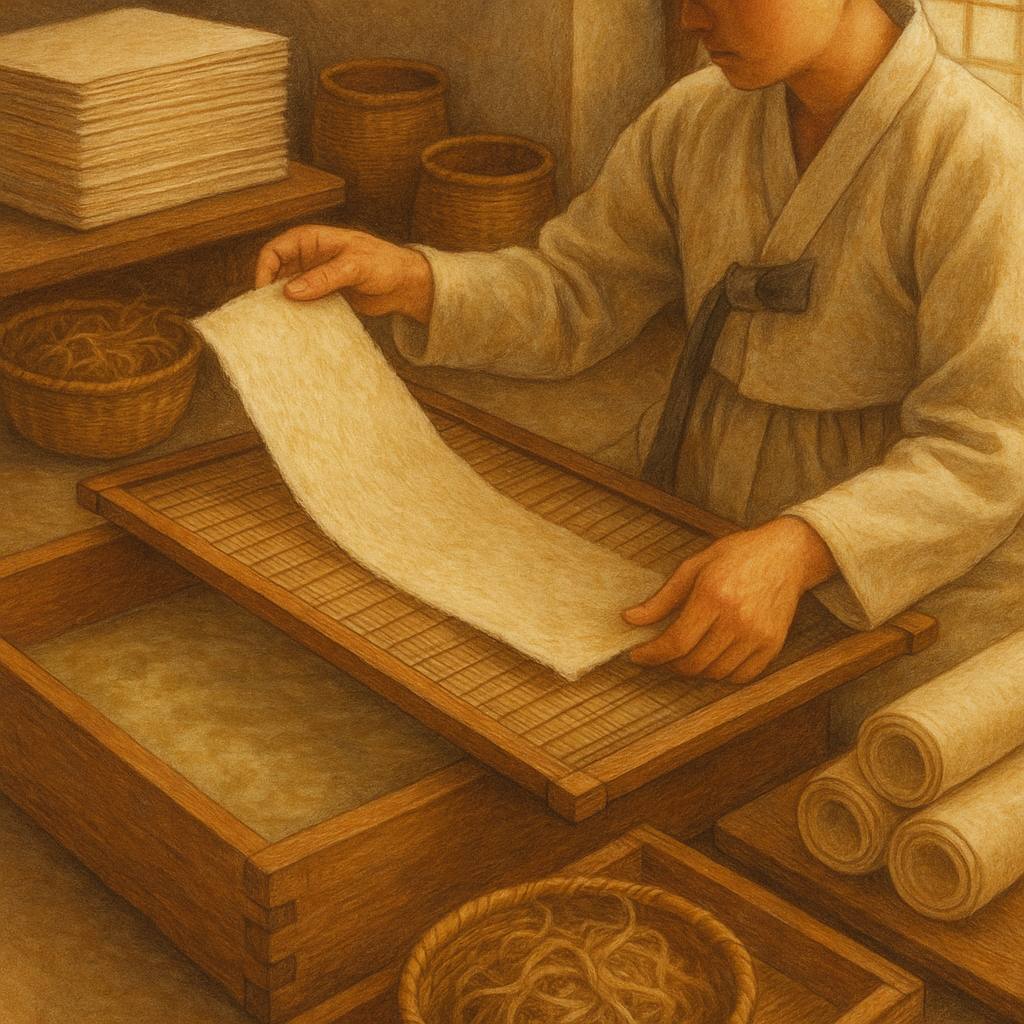
Artisans strip the bark, boil it with wood ash lye, then beat the fibers by hand until they separate into long, thread-like strands. This step matters more than people assume — the length of the fiber is what gives hanji its unusual tensile strength, unlike shorter wood-pulp fibers used in most commercial paper today.
The pulp is then mixed with a mucilage extracted from hibiscus root, which helps the fibers spread evenly in water. Using a bamboo screen, the papermaker sweeps the pulp back and forth in a technique called oe-ol-tteugi, layering fibers in crisscrossing directions rather than a single pass.
That crosshatching is the real secret. It’s why hanji resists tearing along any one direction, unlike paper made with fibers aligned only one way.

Ink, Sutras, and the Weight of Dynasties
Historically, hanji carried more than words — it carried diplomatic weight. During the Joseon dynasty, Korean paper was sent as tribute to the Chinese imperial court, where it was reportedly prized above local varieties for its smoothness and durability.
Buddhist temples relied on hanji to copy sutras that needed to survive for generations, not just years. Government offices used it for official records, understanding that ink sat differently on hanji than on other papers — absorbing just enough to stay crisp without bleeding through the sheet.
This reputation wasn’t accidental. Papermaking villages developed specialized knowledge passed through families, with certain regions like Jeonju becoming known for particular grades of hanji suited to calligraphy versus everyday use.
Beyond the Page: Windows, Armor, Everyday Life
Here’s what surprises most visitors to a hanok, a traditional Korean house: the windows aren’t glass. They’re covered in changhoji, a thin hanji stretched over wooden lattice frames.
Light passing through changhoji softens into a warm, diffused glow rather than a harsh beam — something residents describe as changing the entire mood of a room throughout the day. Layered thickly, hanji was also used for flooring in a technique called jangpanji, coated with bean oil until it became waterproof and surprisingly durable underfoot.
Less known is hanji’s role in protective gear. Records describe paper armor, jibgap, made from multiple compressed layers of hanji, light enough to wear yet dense enough to blunt an arrow’s impact. Clothing, fans, umbrellas, and even burial shrouds were made from treated hanji, each application demanding a slightly different thickness or coating.

Craftsmen Today: A Fragile Continuity
Fewer than a handful of workshops in Korea still produce hanji entirely by hand using traditional methods. Wonju and Jeonju remain centers where this knowledge persists, often passed down through master papermakers who trained for years before touching a finished product on their own.
The work is physically demanding — hours spent standing in cold water, beating fiber, repeating the same sweeping motion with a bamboo screen hundreds of times a day. Younger generations show interest but the economics are difficult, since machine-made paper is far cheaper and faster to produce.
Some artisans have adapted by creating hanji art pieces, lamps, and home décor for international markets, finding new relevance for an old material. Others focus on restoration work, since museums worldwide still need hanji to repair centuries-old Korean documents properly.
Try It Yourself
You don’t need to visit Korea to feel the difference hanji makes. Several online shops ship hanji sheets, notebooks, and lamp shades internationally, often at reasonable prices for small quantities.
Order a single sheet, hold it up to a window, and watch how the light moves through the fibers unevenly, almost like watching cloud shadows cross a field. That small moment might tell you more about six centuries of craftsmanship than any museum placard could.
In every fiber of hanji lies a patience machines have never learned to imitate.