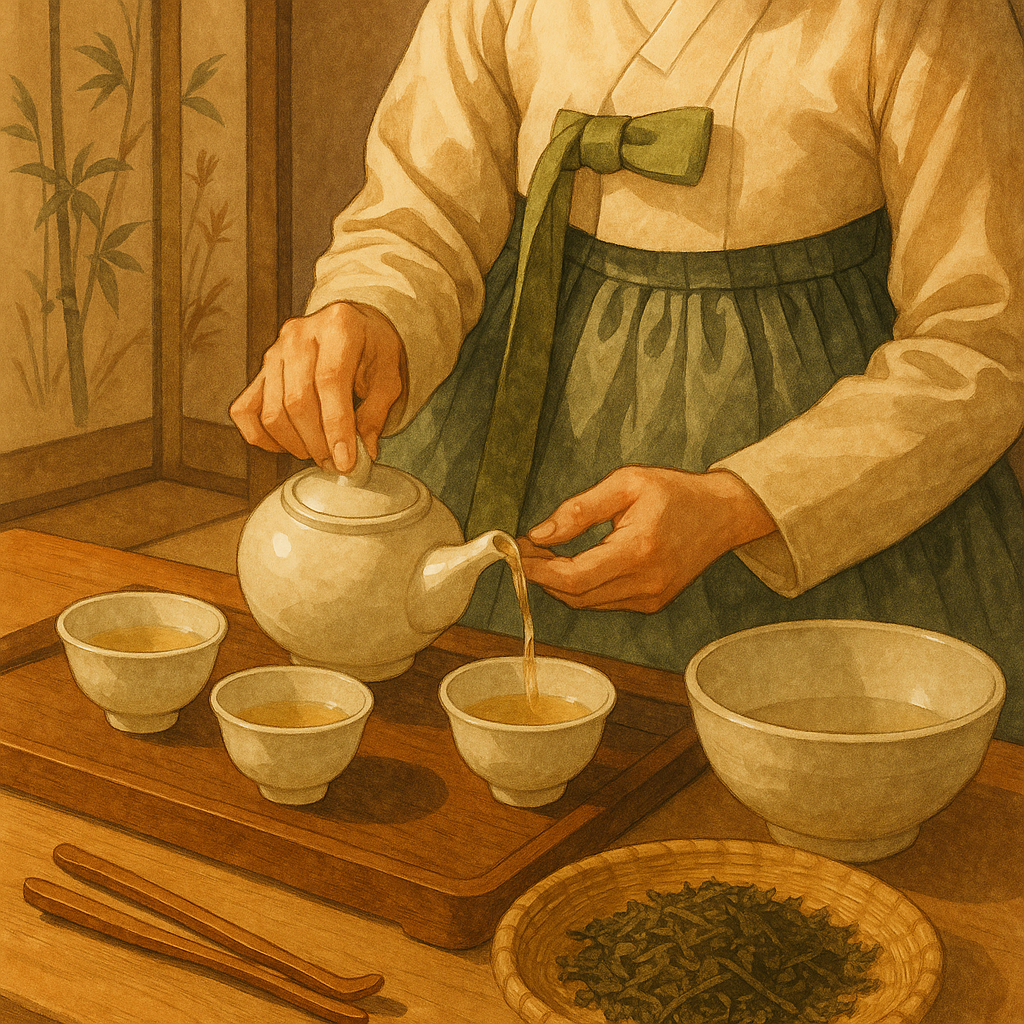
The Sound Before the Tea
A kettle sits over low coals in a wood-floored room, and for a full minute nobody speaks. The host watches the water, not the guests, waiting for the exact moment the bubbles turn from a hiss to a soft rolling murmur. Only then does she reach for the cups. This waiting, more than the drinking itself, is the first thing you notice about darye, Korea’s traditional way of tea.
Not Japan’s Chanoyu, Not China’s Gongfu Cha
It’s tempting to lump all Asian tea rituals together, but darye follows its own logic. Where Japanese chanoyu is built on precise, almost theatrical choreography, and Chinese gongfu cha centers on repeated short infusions poured over a tightly packed clay pot, Korean darye leans toward restraint and naturalness, a value Koreans call jayeon.
There is no single fixed script that every host must follow. Movements are unhurried and quiet rather than performed, and the emphasis falls less on technical mastery than on the mood created between host and guest, a concept rooted in jeong, the warmth of genuine care for another person.
Roots in Temples and Scholars’ Studies
Tea drinking in Korea traces back to contact with continental Buddhist culture, when monks began cultivating tea for use in temple offerings and quiet contemplation. Over centuries, tea moved from monastery gardens into the daily life of Confucian scholars, the seonbi, who found in tea preparation a discipline for cultivating a calm, upright mind.

By the nineteenth century, Korean tea culture had faded in many households, kept alive mainly in temples. The Buddhist monk Chosun Uisun helped revive it, writing “Dongdasong,” a poem-essay praising Korean tea and arguing that the spirit of tea and the spirit of Zen practice were one and the same. His writing is still cited today whenever Koreans talk about what makes their tea culture distinct.
The Leaves Themselves
Korean green tea is graded by when the leaves are picked, not by variety alone. Ujeon, harvested before the spring rains, produces a pale yellow-green liquor with a faint sweetness and almost no bitterness. Sejak and jungjak, picked slightly later, give a fuller body and a grassier, more vegetal cup.
Two regions dominate Korean tea farming: Boseong, with its terraced hillsides in South Jeolla province, and Hadong, along the Seomjin River, where wild tea bushes have grown on steep slopes for generations. Water temperature matters here more than in most tea traditions; Korean green tea is typically brewed cooler than boiling, around 60 to 70 degrees Celsius, to avoid scorching the leaf and to protect its natural sweetness.

A Room Built for Quiet
The setting matters as much as the tea. A traditional darye room uses a low wooden table called a dawon, floor cushions, and sliding doors covered in hanji, the translucent mulberry paper that softens sunlight into a warm, even glow.
Cups and pots are often celadon, the pale jade-green glazed pottery Korea has produced since the Goryeo period, its surface sometimes etched with cranes or willow branches under the glaze. The room stays sparse on purpose. Nothing competes with the sound of water or the color of the tea in the cup.
The Unspoken Rules of the Table
Guests are served before the host, and cups are offered and received with both hands, a small gesture of respect rather than casual habit. A slight bow of the head, not a deep bow, acknowledges the pour.
Nobody rushes to drink immediately. The pause before the first sip lets the guest notice the tea’s color and aroma, and it signals attentiveness to the host’s effort. These small courtesies come from
In the quiet space between pouring and receiving, tea becomes a language of respect.