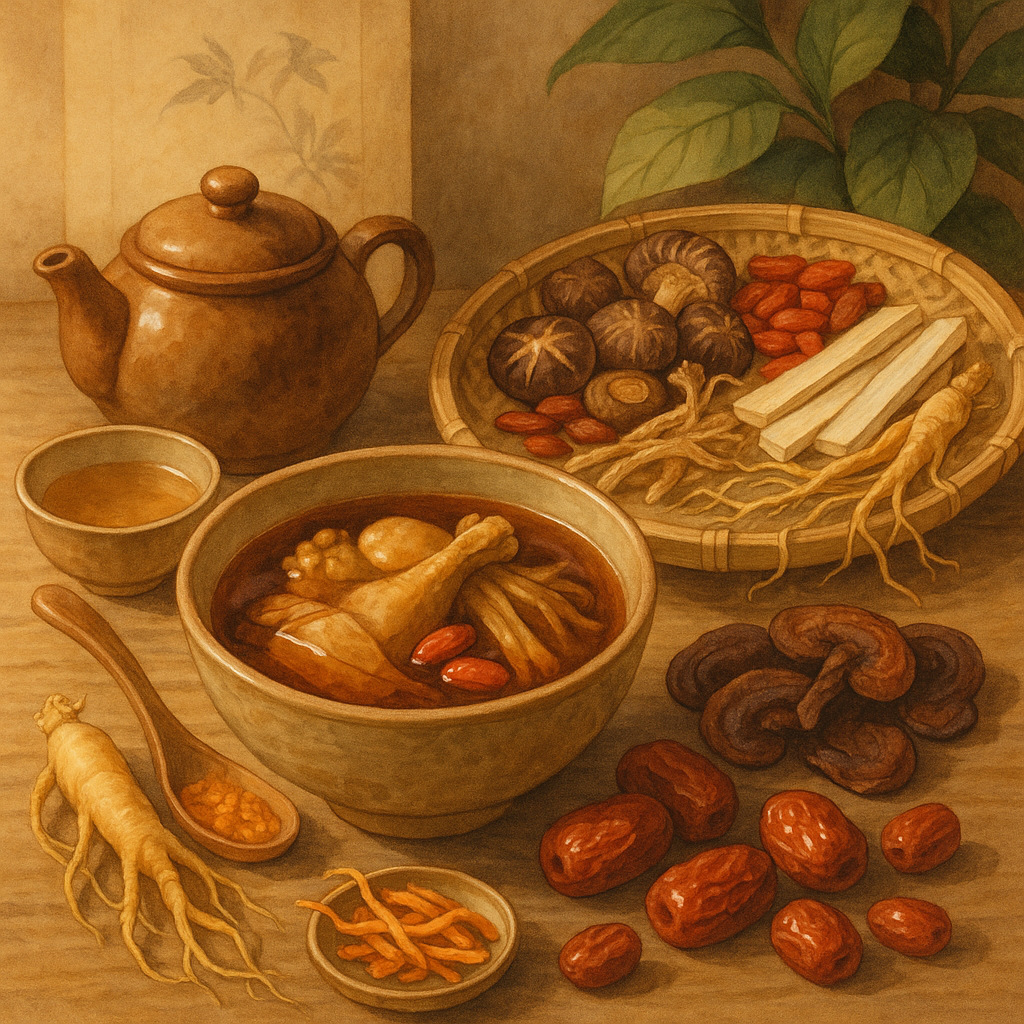
A grandmother in Guangzhou once told me she could taste when a soup was “too hot” for the body—not in temperature, but in nature. She wasn’t talking about spice. She was diagnosing the dish the way a doctor might read a pulse, and to her, this wasn’t mysticism. It was Tuesday dinner.
When Food and Medicine Shared One Kitchen
In classical Chinese thought, there was never a hard border between the pharmacy and the pantry. The phrase yao shan, literally “medicinal cuisine,” reflects a principle traditionally traced back over two thousand years: that food and medicine share the same origin, often summarized as yao shi tong yuan.
Ancient physicians didn’t just prescribe herbs. They prescribed meals. A court physician during the Zhou dynasty period was traditionally recorded as a distinct medical specialty—someone whose job was to design the emperor’s seasonal diet as preventive treatment, not as punishment for illness already present.
This wasn’t fringe theory. It sat at the center of medical training for centuries, documented alongside acupuncture and herbal formulas in classical texts.
The Logic Behind the Broth
Every ingredient in yao shan carries a “nature”—warming, cooling, or neutral—along with a flavor profile linked to specific organs. Ginger and lamb are warming, useful for someone who feels perpetually cold or fatigued in winter. Mung beans and bitter melon are cooling, meant to calm what practitioners call internal heat.
This is why a bowl of soup in a Chinese household is rarely random. Someone recovering from a cold might get a scallion and ginger broth. Someone with dry skin or a persistent cough might be handed a pear stewed with rock sugar and a few slivers of snow fungus.
The goal isn’t flavor first. It’s balance first, flavor second—though the two were never meant to be enemies.

Reading a Bowl Like a Diagnosis
Walk into a Cantonese soup shop and you’ll notice the menu reads like a mild medical chart. Four ingredients might treat dampness. Another combination targets what’s called “liver heat,” often blamed for irritability or red eyes.
This diagnostic habit comes from a body of knowledge, developed over centuries, that treats symptoms as signals of imbalance rather than isolated problems. A headache isn’t just a headache—it’s information about what’s happening elsewhere in the system.
Home cooks absorb this logic without ever opening a textbook. Ask an older relative why she’s adding red dates to your tea, and she may not cite theory at all. She’ll simply say, “You look pale.”
Ingredients That Do Double Duty
Some of the most recognizable Chinese pantry staples started as medicinal materials before they became everyday flavorings. Goji berries, now scattered onto salads in Western cities, were traditionally used to support the eyes and kidneys. Dried longan, sweet and slightly resinous, was associated with calming the mind and nourishing blood.
Astragalus root, often simmered whole in soup and removed before eating, has long been used to support stamina and immunity, particularly after illness or childbirth. Black sesame, ground into a thick paste, was traditionally recommended for hair health and for what practitioners describe as “deficiency” in older age.
None of these ingredients taste like medicine in the bitter, chalky sense. Most taste like something your grandmother would serve without explanation, which is exactly the point.

A Practice, Not a Prescription
What makes yao shan durable across generations isn’t rigid rule-following. It’s adaptability. The same cough might call for a pear dessert in one household and a chrysanthemum tea in another, depending on the specific imbalance a person is believed to have.
This flexibility separates yao shan from a strict medical protocol. It functions more like an inherited intuition, passed down through repeated meals rather than written instruction. Children absorb it the way they absorb table manners—by watching, not studying.
Even now, in cities filled with pharmacies and hospitals, many families still reach for a specific soup before reaching for a pill. Not as a replacement for modern medicine, but as a companion to it.
Try It Tonight
You don’t need rare herbs or a decade of study to start. Pick one small discomfort—a scratchy throat, cold hands, restless sleep—and look up a single traditional Chinese soup or tea associated with it.
Make just that one recipe tonight, using real ingredients rather than supplements. Pay attention to how you feel afterward, not as proof of anything, but as the beginning of the same quiet observation that built this entire tradition in the first place.
Long before medicine had a name, someone was already healing with a spoon.
답글 남기기